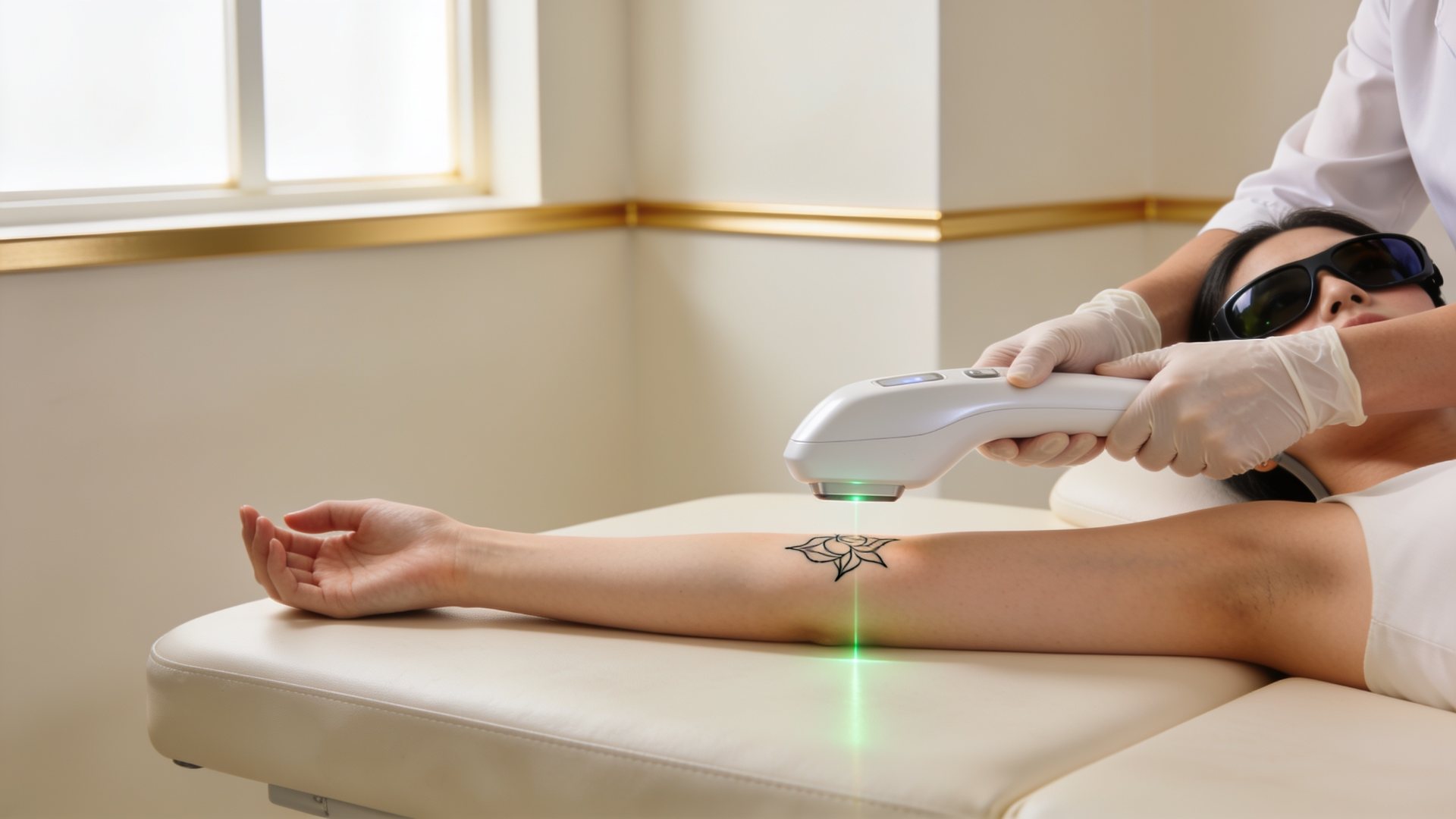
Small vs Large Tattoo Removal: How Size Changes the Plan
Medical Director Dr Sin Yong explains what changes between small and large tattoo removal: session length, sections, healing, excision and realistic timelines.
WhatsApp to Enquire →Key facts ↓Small tattoo removal takes minutes per session but not always fewer sessions: ink density, colour and location matter more. Large tattoos take longer per visit, may be treated in sections, and carry more swelling.
- Size counted in one large cohort: among 352 people treated with Q-switched lasers, tattoos larger than 30 square centimetres responded less well, as did tattoos on the feet or legs [1].
- Size is not a Kirby-Desai factor: the six-factor scale that predicted sessions in 100 patients scores skin type, location, colours, amount of ink, scarring and layering, not size [2].
- Hands and feet are slow: the same scale gives hands, feet and lower limbs the highest location score, 5, against 1 for the head and neck [2].
- More passes per visit are being studied: repeated laser passes within a single session have been trialled [4], and multi-pass and combination approaches are part of current practice [3].
- Picosecond may shorten the course: a 2026 review of 130 patients reported a median of 3 picosecond sessions against 4 Q-switched [5].
Does tattoo size change how tattoo removal works?
Size changes how long each session takes, how much is treated per visit and how much healing follows. The number of sessions depends more on the ink and the location.
A larger tattoo means more pulses, more time and a bigger area to heal. It does not by itself mean many more sessions: a small, dense professional tattoo on a finger may need as many as a larger amateur tattoo on the shoulder. Size did matter in one large cohort, where tattoos over 30 square centimetres responded less well [1], but it sits alongside colour, density and location. The treatment itself is described on tattoo removal in Singapore. At IN Eternity Clinic tattoos of any size are treated on the DEKA TORO, for what Dr Sin Yong calls “T2 laser tattoo removal”, or the Fotona StarWalker PQX.
| Small tattoo | Large tattoo (sleeve, back piece) | |
|---|---|---|
| Time per session | A few minutes | Longer; sometimes split across visits |
| Number of sessions | Set by ink, colour and location; not always few | Similar factors, plus more dense shading and colour |
| Area treated per visit | Usually the whole tattoo | Often in sections, in rotation |
| Numbing | Cream on a small area; local anaesthetic possible for delicate sites | Cream in sections; cooling throughout |
| Healing after each session | Small area of blisters and crusts | More swelling and a larger area to care for |
| Other options | Surgical excision may suit some very small tattoos | Fading for a cover-up is common |
Is a small tattoo quick to remove?
Each session is quick, but the course may not be. Small tattoos are often dense, professional and placed on the wrist, fingers or ankle, which are slow areas.
| Small tattoo | What usually makes it easier | What can make it slower |
|---|---|---|
| Amateur black initials or dots | Little, uneven ink | Ink placed very deep in places |
| Fine-line professional script | Thin lines | Dense, evenly placed ink; sometimes reworked |
| Finger or hand tattoo | Small area | Location: hands score highest for slow clearance; frequent hand use slows healing |
| Ankle or foot tattoo | Small area | Poorer circulation; legs and feet responded less well in one cohort |
| Small colour tattoo | Small area | Each colour needs its own wavelength; some resist |
| Cosmetic brow, liner or lip tattoo | Shallow pigment | Inks that darken; test area first |
For brow, liner and lip work, see eyebrow tattoo removal in Singapore. For how the factors combine, see how many tattoo removal sessions a tattoo needs.
Can a small tattoo be cut out instead of lasered?
Sometimes. A very small tattoo can be excised and stitched in one procedure, but it leaves a linear scar, usually longer than the tattoo, and is not suitable everywhere.
Excision trades several laser sessions for one surgical scar. It may be considered for a very small tattoo on an area where the skin is loose enough to close neatly, or where the ink does not respond to laser. It is less suitable on the hands, fingers, chest and shoulders, where scars are more visible or more likely to stretch or thicken. Laser is the usual first choice because it leaves the skin surface intact; if excision may suit you, a surgical opinion is discussed. Scar care is covered in tattoo removal scarring.
How are large tattoos removed?
In sessions that may treat the whole tattoo or one section at a time, with numbing and cooling, then the same healing gap before the next pass.
- Assessment and mapping: the tattoo is photographed and divided into areas by colour, density and location.
- Deciding the area per visit: how much is treated at once depends on comfort, how much swelling the area tolerates, and skin type.
- Sections in rotation: where a large piece is split, sections are rotated so each area still has its full healing gap.
- Numbing and cooling: numbing cream is applied to the area being treated that day; cold air cooling runs throughout.
- Healing: a larger treated area means more swelling and more dressing; raising a leg or arm helps.
Repeated passes within one session have been trialled as a way to treat more ink per visit [4], and multi-pass approaches are used in current practice [3], but they do not replace the gaps the immune system needs.
Is it safe to treat a large tattoo all at once?
Often the whole tattoo can be treated, but for very large pieces, splitting the area keeps swelling, discomfort and aftercare manageable, especially on the legs.
Every treated area blisters, crusts and swells for days, and on the lower legs and ankles swelling can be marked. Treating a full sleeve in one sitting means a large area of healing skin at once. Splitting it lets you keep working, sleeping and exercising more normally. What is right depends on your skin, the location, how dense the ink is and how you tolerated the first session. Healing advice is in tattoo removal aftercare, and comfort options in is tattoo removal painful.
“A tattoo the size of a coin on a finger can outlast a tattoo the size of a palm on the shoulder. Size decides how long a session takes; ink, colour and place decide how many sessions.”
What should you expect when removing a sleeve or back piece?
A long course measured in years for full removal, with some colours possibly remaining. Many people choose fading for a new design instead.
Large professional pieces are usually dense, multicoloured and sometimes layered, which are the factors that slow removal most. A course commonly runs well over a year at six to eight week gaps or longer; the calendar maths is in tattoo removal sessions. Picosecond pulses may shorten the course for some inks [5]. Fading for a cover-up often needs far fewer sessions; see tattoo fading for a cover-up.
Colour matters more than size in a large piece. Black areas often fade well before greens, light blues and yellows; see colour tattoo removal.
Are fine-line and micro tattoos easy to remove?
They are small and thin, which helps, but fine-line work is often placed precisely and densely, and on sensitive, slow areas such as fingers, wrists and behind the ear.
Thin lines carry less ink in total, and many fade in fewer sessions than bold work. But single-needle tattoos can be surprisingly deep, small colour details still need their own wavelength, and white highlights may darken. In picosecond studies, darkly pigmented tattoos averaged a little over four sessions to a high level of clearance [6]; fine-line tattoos are assessed one by one rather than assumed to be quick.
What Dr Sin Yong looks for
- The size and shape of the tattoo, and whether to treat it whole or in sections.
- Ink density and colours, which drive the number of sessions more than size.
- Location: hands, fingers, feet and lower legs are slower and swell more.
- For very small tattoos, whether excision is worth discussing, and where the scar would sit.
- How much healing you can manage at once, around work, travel and exercise.
- Whether full removal or fading for a new design is the aim for a large piece.
General clinical observations used at consultation; they describe what is checked, not any individual result.
Frequently asked questions
How many sessions does it take to remove a small tattoo?
It depends on the ink and the location more than the size. A small amateur black tattoo on the upper arm may fade in a few sessions; a small dense tattoo on a finger or ankle may need many.
Why do small tattoos take so many sessions?
Because the number of sessions depends on how much ink is in each part of the skin, its colour and its location. A small tattoo can be as dense as a large one.
Can a large tattoo be removed in one session?
No. Large tattoos may be treated whole or in sections at each visit, but the ink is cleared gradually over a course of sessions.
Is it cheaper to remove a small tattoo?
Size affects the time per session, and the number of sessions affects the total. The tattoo removal cost guide explains how estimates are made.
Can a small tattoo be surgically removed?
Sometimes, for very small tattoos where the skin can be closed neatly, but it leaves a linear scar. Laser is usually tried first.
Does removing a large tattoo hurt more?
Each pulse feels the same, but a session covers more area and lasts longer. Numbing in sections and cooling help; very large pieces can be split across visits.
How long does it take to remove a full sleeve?
Full removal of a dense, colourful sleeve usually takes well over a year, sometimes several. Fading for a cover-up takes less time.
Book an assessment
IN Eternity Clinic, 9 Scotts Road, #12-01 Pacific Plaza, Singapore 228210. By appointment with Medical Director Dr Sin Yong. Monday to Saturday, 11am to 8pm. WhatsApp or call +65 8815 3008. At IN Eternity Clinic a consultation fee applies, and it is waived if you go ahead with any medical treatment; the fee is S$120.
International KOL — CLASSYS · HIRONIC · DEKA · ALMA · FOTONA · LUTRONIC
References
- Bencini PL, et al. Removal of tattoos by Q-switched laser: variables influencing outcome and sequelae in a large cohort of treated patients. Arch Dermatol 2012;148(12):1364-1369. doi:10.1001/archdermatol.2012.2946
- Kirby W, Desai A, Desai T, Kartono F, Patel G. The Kirby-Desai scale: a proposed scale to assess tattoo-removal treatments. J Clin Aesthet Dermatol 2009;2(3):32-37. PMC2923953
- Ho SG, Goh CL. Laser tattoo removal: a clinical update. J Cutan Aesthet Surg 2015;8(1):9-15. doi:10.4103/0974-2077.155066
- Kossida T, et al. Optimal tattoo removal in a single laser session based on the method of repeated exposures. J Am Acad Dermatol 2012;66(2):271-277 (online 2011). doi:10.1016/j.jaad.2011.07.024
- Chen et al. Q-switched 1064-nm laser versus picosecond 1064-nm laser in tattoo removal […]. J Cosmet Dermatol 2026. doi:10.1111/jocd.71098
- Saedi N, et al. Treatment of tattoos with a picosecond alexandrite laser: a prospective trial. Arch Dermatol 2012;148(12):1360-1363. doi:10.1001/archdermatol.2012.2894
These sources describe mechanisms and general evidence. They are not a promise of any individual result; suitability is decided at an in-person assessment.