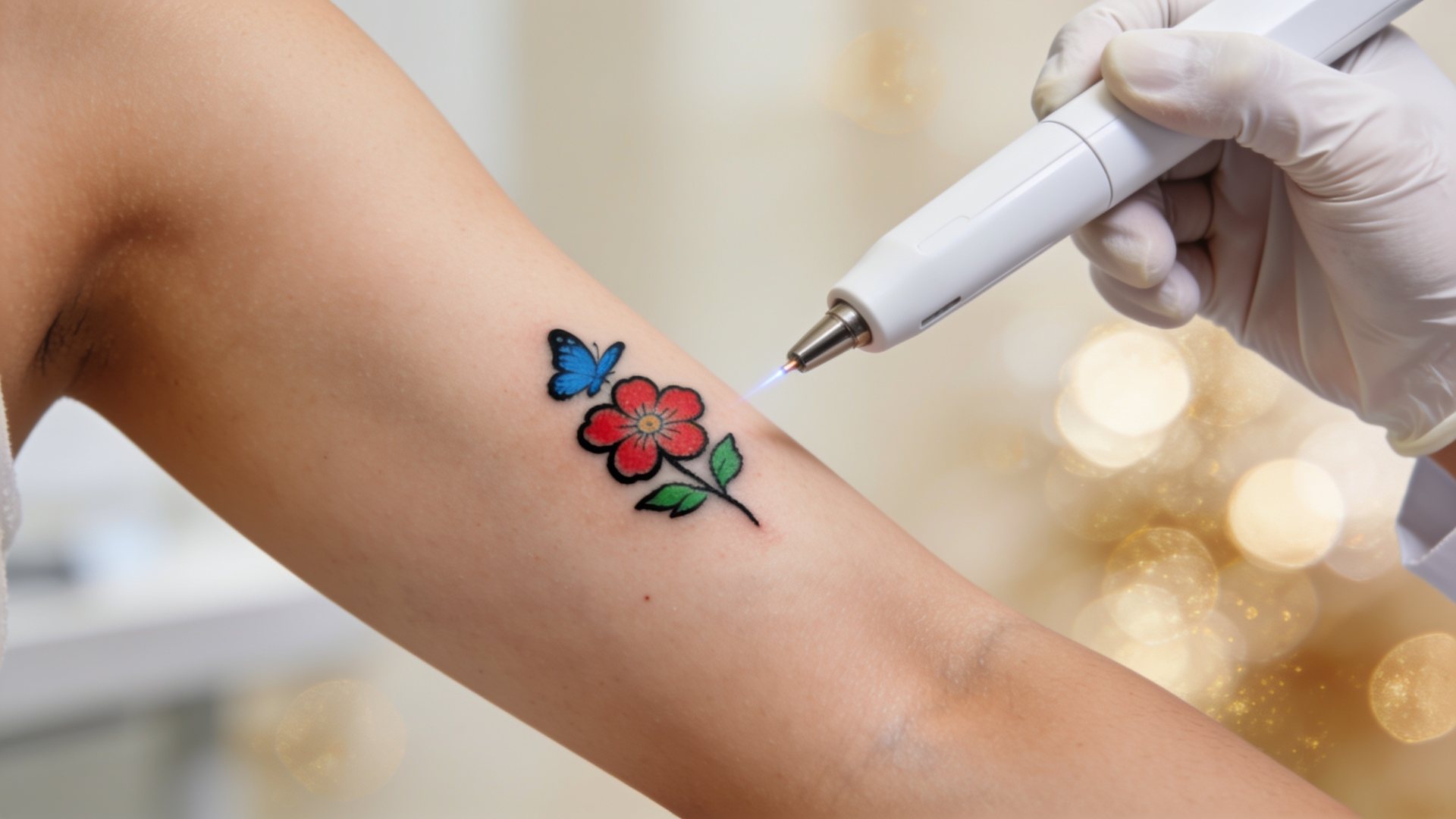
Colour Tattoo Removal: Which Inks Fade, Which Resist, and Why
Medical Director Dr Sin Yong explains how laser wavelengths are matched to black, red, green, blue, yellow and white inks, and what that means for a colour tattoo.
WhatsApp to Enquire →Key facts ↓Colour tattoo removal matches a laser wavelength to each ink. Black and dark blue fade most readily; red and orange often respond; green, light blue and yellow are slower; white or skin-toned inks can darken, so are tested first.
- Colour slows a course: in a prospective cohort of 352 people treated with Q-switched lasers, tattoos containing colours other than black and red responded less well [3].
- Blue and green can respond to a red-light wavelength: 12 tattoos containing blue or green pigment, including some that had resisted earlier treatment, cleared markedly after one or two sessions with a 755 nm picosecond laser [1].
- Yellow is the classic hard case: in a series of six multicoloured tattoos containing yellow, a 532 nm picosecond laser cleared one site in a single session and the other five over two to four [2].
- Some inks darken: immediate, irreversible darkening of cosmetic ink was reported in five cases after short-pulse lasers; in two, further laser did not clear it [4].
- Hidden colours appear: in 76 eyebrow and eyeliner tattoos, previously unseen red, orange, yellow, green or blue pigment was unmasked in 20, and each responded to its matched wavelength [6].
Can colour tattoos be removed with laser?
Yes, most colour tattoos can be faded substantially, but not every colour clears at the same pace, and some may leave a faint trace.
Laser removal works because ink absorbs light that skin absorbs less. A pulse at the right wavelength heats or shocks the ink particle so fast that it breaks into fragments, and immune cells carry them away over the following weeks. Black absorbs almost every wavelength, which is why it fades first. Each colour, by contrast, absorbs only part of the spectrum, so a colour tattoo needs the right wavelength for each ink. Different colours responding more completely to particular wavelengths is one of the most consistent findings in the literature [7].
This guide covers colour in depth; the treatment itself, assessment and safety are on laser tattoo removal in Singapore. At IN Eternity Clinic two platforms cover the colour range: the DEKA TORO, which Dr Sin Yong uses for what he calls T2 laser tattoo removal, and the Fotona StarWalker PQX.
Why does each tattoo colour need a different laser wavelength?
A colour absorbs light of its opposite colour. Red ink absorbs green light, green and blue inks absorb red light, so the laser must emit the colour the ink soaks up.
This is the same reason a red object looks red: it reflects red light and absorbs the rest. A 532 nm laser emits green light, which red, orange and some yellow inks absorb well. Green and blue inks reflect green light, so 532 nm passes through them; they absorb light at the red end of the spectrum, around 694 to 785 nm. Infrared 1064 nm is absorbed by black and dark inks and is the wavelength least absorbed by skin pigment, which is why it is used for darker skin.
Wavelength is only half the story. Pulse length decides whether the energy shatters the particle or simply warms it; the comparison of picosecond vs Q-switched tattoo removal explains that part.
Which tattoo colours are easiest and hardest to remove?
Black and dark blue are usually easiest; red and orange are moderate; green, turquoise, light blue and yellow are harder; white and skin-toned inks are unpredictable.
| Ink colour | Wavelength usually matched | On the IN Eternity platforms | How it tends to respond |
|---|---|---|---|
| Black, dark grey | 1064 nm | StarWalker PQX (pico and Q-switched); TORO (Q-switched) | Usually the most responsive |
| Dark blue | 1064 nm; sometimes red-light wavelengths | StarWalker PQX; TORO 1064 nm and 785 nm picosecond | Often responds, sometimes slower than black |
| Red | 532 nm | StarWalker PQX; TORO (Q-switched) | Often responds; red is also the commonest ink allergy, so this is asked about first |
| Orange | 532 nm | StarWalker PQX; TORO (Q-switched) | Variable; can darken if it contains metal oxides |
| Purple, violet | 532 nm and red-light wavelengths | Both platforms, wavelength by shade | Variable; mixed pigments fade in stages |
| Green, turquoise | Around 694 to 785 nm (red light) | TORO 785 nm picosecond | Slower; often need more sessions and may not clear fully |
| Light blue, teal | Around 694 to 785 nm | TORO 785 nm picosecond | Among the hardest; a faint trace can remain |
| Yellow | 532 nm (absorbs poorly) | StarWalker PQX; TORO (Q-switched) | Stubborn; responds slowly, if at all, in many cases |
| White, skin-toned, pink, peach | Test area first | Either platform, cautiously | Can turn darker when hit; then treated as a dark ink |
| Brown, cosmetic | Test area first | Either platform, cautiously | Iron oxide inks may darken; see eyebrow tattoo removal |
Cosmetic brow, liner and lip pigments behave differently again and have their own page: eyebrow tattoo removal in Singapore.
Why are green and blue tattoos harder to remove?
Because green and blue absorb red light, which older Q-switched systems could deliver only at limited strength, and many green inks are dense, stable pigments.
Green and blue inks reflect the green and infrared light of the commonest tattoo lasers, so those wavelengths pass through them with little effect. They need a red-light wavelength, historically ruby (694 nm) or alexandrite (755 nm), and more recently picosecond wavelengths in the 730 to 785 nm range. In a 2012 series, 12 tattoos with blue or green pigment, including some that had resisted earlier treatment, cleared markedly after one or two sessions with a picosecond 755 nm laser [1].
The TORO’s 785 nm picosecond output sits in this red-light band, which is the main reason it is chosen for blue and green work at IN Eternity Clinic. Even so, light blue and turquoise often fade only partly, and the estimate for a green-heavy tattoo is deliberately cautious.
Why is yellow tattoo ink so stubborn?
Yellow reflects most visible light and absorbs only in the blue-violet band, so even 532 nm, the closest common wavelength, is poorly absorbed.
Yellow clearance has long been described as challenging and usually unsuccessful. In a small series, a 532 nm picosecond laser at six to eight week intervals cleared yellow at one site after one session and at the others over two to four, without scarring [2]. That was six people, and yellow mixed into greens, oranges and skin tones is often harder. Yellow is therefore planned as the last colour to go, and a faint yellow tint is a realistic possibility.
Why can white, pink or skin-coloured tattoo ink turn darker?
Some light inks contain titanium dioxide or iron oxide, which a short laser pulse can change chemically, turning the ink grey or black within seconds.
Darkening is most often reported in cosmetic, flesh-toned, white, peach and pink inks [5]. It was first described as a complication of Q-switched and other short-pulse lasers, and in some cases the darkened ink would not clear [4]. Darkened ink in another cohort was linked with a slower response [3]. So where a tattoo contains these colours, a small test area is treated first and reviewed weeks later before the rest.
If the test darkens, the darker ink can usually be treated further as a dark ink, but the course becomes longer. White highlights inside a dark design are sometimes left alone if they are not visible once the dark ink has gone.
Why does a multi-wavelength laser matter for colour tattoos?
Because a laser can only remove the colours its wavelengths are absorbed by. More wavelengths on one platform means more of the palette can be reached in one plan.
The DEKA TORO combines a 785 nm picosecond wavelength with Q-switched 532 and 1064 nm; the Fotona StarWalker PQX offers 1064 and 532 nm in both picosecond and Q-switched pulses. Between them they cover black and dark blue, red and orange, and the red-light band used for green and blue. A single-wavelength system would leave some colours untouched however many sessions were done. Picosecond lasers in general have level I evidence for tattoo removal [8], but more wavelengths do not promise clearance; they make it possible to try the right one.
| Platform | Picosecond | Q-switched | Colours it reaches |
|---|---|---|---|
| DEKA TORO | 785 nm | 532 nm, 1064 nm | Black, dark blue, red, orange; blue and green at 785 nm |
| Fotona StarWalker PQX | 1064 nm, 532 nm | 1064 nm, 532 nm | Black, dark blue, grey, red, orange |
Device details are on the DEKA TORO and StarWalker PQX pages.
“A colour tattoo is several tattoos sharing one outline. Black may be finished while yellow has barely moved, so the plan is written colour by colour, not session by session.”
Do colour tattoos need more sessions than black ones?
Usually, yes. Each colour fades at its own rate, so the course lasts as long as the slowest colour, and colours can also appear as others clear.
In a large cohort, colours other than black and red were among the factors linked with a poorer response [3]. Colour layering adds to this: once a dark outline fades, a colour underneath may show for the first time, as happened in 20 of 76 cosmetic tattoos in one review [6]. The full set of factors is set out in how many tattoo removal sessions you might need. If you only want a colour faded for a new design, see tattoo fading for a cover-up.
What Dr Sin Yong looks for
- Every colour in the tattoo, including small highlights and shading that look black but are dark green or blue.
- White, pink, peach, flesh-toned or brown inks that need a test area first.
- Raised, itchy or bumpy areas confined to one colour, especially red, which can signal an ink allergy.
- Whether colours were layered or a colour cover-up sits over an older design.
- Your skin type, because darker skin changes which wavelengths and settings are safe.
- What you want: full removal, or one colour faded for a new design.
General clinical observations used at consultation; they describe what is checked, not any individual result.
When is a reaction in a colour tattoo a reason to call?
Call if a colour, most often red, becomes itchy, raised or swollen, or if you have hives, wheeze or facial swelling after treatment.
- Itching, bumps or thickened skin limited to one colour, before or after a session: an ink allergy is assessed before more laser.
- Spreading redness, increasing pain, pus or fever in the days after treatment.
- Hives, swelling of the face or lips, or difficulty breathing: call 995 or go to the nearest emergency department.
IN Eternity Clinic patients: WhatsApp or call +65 8815 3008.
Frequently asked questions
What is the hardest tattoo colour to remove?
Yellow, light blue, turquoise and some greens are usually the hardest, and white or skin-toned inks are unpredictable because they can darken. Black is usually the easiest.
Can red tattoo ink be removed?
Usually, with a 532 nm wavelength. Red is also the ink most often linked with tattoo allergy, so any itching or raised skin in red areas is mentioned before treatment.
Can a colour tattoo be removed completely?
Many fade until they are hard to see, but complete removal is not always possible. A faint trace of yellow, light blue or green, or a light or dark patch, can remain.
Why did part of my tattoo turn grey after laser?
Some light inks contain titanium dioxide or iron oxide, which a laser pulse can change chemically. This is why a test area is used. Darkened ink is usually treated further as a dark ink.
Is colour tattoo removal more painful than black?
Not usually. Sensation depends more on ink density, location and the wavelength used than on colour. See is tattoo removal painful.
Does pico laser remove all colours?
No laser removes every colour equally. Picosecond pulses break ink finely, but the wavelength still has to match the colour. That is why more than one wavelength is used.
Is color tattoo removal different from colour tattoo removal?
No, it is the same treatment; “color” is the American spelling. This guide uses the British spelling used in Singapore.
Book an assessment
IN Eternity Clinic, 9 Scotts Road, #12-01 Pacific Plaza, Singapore 228210. By appointment with Medical Director Dr Sin Yong. Monday to Saturday, 11am to 8pm. WhatsApp or call +65 8815 3008. At IN Eternity Clinic a consultation fee applies, and it is waived if you go ahead with any medical treatment; the fee is S$120.
International KOL — CLASSYS · HIRONIC · DEKA · ALMA · FOTONA · LUTRONIC
References
- Brauer JA, et al. Successful and rapid treatment of blue and green tattoo pigment with a novel picosecond laser. Arch Dermatol 2012;148(7):820-823. doi:10.1001/archdermatol.2012.901
- Alabdulrazzaq H, et al. Clearance of yellow tattoo ink with a novel 532-nm picosecond laser. Lasers Surg Med 2015;47(4):285-288. doi:10.1002/lsm.22354
- Bencini PL, et al. Removal of tattoos by Q-switched laser: variables influencing outcome and sequelae in a large cohort of treated patients. Arch Dermatol 2012;148(12):1364-1369. doi:10.1001/archdermatol.2012.2946
- Anderson RR, Geronemus R, Kilmer SL, Farinelli W, Fitzpatrick RE. Cosmetic tattoo ink darkening: a complication of Q-switched and other short-pulse laser treatment. Arch Dermatol 1993;129(8):1010-1014. doi:10.1001/archderm.1993.01680290082012
- Kirby W, Kaur RR, Desai A. Paradoxical darkening and removal of pink tattoo ink. J Cosmet Dermatol 2010;9(2):149-151. doi:10.1111/j.1473-2165.2010.00493.x
- Kream E, Jairath N, Bajaj S, Orbuch D, Wang JV, Geronemus RG. Laser removal of eyeliner and eyebrow tattoos: chart review, experiences, and learnings. J Clin Aesthet Dermatol 2023;16(11):47-49. jcadonline.com
- Kent KM, Graber EM. Laser tattoo removal: a review. Dermatol Surg 2012;38(1):1-13 (online 2011). doi:10.1111/j.1524-4725.2011.02187.x
- Wu DC, Goldman MP, Wat H, Chan HHL. A systematic review of picosecond laser in dermatology: evidence and recommendations. Lasers Surg Med 2021;53(1):9-49 (online 2020). doi:10.1002/lsm.23244
These sources describe mechanisms and general evidence. They are not a promise of any individual result; suitability is decided at an in-person assessment.