Six Concerns, Planned Into a Single FSX Session
FSX, short for Flawless Smooth Skin, is the LCLR® (Laser Collagen Lipo Remodelling) protocol developed at IN Eternity Clinic. It combines two energies, thulium and erbium glass. Where a typical laser toning visit makes one quick brightening pass, FSX is a planned clinical session that works on six separate concerns together.
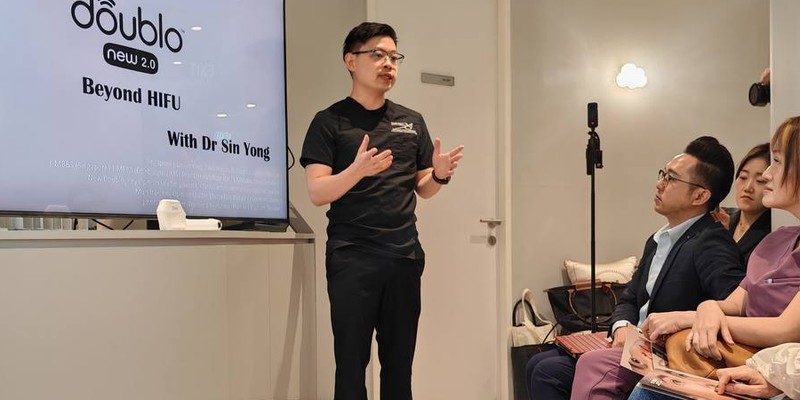
Those six concerns are heavy or hooded upper eyelids, fine wrinkles, inflamed active acne, lingering red marks after acne, the depth of shallow scars, and loose skin on the face and neck. Medical Director Dr Sin Yong sets the energy for each zone as he goes, changing the parameters according to how the skin is responding during that same session.
FSX is suited to a wide range of skin types, including the deeper Fitzpatrick V and VI tones, because settings are matched to the skin in front of us. Numbing cream goes on first so the session is comfortable. Downtime is little for most people, although some treated areas can form light scabs that last around 3–7 days; these should be left to fall away on their own.
- What it is: FSX (Flawless Smooth Skin), IN Eternity Clinic's multi-pass LCLR® laser protocol using thulium and erbium glass energy.
- Used for: heavy upper eyelids, fine lines, active acne, post-acne redness, superficial scars and early-to-moderate laxity.
- Course: usually 3–5 sessions, 4–6 weeks apart, with yearly maintenance.
- Afterwards: redness that settles within a couple of hours for most; after stronger passes, light scabs for about 3–7 days.
- Skin types: settings are chosen for each skin type, including darker Fitzpatrick V–VI skin; melasma has its own approach.
- Who performs it: Medical Director Dr Sin Yong, at 9 Scotts Road, #12-01 Pacific Plaza, Singapore.
What the FSX Laser Addresses
Every Zone FSX Laser Targets
FSX is used for laxity on the face, neck, eyelids and body, and as a separate track for scars, red marks and stretch marks. Choose a category, then hover over a dot to see what the protocol does in that area.
FSX Laser — Flawless Smooth Skin
Skin Tightening & Scar Treatment Zones
Choose Tightening & Laxity for areas of loose skin on the face, neck, eyelids and body, or Scars, Marks & Redness for acne scars, burn scars, red surgical scars and stretch marks. Then hover over a dot for details.
← HOVER A ZONE TO EXPLORE
Read every zone as text
Face
- Heavy upper eyelids. For mild hooding, carefully placed thulium passes heat the thin upper-eyelid skin so it contracts and then rebuilds collagen over the following weeks. This is not a replacement for eyelid surgery: marked excess skin or a drooping lid muscle is referred for a surgical opinion.
- Crepey lower-eyelid skin. The lower lid has some of the thinnest skin on the face, so it is treated at gentler settings. The aim is finer texture and less crepiness. Under-eye hollows and fat bags are a different problem and are assessed separately.
- Overall skin quality and early laxity. A full-face session takes about 30–45 minutes after numbing. Settings are adjusted zone by zone: lighter over thin skin, more passes where skin is thicker. Collagen remodelling continues for several weeks after each session, so changes are judged over the course, not on the day.
- Neck texture and horizontal lines. Neck skin heals more slowly than facial skin, so it is treated with more conservative settings and longer gaps between sessions. FSX can help skin quality and fine horizontal lines; prominent muscle bands or heavy loose skin may need a different approach.
- Shallow acne scars. FSX is used for shallow, textural acne scarring, usually planned over 3–5 sessions. Deep ice-pick, boxcar or tethered rolling scars need a different plan, which at IN Eternity Clinic is the 4D Scar Reconstruction protocol.
- Red marks after acne (PIE). Post-inflammatory erythema is the pink or red mark that lingers after a spot heals. It is a blood-vessel mark, not pigment, so it is planned differently from brown marks. FSX may be combined with other steps for it; how quickly marks change varies from person to person.
- Facial surgical and procedure scars. Scars from excisions, biopsies or facial surgery are usually treated once the wound has healed and the operating doctor is satisfied with healing. Timing, scar colour and texture are assessed first, and a raised or thickened scar may need other treatment alongside.
Body
- Upper-arm and underarm skin. Thin, crepey skin on the upper arm can be treated for texture. Where looseness comes with excess fat, FSX may be planned alongside a body-contouring treatment; larger amounts of loose skin are a surgical question.
- Crepey skin above the knee. The skin above and around the knee often creases and thins with age. FSX is used here for texture, usually as a course of 3–5 sessions with longer healing intervals than the face.
- Elbow texture. Elbow skin is thick, often darker and prone to creasing. Settings are chosen with pigment risk in mind, particularly in darker skin types, and progress is reviewed between sessions.
- Abdominal skin texture. After pregnancy or weight change, abdominal skin can look crinkled. FSX addresses skin texture; where fat is also a concern it may be paired with a contouring treatment. Separated tummy muscles or large skin excess are referred for surgical opinion.
- Mature burn scars. Burn scars vary widely in depth, colour and tightness. Older, settled scars can be considered for fractional laser to improve texture; fresh, tight or thickened burn scars are assessed carefully and may need other care first.
- Body surgical scars, including caesarean scars. Scars from caesarean section or other body surgery are treated once healed and cleared by the doctor who performed the operation. The plan depends on whether the scar is red, raised or flat, and on skin type.
- Stretch marks (striae). Newer red or pink stretch marks (striae rubra) and older white ones (striae alba) behave differently and are planned differently. Laser can improve texture and colour to a degree; it does not erase stretch marks.
- Acne scars on the back and chest. Back and chest acne scars are treated much like shallow facial scars, with body-appropriate settings. Any active body acne is brought under control first, because new breakouts keep creating new marks.
“One pass rarely answers one face. FSX is planned layer by layer, and adjusted zone by zone while the session is running.”
Frequently Asked Questions
Pricing depends on the area treated and the number of sessions your plan involves, which vary with your skin and concern. Because the course is tailored, IN Eternity Clinic sets out the full plan and cost at consultation rather than a fixed price.
Most patients describe a warm or light prickling sensation during treatment, managed with cooling and adjustable settings. Numbing can be applied where helpful. The sensation passes quickly, and what to expect is explained beforehand.
Results from the FSX Laser build in the weeks after each session as the skin renews, and are commonly maintained with periodic treatment. The interval depends on your skin and concern, and is planned individually.
The FSX Multi-Pass Protocol
Rather than one pass aimed at one problem, an FSX LCLR® session is built from several calibrated passes at different energies. Each works on its own layer and concern, all in one visit, and most people have little downtime.
Pass 1 — Brightening the surface: gentle thulium passes act on melanin near the surface, lightening pigment without removing skin and without the PIH risk linked to Q-switched settings.
Pass 2 — Refining pores: heat directed around the hair follicle and oil gland helps enlarged pores contract and firms the collagen around them over time.
Pass 3 — Remodelling the dermis: stronger passes warm the deeper dermis, prompting fibroblasts to lay down fresh collagen over the following 4–6 weeks.
Pass 4 — Finishing sweep: a last, gentle pass evens out the treatment across the face for clearer, more uniform skin tone.
Choosing a Laser Rejuvenation Plan: What Matters
Problems seen after poorly planned laser toning include PIH when Q-switched settings are pushed too hard on darker skin, melasma flaring back after an unsuitable protocol, and results that fade quickly because a single pass never delivered enough heat to the dermis. FSX is designed around these risks, using thulium and erbium glass wavelengths that can be set safely across skin types, Fitzpatrick V and VI included.
At every visit Dr Sin Yong checks your Fitzpatrick skin type and sets the energy to match. Melasma is treated with a dedicated sub-ablative approach instead of strong passes that can make it worse. The aim at IN Eternity Clinic is a gradual, lasting change in texture, tone and firmness rather than a one-visit glow, and every FSX session is carried out by Dr Sin Yong himself, not delegated to therapists or nurses.
Does it hurt? Comfort and numbing
FSX uses non-ablative thulium and erbium glass energy, so the skin surface is not removed, but the passes still deliver real heat. A numbing cream is applied for about 45 minutes before the session and wiped off just before treatment, and protective eye shields are worn. During the passes most people feel a warm prickling, often described as a light snap followed by heat, building as each zone is covered. Cooled air is used to keep the surface comfortable.
Areas over bone, such as the forehead and jawline, and the delicate skin around the upper eyelids, tend to feel warmer than the cheeks. Dr Sin Yong adjusts energy zone by zone as part of the protocol and pauses if you need a moment. Afterwards the face feels hot and flushed, like a mild sunburn, for one to two hours. Where stronger passes were used, a tight, dry feeling can last a few days while light scabs form. A cool compress and a gentle moisturiser help.
What to expect, day by day
- Day 0: Redness and warmth settle within a couple of hours for most people; there may be mild swelling, especially around the eyes after eyelid work. Use a gentle cleanser, moisturiser and sunscreen.
- Days 1–3: The skin may feel dry, tight or slightly rough, sometimes with tiny bronze dots that shed on their own. After stronger passes, light scabs can form; do not pick them. Pause exfoliating acids, scrubs and retinoid creams.
- Week 1: Any scabs fall away within about 3 to 7 days, and the surface feels smoother as it renews. Make-up can usually be worn from the next day, or once scabs have gone.
- Weeks 2–4: Collagen remodelling is under way beneath the intact surface. Fine lines and early laxity improve gradually over four to eight weeks. Daily sunscreen continues.
- Review: At the next session, four to six weeks later, Dr Sin Yong reviews how each zone responded and adjusts the settings before treating again.
Common myths, answered
- Myth: If the skin does not peel, the laser is not doing anything.
Fact: Non-ablative energy heats the dermis under an intact surface. The collagen response builds over weeks, which is why recovery is shorter but change is gradual. - Myth: Laser thins the skin over time.
Fact: Collagen-stimulating laser adds dermal collagen. Thinning is not expected when settings and intervals are appropriate. - Myth: One session gives the full result.
Fact: FSX is usually planned as three to five sessions four to six weeks apart, because collagen builds between visits. - Myth: Light scabs mean the skin has been burned.
Fact: Light scabs after stronger passes are tiny treated spots healing as expected. Blisters, oozing or increasing pain are not expected and should be reported.
More questions answered
Can I go back to work the same day?
Most people do. Redness usually settles within an hour or two, and make-up can normally be worn from the next day. Where stronger passes have been used, light scabs may be visible close up for three to seven days, so sessions with stronger settings are better planned away from important events.
Will people notice I've had laser?
For most people, not after the first few hours. The change in texture, pores and tone builds gradually across the course, so others tend to notice that your skin looks clearer or smoother rather than that you had a treatment. If light scabs form, they look like small brown dots that shed within a week.
Can I keep using my normal skincare after FSX?
Use a gentle cleanser, a plain moisturiser and sunscreen in the days after a session. Exfoliating acids, scrubs and retinoid creams are usually paused for about five to seven days, or until the skin no longer feels sensitive. Dr Sin Yong reviews your routine at assessment and tells you what to pause and when to restart.
MSc Aesthetic Medicine (University of London) · MSc Practical Dermatology (Cardiff University) · Graduate Diploma in Sports Medicine (Singapore)
At IN Eternity Clinic, FSX also serves as a pigmentation treatment, evening out tone while tightening pores and clearing the overall look of the skin.
Comparing FSX with fractional CO2 or carbon laser? They work differently: CO2 removes microscopic columns of skin, while FSX heats beneath an intact surface. At IN Eternity Clinic on Orchard Road, Medical Director Dr Sin Yong examines your skin first and explains which approach fits your texture, pores and tone, and the recovery you can allow. Founded by AYA, IN Eternity Clinic pairs the care of a doctor-led aesthetic clinic in Singapore with genuine, unhurried care.
References
- Manstein D, Herron GS, Sink RK, Tanner H, Anderson RR. Fractional photothermolysis: a new concept for cutaneous remodeling using microscopic patterns of thermal injury. Lasers Surg Med 2004;34(5):426-438. doi:10.1002/lsm.20048
- Li X, Qin S, Shi S, et al. Prospective study of efficacy and safety of non-ablative 1927 nm fractional thulium fiber laser in Asian skin photoaging. Front Surg 2023;10:1076848. doi:10.3389/fsurg.2023.1076848
- Huang Q, Xu LL, Wu T, et al. New Progress in Therapeutic Modalities of Striae Distensae. Clin Cosmet Investig Dermatol 2022;15:2101-2115. doi:10.2147/CCID.S379904
- Singapore Medical Council. Guidelines on Aesthetic Practices for Doctors (2016 edition). healthprofessionals.gov.sg/smc
These sources describe mechanisms and general evidence. They are not a promise of any individual result; suitability is decided at an in-person assessment.
Book Your FSX Laser Consultation
Each FSX session is performed by Medical Director Dr Sin Yong · IN Eternity Clinic, 9 Scotts Road, #12-01 Pacific Plaza · Little downtime for most
Book My AppointmentRelated: Pigmentation Treatment Singapore