Laser hair removal at IN Eternity Clinic Singapore using the dual-wavelength Clarity II
Dual-Wavelength · Lutronic Clarity II · All Skin Types Assessed · Orchard Road

Laser Hair Removal Singapore

Two wavelengths on one platform — 755 nm Alexandrite and 1064 nm long-pulsed Nd:YAG — chosen for your skin type rather than dictated by what the clinic owns. Every assessment is carried out personally by Medical Director Dr Sin Yong. Female doctor available on request.

In short: laser hair removal at IN Eternity Clinic Singapore uses the Lutronic Clarity II, a dual-wavelength platform combining a 755 nm Alexandrite laser and a 1064 nm long-pulsed Nd:YAG. The 755 nm wavelength absorbs melanin more strongly and suits finer hair and lighter skin types; the 1064 nm wavelength absorbs less and penetrates deeper, making it the safer choice for darker skin types. Wavelength is selected by Fitzpatrick skin type at assessment. Treatment is delivered as a course because only follicles in the active anagen growth phase respond. The accurate outcome term is permanent hair reduction — a lasting reduction in hair count, not the elimination of all hair. Areas treated include face, underarms, arms, bikini line, extended bikini, Brazilian, Boyzilian, perianal, legs, chest, abdomen and back. A female doctor is available on request for intimate-area treatment.

Key facts
THE TWO WAVELENGTHS
755 nm Alexandrite and 1064 nm long-pulsed Nd:YAG on one platform — selected per patient, not per clinic
WHY MELANIN
Wavelengths between 600 and 1100 nm are absorbed efficiently by melanin, which is what allows follicular targeting
755 nm — WHAT IT SUITS
Higher melanin absorption; regarded as the reference wavelength, particularly for Fitzpatrick I–III and finer hair
1064 nm — WHAT IT SUITS
Lower melanin absorption and deeper penetration — the safer choice in darker phototypes
LONG-PULSED, NOT Q-SWITCHED
A millisecond pulse heats the follicle rather than shattering pigment — a different mechanism from pigment lasers
WHY SEVERAL SESSIONS
Only follicles in the active anagen phase respond; at any moment the rest of the field is dormant
THE HONEST TERM
Regulators permit “permanent hair reduction”, not “permanent removal” — a lasting reduction in hair count, not zero hair
WHO ASSESSES
Fitzpatrick type, hair colour and coarseness, site and medication are established before a wavelength is chosen

Why two wavelengths and not one

Laser hair removal works by selective photothermolysis: light is absorbed by melanin in the hair shaft and follicle, converted to heat, and that heat damages the structures that regenerate the hair. Wavelengths between roughly 600 and 1100 nm do this well because melanin absorbs them efficiently. The difficulty is that melanin sits in two places — in the hair you want to treat, and in the skin you do not. At 755 nm, melanin absorption is high, which makes the Alexandrite wavelength efficient against finer and lighter hair, particularly in Fitzpatrick I–III skin. But the same high absorption means more energy is taken up by epidermal pigment in darker skin. At 1064 nm, absorption is lower and penetration deeper, so less energy is intercepted on the way down — which is why the long-pulsed Nd:YAG is the wavelength of choice in darker phototypes. A single-wavelength device forces one compromise on every patient. Having both means the wavelength is chosen for the skin and hair in front of us.

Smooth arms after laser hair removal at IN Eternity Clinic Singapore

Why this matters particularly in Singapore

Singapore's population spans Fitzpatrick III to V in large numbers. A clinic running only 755 nm is well equipped for lighter skin and progressively more cautious as phototype rises; a clinic running only 1064 nm gives up efficiency on fine hair to gain safety margin. The published comparisons bear this out rather than settling it: a randomised intra-individual study in dark phototypes found multipass low-fluence 755 nm safe and effective compared with high-fluence 1064 nm, while a study of a device emitting both wavelengths reported the highest satisfaction for the combined mode — 69.1% giving the top score, against 48.9% for 755 nm alone and 33.3% for 1064 nm alone. The useful conclusion is not that one wavelength wins. It is that matching wavelength to phototype is the variable that matters, and that requires having both.

Laser hair removal for legs at IN Eternity Clinic Singapore

Why it takes a course, and why the interval is set deliberately

Hair grows in cycles — anagen (active growth), catagen (transition) and telogen (rest). Only follicles in anagen contain enough melanin in the right place to absorb energy and be affected. At any given moment, a proportion of the follicles in any area are dormant and effectively invisible to the laser. That explains the whole course structure: sessions are spaced so a new cohort of follicles has entered anagen by the time you return, and the number of sessions depends on the site. It also explains why a course cannot be compressed. Treating more often does not treat more follicles; it treats the same skin more often.

What “permanent” actually means

This is the point on which the industry is least straight. The recognised term is permanent hair reduction — a long-term, stable reduction in the number of hairs regrowing after a course. It is not permanent removal, and it does not mean zero hair. Some follicles are destroyed. Others are damaged and regrow finer, lighter and slower. A proportion, particularly hormonally driven hair, may recover over time and need maintenance, and conditions such as PCOS change the picture materially. What is reasonable to expect is a substantial, lasting reduction — described honestly at assessment, before you commit to a course.

What is established before treatment

Fitzpatrick skin type, because it determines the wavelength. Hair colour and coarseness, because light and white hair contains little melanin and responds poorly regardless of device. The site, because anagen proportion and skin thickness differ across the body. Recent sun exposure or tanning, which raises epidermal melanin and changes safe settings. Medication matters too — photosensitising drugs, recent isotretinoin, and anything affecting healing. A test patch is used where the picture is not clear-cut, and there are occasions when the honest answer is that laser is not the right tool.

“The industry sells “permanent removal”. The evidence supports permanent hair reduction — and the gap between those two words is where most disappointment in this treatment lives.”

Dr Sin Yong · Medical Director

Areas we treat

Each area behaves differently — hair coarseness, skin thickness and the proportion of follicles in the active growth phase all vary by site. That is why the plan is set per area rather than sold as one blanket course.

Face · 7 areas
Upper lip & moustache
Fine, often hormonally influenced hair. Settings are conservative; this is a site where over-treating shows.
Chin & jawline
Frequently coarse and hormonally driven; commonly needs maintenance beyond the initial course.
Sideburns & cheeks
Treated cautiously in darker phototypes, where 1064 nm is usually the appropriate wavelength.
Neck & front of neck
Skin is thinner here than on the face; fluence is adjusted accordingly.
Back of neck / nape
Often overlooked and commonly requested by men, particularly where the hairline is shaped.
Nose (external nostril rim)
Only the visible external rim is treated. Hair inside the nasal passage has a filtering function and is left alone.
Between the brows
Between the brows only — never above or below the brow line, because of proximity to the eye.
Underarm & arms · 4 areas
Underarms / armpits
The most requested single area and among the most responsive — hair is typically coarse and dark.
Upper or lower arm
Either forearm or upper arm, treated as separate areas.
Full arm
Shoulder to wrist, including the hands where requested.
Hands & fingers
Small area, usually added to a full arm rather than treated alone.
Bikini & intimate · 5 areas
Bikini line
The area outside the underwear line — the most common starting point for this region.
Extended bikini
Bikini line plus the upper inner thigh.
Brazilian
Full removal front to back, with or without a strip retained. Skin here is thin and sensitive, so settings and cooling matter more.
Boyzilian
The male equivalent of a Brazilian. Hair is typically coarser and denser, so session planning differs.
Perianal
Treated as part of a Brazilian or separately, and discussed plainly at assessment.
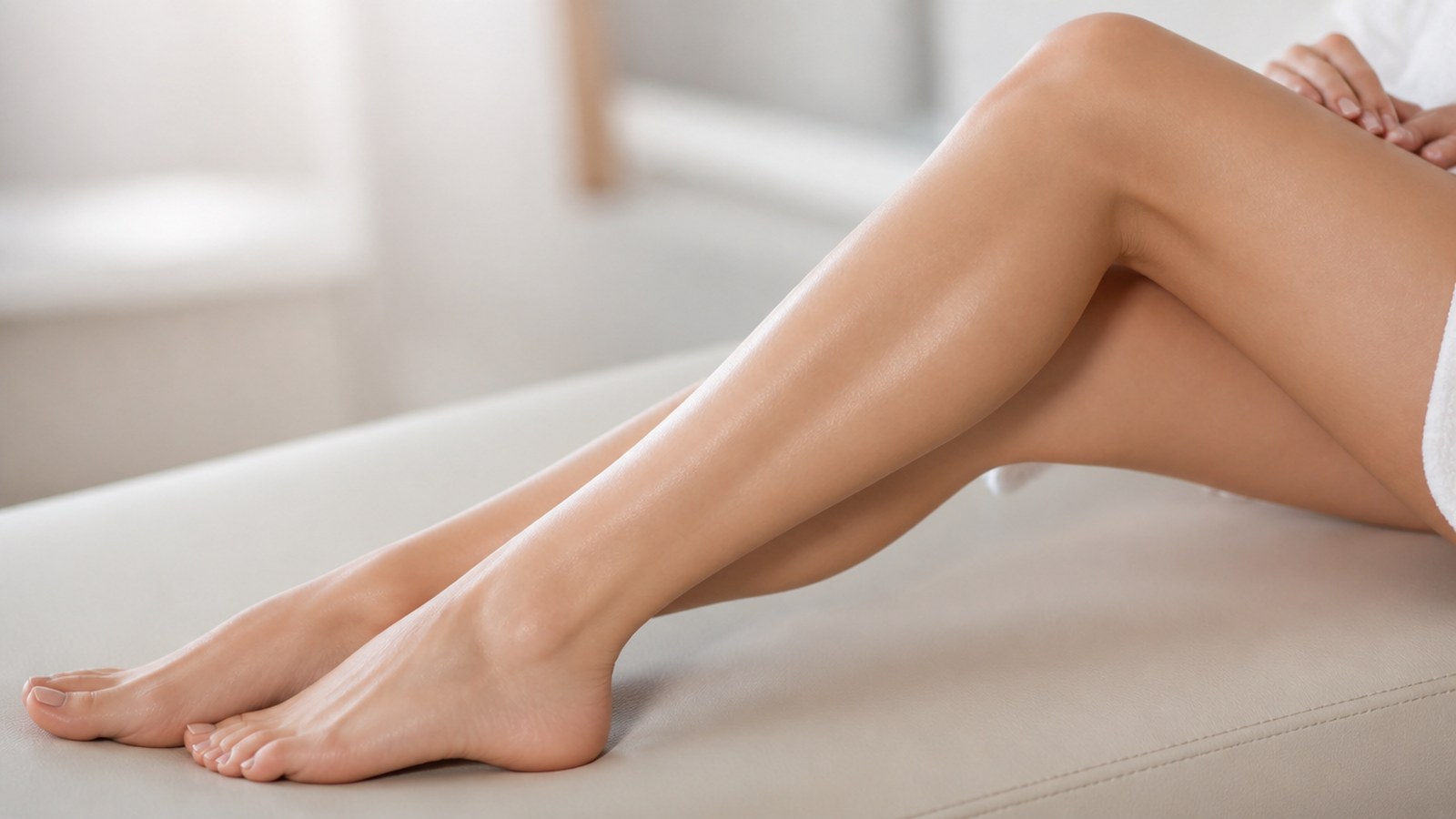
Legs · 4 areas
Lower leg
Knee to ankle — the most commonly requested leg area.
Upper leg
Thigh to knee.
Full leg
Thigh to ankle, with feet and toes where requested.
Feet & toes
Small area, generally added to a leg treatment.
Body · 5 areas
Chest
Frequently requested by men; hair is usually coarse and responds well.
Abdomen & navel line
Including the line below the navel, often the only part someone wants treated.
Upper or lower back
Large surface area; usually the longest single session.
Shoulders
Often treated together with the back.
Buttocks
Treated as its own area or alongside a Brazilian.
Facial laser hair removal — upper lip, chin and jawline at IN Eternity Clinic Singapore
Bikini, Brazilian & Boyzilian

Brazilian and Boyzilian laser hair removal

This is the area people ask about most and say least about, so it is worth setting out plainly. Bikini line treats what sits outside the underwear line. Extended bikini adds the upper inner thigh. Brazilian is full removal front to back, with or without a strip retained — your choice, agreed before we start. Boyzilian is the male equivalent, and perianal can be treated as part of a Brazilian or on its own.

Two things make this area different from a leg or an underarm. The skin is thinner and more sensitive, so fluence and cooling matter more than elsewhere. And the hair is typically coarse and dense — which is good news, because coarse dark hair contains more melanin and is exactly what the laser targets best. Boyzilian hair is usually denser again, so it is planned separately rather than repeating the Brazilian protocol. Hormonal influence is also more pronounced here than almost anywhere on the body, which is why this is one of the areas most likely to need maintenance after the initial course.

Before you come in

Shave, do not wax. The laser needs the hair shaft and follicle intact to absorb energy — waxing and plucking remove exactly what it is aiming at. Stop waxing, plucking and threading around four weeks beforehand and shave the area a day or so before your session. Avoid sun exposure and self-tan on the area, since both raise epidermal melanin and change what settings are safe.

Female doctor available

A female doctor is available at IN Eternity Clinic. For bikini, Brazilian, Boyzilian, perianal and any other intimate-area treatment, you can request a lady doctor when you enquire and the appointment is arranged accordingly. You do not need to give a reason, and it does not change how the treatment is performed.

IPL vs laser hair removal

IPL is not a laser, and that is the whole difference. A laser emits a single coherent wavelength. Intense pulsed light emits a broad spectrum, typically 500 to 1200 nm, filtered toward a target band. Because the output is spread across many wavelengths, less of the delivered energy lands precisely on follicular melanin and more is absorbed by everything else in its path. In practice IPL is generally gentler per pass, usually needs more sessions, and carries a narrower margin in darker skin, where the shorter wavelengths in its spectrum are absorbed strongly by epidermal pigment.

How this compares to a diode laser

The 810 nm diode sits between our two wavelengths, and that is its strength: one wavelength that is a reasonable compromise across many skin types, which is why it is the workhorse of high-volume chains. The trade-off is that a compromise wavelength is optimal for nobody in particular. A dual-wavelength platform lets the clinician move to whichever end of that range your skin and hair actually sit at, rather than meeting in the middle for everyone. Read the diode vs dual-wavelength comparison.

“IPL is not a laser, and a diode is not two wavelengths. Both work. Neither lets the clinician move to the end of the spectrum your skin actually needs — which is the whole argument for a dual-wavelength platform.”

Dr Sin Yong · Medical Director
The clinic’s view

We run both wavelengths because Singapore is not one skin type. A clinic with a single wavelength has to make the same compromise on every patient; having 755 nm and 1064 nm on one platform means the decision is clinical rather than inventory-led. What we will not do is quote a session count before looking at your hair and your skin, or describe the result as permanent removal when the honest word is reduction.

Brazilian laser hair removal — the full guide  ·  Underarm treatment

Back and shoulder laser hair removal at IN Eternity Clinic Singapore

IPL hair removal Singapore and diode laser hair removal Singapore — how they differ

Most people comparing options locally are choosing between three things, and they are not the same technology.

IPL hair removal Singapore

IPL hair removal Singapore uses a broad spectrum of filtered light rather than one coherent wavelength. Less of the delivered energy lands precisely on follicular melanin, which generally means more sessions and a narrower safety margin as skin type darkens.

Diode laser hair removal Singapore

Diode laser hair removal Singapore is usually 810 nm — a genuine laser and a reasonable compromise across many skin types, which is why it is the workhorse of high-volume chains. The trade-off is that a compromise wavelength is optimal for nobody in particular.

Questions patients actually ask

Which wavelength will be used on me?

That is decided at assessment, based on your Fitzpatrick skin type, hair colour and coarseness, and the area. Broadly, 755 nm suits lighter phototypes and finer hair, while 1064 nm is the safer choice as phototype darkens.

Is laser hair removal permanent?

The accurate term is permanent hair reduction — a long-term, stable reduction in the number of hairs, not zero hair. Some follicles are destroyed, others regrow finer and lighter, and hormonally driven hair may need maintenance.

How many sessions will I need?

It depends on the site and your hair. Only follicles in the active growth phase respond, and the proportion in that phase differs between face, underarm and leg. The number and interval are set at assessment.

Is it safe for darker skin?

That is precisely why the dual-wavelength platform matters. The 1064 nm long-pulsed Nd:YAG has lower melanin absorption and deeper penetration, so less energy is taken up by epidermal pigment.

Does it work on white, grey or blond hair?

Poorly — a limitation of the physics, not the device. The laser targets melanin; hair with little melanin gives it nothing to absorb. If most of your hair is white or very light, we will say so.

Is a female doctor available for Brazilian or bikini treatment?

Yes. You can request a female doctor when you enquire about any intimate-area treatment. You do not need to give a reason, and it does not change how the treatment is performed.

What is the difference between a bikini, Brazilian and Boyzilian?

Bikini line treats the area outside the underwear line. Extended bikini adds the upper inner thigh. Brazilian is full removal front to back. Boyzilian is the male equivalent.

Can I wax before laser hair removal?

No. The laser targets melanin in the hair shaft and follicle, so waxing or plucking removes what it needs. Stop waxing about four weeks beforehand and shave shortly before your session instead.

What is the difference between IPL and laser?

IPL emits a broad spectrum of light filtered toward a target band, whereas a laser emits one coherent wavelength. Less IPL energy lands precisely on follicular melanin, which generally means more sessions and a narrower margin in darker skin.

How does this compare to a diode laser?

The 810 nm diode is a single compromise wavelength. A dual-wavelength platform lets the clinician choose 755 nm for efficiency on finer hair or 1064 nm for safety in darker skin.

Which areas can be treated?

Face, underarms, arms, hands, bikini line, extended bikini, Brazilian, Boyzilian, perianal, legs, feet, chest, abdomen, back, shoulders and buttocks.

Can men have laser hair removal here?

Yes — chest, back, shoulders, abdomen, nape and Boyzilian are commonly treated. Male hair is often coarser, which the laser targets well.

Does it hurt?

Most people describe a snapping sensation with heat. Tolerability varies by site and settings, and cooling is used throughout.

Can I have it after sun exposure?

Recent tanning raises melanin in the epidermis, which changes what settings are safe, so treatment is usually deferred until that settles.

Is laser hair removal safe during pregnancy?

It is generally deferred. There is no strong evidence of harm, but no good evidence of safety either, and pregnancy changes hair growth unpredictably.

What is the difference between IPL hair removal and laser?

IPL is not a laser, and that is the whole difference. A laser emits a single coherent wavelength; intense pulsed light emits a broad spectrum, typically 500 to 1200 nm, filtered toward a target band. Because IPL hair removal spreads energy across many wavelengths, less of it lands precisely on follicular melanin. In practice IPL hair removal in Singapore is generally gentler per pass, usually needs more sessions, and carries a narrower safety margin in darker skin, where the shorter wavelengths in its spectrum are absorbed strongly by epidermal pigment.

Is SHR hair removal the same as laser hair removal?

SHR hair removal — super hair removal — describes a delivery method rather than a distinct technology. It uses repeated low-fluence pulses with a moving handpiece to raise follicular temperature gradually, rather than fewer high-energy pulses. It is generally more comfortable and is offered on both diode and IPL platforms. It is a technique for delivering energy, not a different wavelength, so the underlying physics of what the energy targets is unchanged.

How does diode laser hair removal in Singapore compare with dual-wavelength?

The 810 nm diode sits between the two wavelengths on a dual platform, and that is its strength: one wavelength that is a reasonable compromise across many skin types, which is why diode laser hair removal in Singapore is the workhorse of high-volume chains. The trade-off is that a compromise wavelength is optimal for nobody in particular. A dual-wavelength platform lets the clinician move to whichever end of that range your skin and hair actually sit at, rather than meeting in the middle for everyone.

Which is better for hair removal in Singapore — IPL or laser?

For hair removal in Singapore, where skin types commonly span Fitzpatrick III to V, wavelength control matters more than it does in lighter-skinned populations. A laser gives one precise wavelength, which allows the clinician to choose 755 nm for efficiency on finer hair or 1064 nm for safety as phototype darkens. IPL hair removal can work, particularly in lighter skin, but offers less control over where the energy lands. Neither is universally better; the match between wavelength and your skin is what determines both safety and result.

Laser hair removal for legs at IN Eternity Clinic Singapore — suitable across skin types
References
  1. Long-Term Efficacy and Safety of 755-nm Alexandrite Laser for Axillary Hair Removal — PubMed Central. Source
  2. Simultaneous Emission of Nd:YAG and Alexandrite Lasers for Hair Removal and Permanent Hair Reduction — PubMed Central. Source
  3. Multipass low fluence 755-nm alexandrite versus high fluence 1064-nm long-pulsed Nd:YAG in dark skin phototypes — PubMed. Source

Find out which wavelength suits your skin

Assessment establishes your Fitzpatrick type, hair characteristics and the right wavelength before any course is discussed. If laser is not the right tool for your hair, you will be told that.

WhatsApp the clinic →
9 Scotts Road, #12-01 Pacific Plaza, Singapore 228210