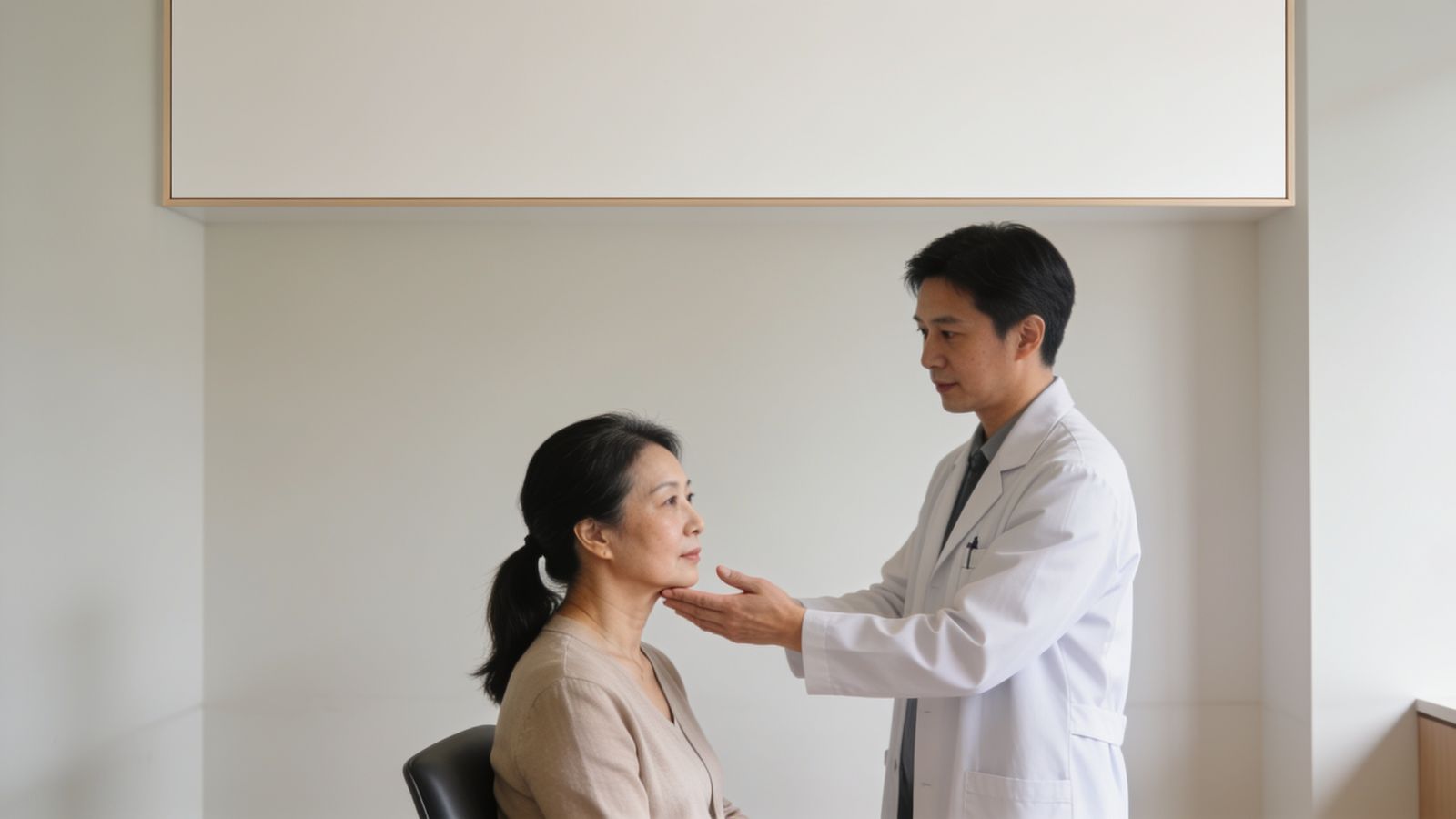
Focused ultrasound, radiofrequency, threads and fractional laser each work at a different depth. At IN Eternity Clinic, Dr Sin Yong chooses by where your laxity sits and the shape of your face.
WhatsApp to Enquire →Key facts ↓Skin tightening treatments heat or support tissue at different depths. HIFU and Ultherapy focus ultrasound down to the SMAS; Thermage FLX and the VF Lift – Vertical Facelift on Volnewmer use monopolar radiofrequency in the dermis; thread lifts reposition tissue mechanically; FSX laser works nearer the surface. At IN Eternity Clinic, the layer that has loosened and the shape of your face decide which is used.
Skin loosens for three reasons that usually arrive together: the collagen and elastic fibres of the dermis thin out, the fibrous support layer beneath (the SMAS and its ligaments) slackens, and fat and bone beneath both recede. Non-surgical skin tightening works on the first two. It does not replace lost volume and it does not remove excess skin.
Most tightening treatments use controlled heat. When collagen is heated to the right temperature it contracts, which gives a little firmness early on; the larger effect comes over the following two to six months, as the skin repairs the heated zones by laying down new collagen. Thread lifts work differently: they reposition tissue mechanically along planned lines and prompt collagen to form around each thread as it dissolves.
Realistically, these treatments suit mild to moderate laxity: a softening jawline, early jowls, crepey skin on the neck or eyelids, a slightly heavier brow. Change is gradual and varies between people. Where tissue has descended a long way or there is a fold of excess skin, a surgical opinion may serve you better, and that is said plainly at IN Eternity Clinic.
Each option works at a different layer, which is why the right choice depends on where the laxity sits and on the shape of the face, not on which device is newest.
| Treatment | Energy and depth | Usually suits | Less suited to | Typical recovery | Usual sessions |
|---|---|---|---|---|---|
| HIFU (CLASSYS Ultraformer MPT) | Focused ultrasound points at 1.5, 3.0 and 4.5 mm, reaching the SMAS | Early jowls, soft jawline, loose skin under the chin, heavy brow | Very lean faces; fat-driven fullness | Redness or tenderness for hours to a few days | Often one, reviewed at about three months |
| Ultherapy | Micro-focused ultrasound with live imaging, including the SMAS | Brow, jaw and neck laxity where imaging of each layer is wanted | Very lean faces; fat-driven fullness | Tenderness for a few days; occasional small bruises | Usually one; maintenance often discussed at 12–18 months |
| Thermage FLX | Monopolar radiofrequency heating deep dermis and subdermal layers, surface cooled | Crepey skin, overall firmness, eyelids with the Eye Tip, neck and body | Marked sagging of deeper tissue | Mild redness, usually brief | Usually one, with yearly maintenance often suggested |
| VF Lift – Vertical Facelift | Continuous 6.78 MHz monopolar RF on CLASSYS Volnewmer, passes along vertical vectors | Leaner faces with laxity; lift, reduce and restore planned zone by zone | Advanced descent or skin excess | Warmth and flush for an hour or two | Usually two to four, then maintenance |
| Thread lift | Absorbable PDO and PCL threads placed under the skin | Visible descent of cheeks and jowls needing a mechanical lift | Very thin skin; heavy tissue with a lot of excess | Tenderness and swelling, settling over one to two weeks | Usually one procedure |
| FSX laser | Fractional thulium and erbium glass, multi-pass, nearer the surface | Crepey texture, fine lines, heavy upper eyelids, early laxity | Deep structural sag | Redness for hours; light scabs for 3–7 days after stronger passes | Usually 3–5, 4–6 weeks apart |

High-intensity focused ultrasound brings sound energy to a focal point beneath the skin, creating rows of tiny heated points at fixed depths while the surface stays intact. The deepest lines reach the SMAS, the layer repositioned in a surgical facelift, which is why focused ultrasound is the energy most associated with lifting along the jaw, under the chin and at the brow.
At IN Eternity Clinic, HIFU is delivered on the CLASSYS Ultraformer MPT; Ultherapy adds real-time imaging so each line can be confirmed at its intended depth. Both suit people with early to moderate laxity and enough soft tissue to work on. In a lean face, heat-based tightening can occasionally leave the cheeks looking a little hollower, which is discussed beforehand and is one reason a leaner face is often planned around radiofrequency instead. The differences are set out in Thermage vs Ultherapy and HIFU.
Thermage FLX and Volnewmer are both monopolar radiofrequency platforms at 6.78 MHz. Rather than focusing energy at points, they warm a broader volume of dermis and the fibrous septa beneath, which suits crepey, thinning skin and overall firmness. The practical differences lie in how the surface is cooled, the rhythm of treatment and how the passes are planned.
Thermage FLX cools the surface with each pulse and is usually given as a single session, with an Eye Tip for the eyelids. The VF Lift – Vertical Facelift is a protocol developed by Dr Sin Yong and runs on CLASSYS Volnewmer alone, without focused ultrasound. Volnewmer delivers continuous radiofrequency through a water-cooled tip, and the passes follow vertical vectors against the direction that particular face has descended, zone by zone. It is usually planned as two to four sessions followed by maintenance.

Heat tightens; it does not move tissue very far. When the main problem is descent, cheeks that have slipped and jowls that hang below the jawline, a thread lift can reposition tissue mechanically in a way energy cannot. Absorbable PDO and PCL threads are placed under local anaesthetic along planned vectors, and collagen forms around them over about three months as they dissolve.
At IN Eternity Clinic the Bliss Lift uses PDO and PCL threads, and RVR ProLift is Dr Sin Yong’s vertical thread-lifting protocol. Swelling, tenderness and small puckers near entry points are common for the first week or two; infection, thread visibility and asymmetry are uncommon risks that are discussed in full before treatment. Threads are often combined with energy-based tightening on another day.
Crepey skin on the lower face, neck and eyelids is a problem of the upper dermis, closer to the surface than the layers HIFU targets. FSX laser, IN Eternity Clinic’s multi-pass protocol using thulium and erbium glass energy, works in this zone. It treats fine lines, rough texture and heavy upper eyelids alongside early laxity, over a course of three to five sessions.
For the eyelids specifically, Thermage FLX with the Eye Tip is another option. Neither replaces surgery for a large fold of excess eyelid skin; that is assessed honestly, with a referral where appropriate. See droopy eyelid treatment for how hooded lids are assessed.
“Skin tightening is not one treatment. It is a decision about which layer has let go, and a lean face and a full face rarely need the same answer.”
Most plans combine two approaches on separate days. The broader picture is on sagging face treatment.

New collagen made after treatment becomes part of your tissue, but the processes that loosened the skin carry on: collagen keeps thinning, sun keeps breaking it down, and fat and bone keep changing. The effect of tightening therefore fades gradually rather than stopping on a date. How quickly varies with age, sun exposure, weight change and the treatment used.
Maintenance is planned individually: focused ultrasound and Thermage are often reviewed yearly or longer, the VF Lift has periodic maintenance sessions after its initial course, and threads are reassessed once they have dissolved. Daily sunscreen and a stable weight do more to protect the result than any device.
Cost depends on the treatment or protocol, the areas treated, the number of lines, pulses or threads, how many sessions the plan needs and whether treatments are combined. Because these differ from face to face, a figure given before assessment would mean little. At IN Eternity Clinic the plan and its cost are set out after assessment, and the consultation fee is waived with any medical treatment. The factors are explained in HIFU price factors and Thermage cost.
Treatment is usually postponed during pregnancy, over active skin infection or inflammation, and soon after recent filler or threads in the same area until they have settled. Radiofrequency needs care around metal implants and implanted electronic devices, which are reviewed beforehand. Recent sun tanning, a history of keloid scarring and certain medicines are also discussed, and anyone expecting a surgical-level change is told so honestly at the start.
It depends on which layer has loosened and the shape of your face. Focused ultrasound suits laxity along the jaw and brow, radiofrequency suits crepey skin and leaner faces, threads suit visible descent, and FSX suits texture and fine lines. Dr Sin Yong decides after an in-person assessment.
HIFU focuses ultrasound into small points at fixed depths, reaching the SMAS for lift. Thermage FLX uses monopolar radiofrequency to warm a broader volume of deep dermis for firmness. They act on different layers and are sometimes combined in separate sessions.
Ultherapy is a form of focused ultrasound with live imaging, so each line can be confirmed at its intended depth. Other HIFU platforms, such as Ultraformer MPT, use fixed-depth cartridges without imaging. Results depend more on suitability and planning than on the brand.
No. The upgraded VF Lift – Vertical Facelift protocol runs on CLASSYS Volnewmer monopolar radiofrequency alone. Ultraformer MPT is offered separately at IN Eternity Clinic as its own HIFU treatment.
Not for everyone. Non-surgical tightening suits mild to moderate laxity and gives gradual, natural-looking change. Advanced descent or a fold of excess skin may be better served by a surgical opinion, and Dr Sin Yong will say so if that applies.
Most people feel deep warmth or brief pricking. Focused ultrasound can ache over bone, radiofrequency builds as heat that the cooling tip controls, and threads are placed under local anaesthetic. Numbing cream and adjusted settings keep sessions manageable.
Yes. They work at different depths, so they are sometimes planned in the same course, usually as separate sessions spaced a few weeks apart. Whether a combination is needed depends on the laxity, fat and skin quality found at assessment.
A little firmness may be felt early, but the main change builds over two to six months as new collagen forms. Thread lifts show some lift straight away, settling over one to two weeks. Progress is reviewed with standard photographs.
IN Eternity Clinic, 9 Scotts Road, #12-01 Pacific Plaza, Singapore 228210. By appointment with Medical Director Dr Sin Yong. Monday to Saturday, 11am to 8pm. WhatsApp or call +65 8815 3008. The consultation fee is waived with any medical treatment.
These sources describe mechanisms and general evidence. They are not a promise of any individual result; suitability is decided at an in-person assessment.