
Droopy Eyelid Treatment Singapore
A droopy eyelid is an upper lid that sits, or looks, lower than it should. Heavy-looking upper lids can come from excess lid skin, a brow that has dropped, or a weak lid-lifting muscle. Medical Director Dr Sin Yong tells these apart before anything is suggested. Droopy eyes from mild heaviness can sometimes be eased without surgery; true ptosis is referred to an eye specialist.
Droopy eyelid treatment depends on the cause: hooding and a low brow can be softened without surgery, while true ptosis needs an eye specialist.
WhatsApp to Enquire →Key facts ↓A droopy eyelid is either true ptosis, where the lid edge sits low, or heaviness from a lowered brow or loose upper-lid skin. Mild heaviness can sometimes be eased without surgery: anti-wrinkle injections to lift the brow tail, and radiofrequency or focused ultrasound to tighten skin, with little visible downtime. A lid that covers the pupil, or a weak lifting muscle, needs an eye specialist.
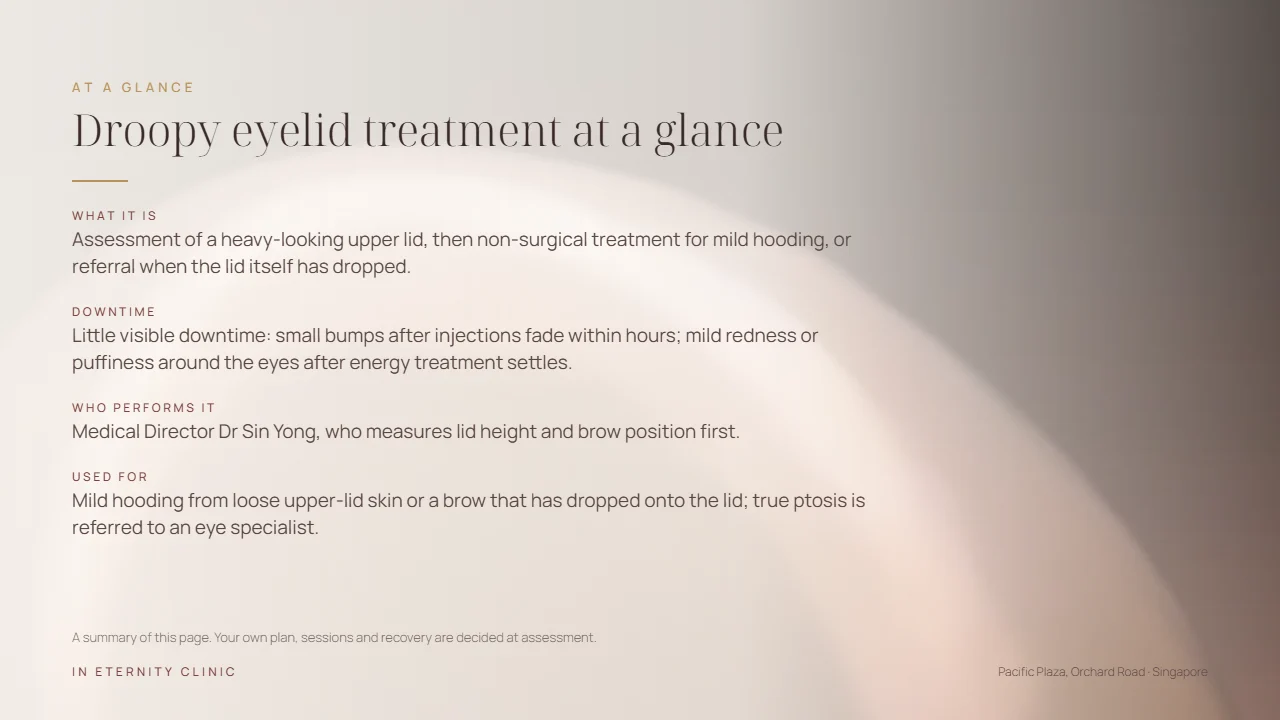
Droopy eyelid treatment at a glance
| Droopy eyelid treatment at IN Eternity Clinic | |
|---|---|
| What it is | Assessment of a heavy-looking upper lid, then non-surgical treatment for mild hooding, or referral when the lid itself has dropped. |
| Used for | Mild hooding from loose upper-lid skin or a brow that has dropped onto the lid; true ptosis is referred to an eye specialist. |
| How it works | Anti-wrinkle injections relax the muscle that pulls the brow tail down; Thermage FLX (Eye Tip), FSX Laser or shallow HIFU along the brow tighten skin and support tissue. |
| Typical sessions | Injections are a single quick treatment, repeated as the effect wears off; energy treatments are planned at assessment and reviewed at three months. |
| Downtime | Little visible downtime: small bumps after injections fade within hours; mild redness or puffiness around the eyes after energy treatment settles. |
| When results show | A brow-lift effect from injections shows from around day three to five and peaks at about two weeks; collagen tightening develops over two to six months. |
| Who should avoid or wait | A lid edge that covers part of the pupil, a weak lifting muscle, or a sudden droop needs an eye specialist, not cosmetic treatment. |
| Who performs it | Medical Director Dr Sin Yong, who measures lid height and brow position first. |
Dr Sin Yong, Medical Director of IN Eternity Clinic, explains that if the lid itself has dropped, no injection or energy treatment will lift it; that is a conversation for an eye specialist, and he says so.
On this page
- Three causes: excess upper-lid skin (dermatochalasis), a brow that has descended onto the lid, and blepharoptosis — a lid margin that sits low because the lifting muscle or its tendon has weakened.
- Brow-lift effect: small doses of botulinum toxin, a prescription medicine, relax the muscle that pulls the outer brow down, which can raise the brow tail by a few millimetres.
- Energy options at IN: Thermage FLX with the Eye Tip for lid skin laxity, and shallow focused ultrasound (HIFU) along the brow and forehead, kept away from the eye itself.
- When surgery is needed: true ptosis, heavy folds of excess skin, or a lid that blocks the upper field of vision usually need an oculoplastic opinion.
- Red flags: a droop that appears suddenly, or comes with double vision, a different pupil size, headache or weakness, needs urgent medical review the same day.
- Where: IN Eternity Clinic, 9 Scotts Road, #12-01 Pacific Plaza, Singapore.
- With monopolar radiofrequency on the eyelids, upper-lid tightening was seen in 88% of people and lower-lid tightening in 71–74%, with no serious side effects (Lasers Surg Med 2006)
- In a multicentre radiofrequency study, blinded scoring found eye-area wrinkle improvement in 83.2% of treated areas and a brow lift of at least 0.5 mm in 61.5% (Lasers Surg Med 2003)
- In a rater-blinded study of focused ultrasound, 86% of people had a clinically significant brow lift at 90 days, averaging 1.7 mm (J Am Acad Dermatol 2010)
- Brow-lift effect from injections: in 7 women, small doses to the muscles that pull the brow down lifted the brow in 5, by a mean of 1 mm at one month. (Source: Huilgol 1999) [1]
- Radiofrequency around the eyes: in 86 people treated once, 40 of 65 measured brows rose by at least 0.5 mm; second-degree burns occurred in 21 of 5,858 applications. (Source: Fitzpatrick 2003) [5]
- Radiofrequency on the eyelids: a monopolar radiofrequency eyelid tip used once in 72 people tightened the upper lid in most at six months, with no serious adverse effects. (Source: Biesman 2006) [2]
- Focused ultrasound on the brow: 30 of 35 people had a clinically significant brow lift 90 days after one treatment, a mean of 1.7 mm. (Source: Alam 2010) [6]
Is it hooding, a low brow or ptosis?
Hooding is usually skin: a fold of upper-lid skin that rests on the lashes as elasticity falls with age. A low brow adds weight from above, especially at the outer third, and lifting the brow with a fingertip often opens the eye. Ptosis is different again: the lid margin itself sits low over the iris because the levator muscle or its attachment has stretched or weakened. It may be from age, long-term contact lens wear, previous eye surgery, or, less often, a nerve or muscle condition. Lower-lid bags are a different question from upper-lid drooping; 4D eye bag removal and scarless surgery are explained in their own guide.

Dr Sin Yong looks at brow height at rest, how much lid skin there is, where the lid margin sits relative to the pupil, and whether the forehead is working hard to hold the brows up. Anti-wrinkle injections in the forehead of someone who relies on that muscle to keep their lids open can make things worse, which is one reason this assessment comes first.

Which non-surgical options can help mild hooding?
Brow-lift effect with anti-wrinkle injections. The outer part of the muscle around the eye pulls the brow tail downward. Relaxing it with small, precisely placed doses of botulinum toxin lets the brow-lifting muscle act a little more freely. The change is subtle and wears off over months. See anti-wrinkle injections.
Thermage FLX with the Eye Tip. Monopolar radiofrequency heats the dermis of the upper and lower lid skin to tighten collagen and prompt new collagen over months. Protective eye shields are placed for treatment of the lids. See Thermage FLX.
FSX Laser. FSX Laser is a non-surgical option for loose eyelid skin: thulium energy is placed carefully on the thin upper-lid skin, and it can make the two sides look more even and open. How much changes varies, and it is planned at assessment.
Focused ultrasound along the brow. Shallow HIFU lines along the brow and forehead can tighten the tissue that supports the brow; lines are placed away from the eye itself. See HIFU. Often a combination works more gently than any single step.
“If the lid itself has dropped, no injection or energy treatment will lift it. That is a conversation for an eye specialist, and I will say so.”
When does a droopy eyelid need an eye specialist?
If the lid margin covers part of the pupil, if you find yourself raising your eyebrows or tilting your chin to see, or if one lid has dropped noticeably more than the other, the cause is likely ptosis or heavy dermatochalasis. These are treated surgically by an oculoplastic specialist, and no injection or energy treatment will lift a lid whose muscle has weakened. Dr Sin Yong will tell you this at assessment and can arrange a referral.
A droop that comes on over hours or days, especially with double vision, a change in pupil size, eye pain or headache, can signal a nerve problem and needs same-day medical attention rather than an aesthetic appointment.

How is droopy eyelid treatment done? Step by step
Every plan starts by finding which of the three causes is present.
- Assessment. Dr Sin Yong measures lid height on each side, checks brow position and forehead effort, and decides between hooding, a low brow and ptosis.
- Photographs. Photographs are taken at rest and with the eyes open wide.
- Referral if needed. Ptosis or heavy dermatochalasis is referred to an eye specialist rather than treated here.
- Treatment for mild hooding. Small, precisely placed anti-wrinkle injections for the brow tail, and/or Thermage FLX with the Eye Tip, FSX Laser on the upper-lid skin, or shallow HIFU along the brow, with eye shields where needed.
- Straight after. You can usually return to normal activities the same day; avoid rubbing the area.
- Review. Brow position is checked at about two weeks; energy treatments are reviewed again at three months.
Does it hurt? Comfort and numbing
Anti-wrinkle injections around the brow feel like a few quick pinpricks and take minutes; numbing is rarely needed. Thermage on the eyelids is done with numbing cream, and each pulse feels like a short burst of heat followed by cooling and vibration. HIFU along the brow can feel like deep, brief prickling or aching over bone; numbing cream and adjusted energy keep it tolerable.
What to expect: day by day
Day 0: assessment, photographs at rest and with eyes open wide, then treatment if suitable. You can usually return to normal activities the same day.
Days 1–3: after injections, small bumps at the injection points fade within hours; avoid rubbing the area. After Thermage or HIFU, mild redness or puffiness around the eyes can occur and settle.
Week 1: the toxin effect starts to show from around day three to five.
Weeks 2–4: the brow-lift effect reaches its full level by about two weeks. Collagen tightening from Thermage or HIFU develops more slowly, over two to six months.
Review at about two weeks: the brow position is checked and any small adjustment discussed; energy treatments are reviewed again at three months.
What affects the cost of droopy eyelid treatment in Singapore
Cost follows the cause found at assessment. Hooding from a dropped brow, loose lid skin and true ptosis lead to different plans, and ptosis leads to a referral rather than treatment here.
| What affects it | How it changes the plan |
|---|---|
| Cause | Brow descent, loose lid skin or both; ptosis is referred to an eyelid specialist. |
| Method | Anti-wrinkle injections for a brow-lift effect, Thermage FLX with the eye tip for lid skin, or HIFU along the brow, alone or together. |
| Areas | Upper lids only, upper and lower lids, or the brow and forehead as well. |
| Sessions and maintenance | Injections are repeated every few months if you want to keep the effect; energy tightening is usually one session reviewed months later. |
| Assessment findings | Dry eyes, previous eyelid surgery or an uneven lid can change what is safe to offer. |
At IN Eternity Clinic a consultation fee applies, and it is waived if you go ahead with any medical treatment; the fee is S$120.
How many droopy eyelid treatment sessions are needed, and what do results look like over time?
The plan depends on the cause; a combination often works more gently than any single step.
| When | What usually happens |
|---|---|
| Day of treatment | Small bumps after injections fade within hours; mild redness or puffiness after energy treatment |
| Three to five days | The brow-lift effect from injections starts to show |
| About two weeks | The brow-lift effect reaches its full level; brow position is reviewed |
| Two to six months | Collagen tightening from Thermage or HIFU develops; energy treatments are reviewed at three months |
| Three to four months | The brow-lift effect from injections usually wears off and can be repeated |
Droopy eyelid treatment risks and side effects
The eye area is thin and close to delicate structures, so the risks depend on the tool. Radiofrequency of the eyelids and the skin around them has been studied with protective eye shields in place, and the side effects reported were mostly mild and temporary (Fitzpatrick et al., 2003; Biesman et al., 2006).
Common and expected
- Small bumps or pinpoint bruises at injection points, fading within hours to days.
- Redness and mild puffiness around the eyes after Thermage or HIFU, usually settling within a day or two.
- Tenderness over the brow bone after HIFU.
Uncommon
- A lid that sits lower, or brows that sit unevenly, after anti-wrinkle injections if the product spreads; it wears off over weeks.
- Dry or gritty eyes for a few days.
- Blistering, temporary numbness or, rarely, a small burn after energy treatment.
When to contact the clinic
- A lid that drops further than before, double vision or difficulty closing the eye.
- Eye pain, sensitivity to light or blurred vision after any treatment near the eye: seek help the same day.
- Blisters, crusts or swelling that is increasing after the second day.
WhatsApp or call the clinic on +65 8815 3008, with a photograph if you can; Dr Sin Yong reviews concerns after treatment. The difference between hooding and true ptosis is explained in hooded eyes: causes and non-surgical options; eye-area concerns are grouped on eye concerns; and the injection side is covered on anti-wrinkle injections in Singapore.
What causes a droopy eyelid?
Most droopy eyelids in adults come from a stretched lifting tendon, or from a lowered brow and loose skin resting on a normal lid. Less often the cause is present from birth, or is a muscle or nerve problem that needs urgent care.
| Cause | What happens | Typical clues | Who treats it |
|---|---|---|---|
| Ageing of the lifting tendon (aponeurotic ptosis) | The tendon of the lid-lifting muscle stretches or detaches | Gradual droop, high or absent crease, often both sides; linked to age, long-term contact lens wear, eye rubbing and eye surgery | Eyelid specialist; usually surgical repair |
| Present from birth (congenital) | The lifting muscle developed poorly | Since childhood; the lid may lag on looking down | Eyelid specialist |
| Muscle or nerve conditions | Weakness of the muscle or its nerve supply | Droop that varies through the day, double vision, a different pupil size | Urgent medical assessment |
| Weight on the lid (mechanical) | A swelling, lump or heavy skin pushes the lid down | A visible lump, swelling or heavy fold | Diagnosis first; treatment depends on the cause |
| A low brow or loose lid skin (pseudoptosis) | The lid edge is normal; brow and skin sit on it | Lifting the brow with a fingertip opens the eye | Non-surgical options may help when mild |
How is a droopy eyelid measured?
The key measurement is the distance from the light reflex in the centre of the pupil to the edge of the upper lid, recorded in millimetres with the eyes looking straight ahead and the forehead relaxed. A lid edge at a normal height with skin folding over it is hooding; a lid edge that is low is ptosis. Photographs at rest and with the brows held still are taken at the first visit.
Droopy eyelid or hooded eyes: which do I have?
If the lid edge sits at a normal height and skin covers the crease, that is hooding; if the lid edge itself sits low, that is a droopy eyelid (ptosis).
The distinction decides the plan. Hooded eyes from a lower brow and looser skin can be lifted a millimetre or two without surgery. True ptosis needs the lifting tendon repaired, which is a referral to an eyelid specialist.
Can droopy eyelids be prevented?
- Avoid rubbing the eyes, especially with allergies; treat itchy eyes instead.
- Take contact lenses out gently and follow wearing times; long-term hard lens wear is linked to tendon stretching.
- Protect the lid skin from sun with sunglasses and a hat.
- Have a sudden or one-sided droop checked the same day.
Brow-led heaviness and the non-surgical options are compared further on eye lifting treatment in Singapore.
Can eye drops lift a droopy eyelid, and which tests come first?
Some prescription eye drops can raise a mildly droopy lid by stimulating a small lifting muscle, but the lift is modest and lasts only while the drops are used. They do not help hooding from loose skin or a low brow. Tests first establish which problem you have and whether vision is affected.
Checks an eye specialist or doctor may use:
- Lid height: the distance from the light reflex in the pupil to the lid edge, in millimetres.
- Lifting-muscle strength: how far the lid travels from looking down to looking up, which guides any surgical plan.
- Visual field test: shows whether the lid is blocking upper vision, with the lid resting and taped up.
- Eye movements and pupils: to look for a nerve cause, especially with double vision or a different pupil size.
- Fatigue and ice-pack tests: used when the droop varies through the day, to look for a muscle-nerve condition.
On drops: a 2025 analysis of four randomised trials in 448 people with acquired ptosis found that oxymetazoline 0.1% raised the lid by about 0.65 mm on average, compared with 0.26 mm with placebo, with no difference in serious side effects (Bawazir 2025). That is a small change, and it fades if the drops stop. Drops are prescribed by eye doctors where available; they are not part of treatment at IN Eternity Clinic.
Signs that a droop is affecting vision include an aching forehead from raising the brows, tiredness when reading and tilting the chin up to see. These warrant an eye specialist review. Where the problem is a lowered brow or loose lid skin instead, non-surgical options are compared on eye lifting treatment in Singapore and hooded eyes treatment. Suitability is decided at assessment.
When a droopy eyelid needs an eye doctor first
A droopy eyelid can be loose skin (dermatochalasis), a weak lifting muscle (ptosis), or a heavy brow. Ptosis surgery is done by eye surgeons (ophthalmologists). Some droops need an eye doctor before any cosmetic treatment.
- Urgent: a droop that comes on suddenly, especially with double vision, a larger pupil on one side, headache or eye pain.
- Soon: a droop that gets worse as the day goes on or with tiredness, which can point to a muscle or nerve condition.
- Children: a droopy lid that covers the pupil, which can affect vision development and needs an eye doctor early.
- After eye surgery or long-term contact lens wear: a lifting muscle that has stretched may need ptosis surgery rather than skin treatment.
When the droop is loose skin or a heavy brow, non-surgical options such as Thermage Eye may help; when it is ptosis, Dr Sin Yong refers to an eye surgeon.
Frequently asked questions about droopy eyelid treatment Singapore
Which treatment suits droopy eyelids?
For heavy skin and a low brow: focused ultrasound or radiofrequency to tighten the brow and lid skin, or threads to support the lateral brow. For skin that rests on the lashes or a lid margin that covers the pupil: surgery (blepharoplasty or ptosis repair). Non-surgical treatments give a modest, gradual change and suit earlier stages. Results vary between people.
Which doctor treats a droopy eyelid?
It depends on the cause. If the eyelid margin itself sits low over the pupil (ptosis), an oculoplastic surgeon is the right specialist, and sudden ptosis needs urgent medical review. If the problem is loose upper-lid skin or a brow that has descended, an aesthetic doctor can assess and, where suitable, treat it non-surgically. The first assessment sorts out which it is.
What affects the cost of droopy eyelid treatment?
Whether the cause is skin laxity, brow descent or true ptosis of the eyelid muscle. Skin and brow problems can be treated non-surgically with focused ultrasound, radiofrequency or threads, priced by area and session; muscle ptosis is surgical and priced by the surgeon. A written estimate follows assessment with Dr Sin Yong; no price list is published.
Are droopy eyes the same as a droopy eyelid?
Not always. People say droopy eyes for an upper lid that sits low, a brow that has dropped onto the lid, or loose upper-lid skin folding over the lashes. Only the first is true ptosis, which comes from the lid-lifting muscle and is referred to an eye specialist. The other two can sometimes be eased without surgery. Dr Sin Yong measures lid height and brow position to tell them apart.
Do eyelid tapes or creams fix droopy eyelids?
No. Eyelid tapes can hold a fold up temporarily for appearance, and eye creams can hydrate skin and soften fine lines, but neither lifts a descended brow, tightens a fold of excess skin or strengthens a weak lid-lifting muscle. If a droopy lid is affecting your vision, or appeared suddenly, it should be examined rather than covered up.
Can anti-wrinkle injections cause droopy eyelids?
Yes, occasionally. If toxin spreads to the muscle that lifts the eyelid, the lid can sit lower for some weeks. It is temporary. Careful mapping, small doses and avoiding rubbing the area afterwards reduce the risk, and eye drops can help while it resolves.
When should a droopy eyelid be seen urgently?
See a doctor the same day if an eyelid droops suddenly, or if the droop comes with double vision, a change in pupil size, eye pain, headache or weakness elsewhere. These can signal a nerve or neurological problem rather than ageing.
Does droopy eyelid treatment hurt?
Most people find it manageable. Injections around the brow feel like a few quick pinpricks. Thermage on the eyelids is done after numbing cream, and each pulse is felt as brief heat followed by cooling and vibration. HIFU along the brow can ache over bone. Energy is adjusted to what you report, and you can ask for a pause at any time.
Book an assessment
IN Eternity Clinic, 9 Scotts Road, #12-01 Pacific Plaza, Singapore 228210. By appointment with Medical Director Dr Sin Yong. Monday to Saturday, 11am to 8pm. WhatsApp or call +65 8815 3008.
International KOL — CLASSYS · HIRONIC · DEKA · ALMA · FOTONA · LUTRONIC
References
- Huilgol SC, Carruthers A, Carruthers JDA. Raising eyebrows with botulinum toxin. Dermatol Surg 1999;25(5):373-376. doi:10.1046/j.1524-4725.1999.08286.x
- Biesman BS, Baker SS, Carruthers J, et al. Monopolar radiofrequency treatment of human eyelids: a prospective, multicenter, efficacy trial. Lasers Surg Med 2006;38(10):890-898. doi:10.1002/lsm.20452
- Finsterer J. Ptosis: causes, presentation, and management. Aesthetic Plast Surg 2003;27(3):193-204. doi:10.1007/s00266-003-0127-5
- Singapore Medical Council. Guidelines on Aesthetic Practices for Doctors (2016 edition). healthprofessionals.gov.sg/smc
- Fitzpatrick R, Geronemus R, Goldberg D, Kaminer M, Kilmer S, Ruiz-Esparza J. Multicenter study of noninvasive radiofrequency for periorbital tissue tightening. Lasers Surg Med 2003;33(4):232-242. doi:10.1002/lsm.10225
- Alam M, White LE, Martin N, et al. Ultrasound tightening of facial and neck skin: a rater-blinded prospective cohort study. J Am Acad Dermatol 2010;62(2):262-269. doi:10.1016/j.jaad.2009.06.039
These sources describe mechanisms and general evidence. They are not a promise of any individual result; suitability is decided at an in-person assessment.