Laser Hair Removal vs Electrolysis: Which Suits Your Hair?
Medical Director Dr Sin Yong compares laser hair removal with electrolysis: how each works, which hair each suits, comfort, darker skin and when to use both.
WhatsApp to Enquire →Key facts ↓Laser hair removal vs electrolysis: laser heats many dark-haired follicles per pulse and suits larger areas, while electrolysis treats one follicle at a time and works on any hair colour. See laser hair removal in Singapore.
- Head to head: in 12 people with laser on one underarm and electrolysis on the other, average clearance six months after the first treatment was about 74 in 100 with alexandrite laser and 35 in 100 with electrolysis [1].
- Speed and comfort: in the same study laser was 60 times faster and less painful, and needed fewer sessions [1].
- The wider evidence: a review of controlled trials found laser superior to shaving, waxing and electrolysis in the short term; no method gave complete, persistent removal [2].
- Trial evidence for laser: a Cochrane review of 11 trials in 444 people found about 50 in 100 short-term hair reduction with alexandrite and diode lasers, up to six months [3].
- Laser needs pigment: light is absorbed by a pigmented target and turned into heat; without pigment in the hair, there is nothing to heat [5].
What is the difference between laser hair removal and electrolysis?
Laser uses light absorbed by dark hair pigment to heat many follicles at once; electrolysis passes a fine probe into one follicle at a time and applies an electric current.
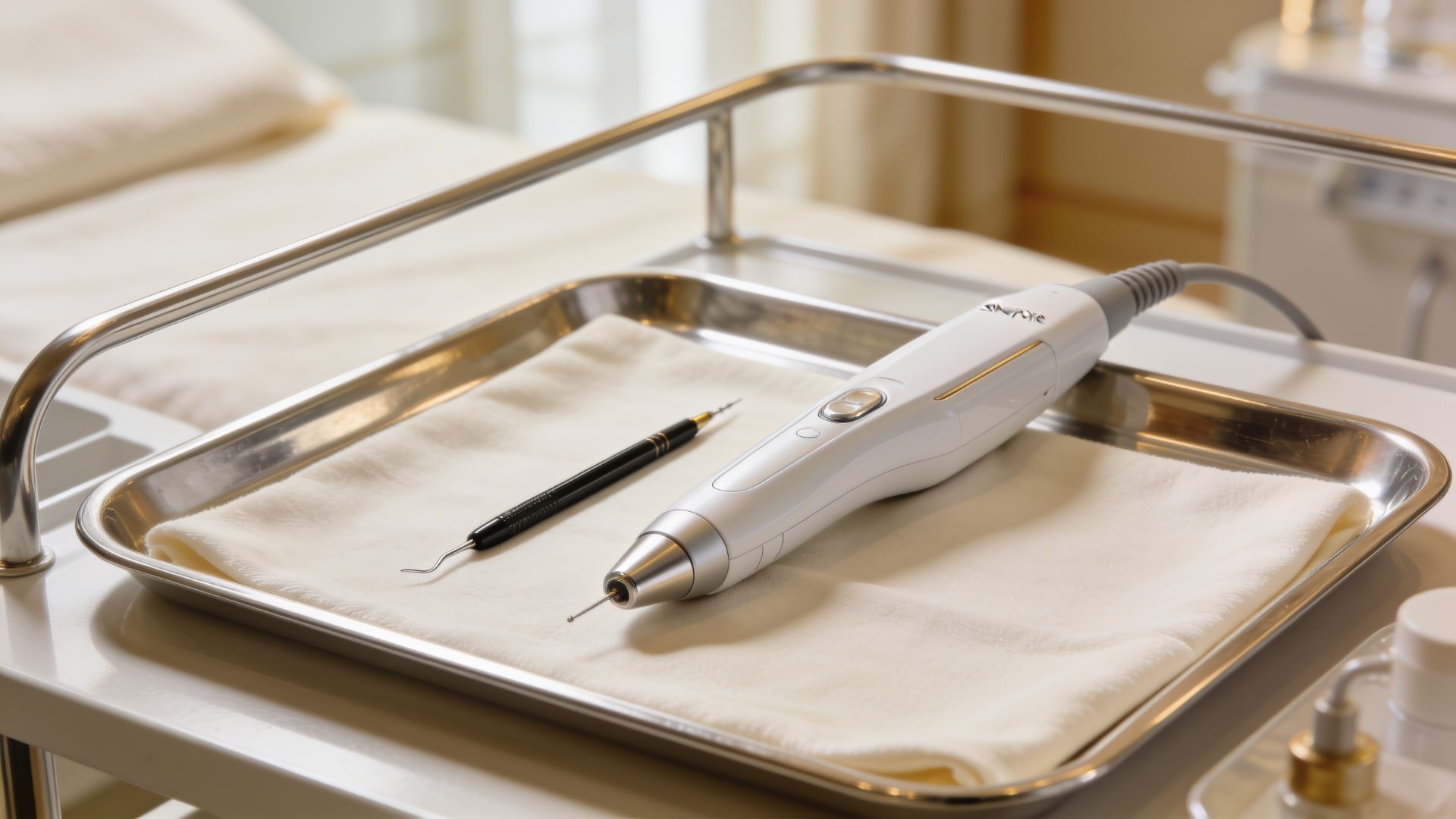
Because laser relies on the colour of the hair, it suits dark hair across larger areas. Electrolysis does not depend on pigment, so it can treat white, grey, red or very fair hairs, but only one by one. At IN Eternity Clinic laser hair removal is done on the Lutronic Clarity II, with 755 nm alexandrite or 1064 nm Nd:YAG chosen for your skin and hair.
| Laser hair removal | Electrolysis | |
|---|---|---|
| How it works | Light absorbed by hair pigment heats many follicles per pulse | A fine probe delivers current into a single follicle |
| Hair colour | Black or brown hair; not white, grey, red or very fair | Any colour, including white and grey |
| Skin type | Wavelength matched to skin: 755 nm for fairer, 1064 nm for darker or tanned | Not pigment-dependent; irritation and marks are still possible |
| Suits | Larger or dense areas: underarms, legs, bikini, back | Small areas and the last light or stray hairs |
| Speed | Seconds to minutes per area | Follicle by follicle; many visits for a large area |
| Typical course | About six to eight sessions, four to eight weeks apart | Many shorter visits over months |
| Feel | Quick snap and heat; cryogen cooling | A sting or heat at each follicle |
Which works better: laser or electrolysis?
For dark hair over an area such as the underarms, laser usually clears more hair in fewer, faster sessions. Electrolysis is slower, but works where laser cannot.
In a small study, 12 people had laser on one underarm and electrolysis on the other. Six months after the first treatment, average clearance was about 74 in 100 hairs on the laser side and 35 in 100 on the electrolysis side, and laser was 60 times faster and less painful [1]. An evidence review of controlled trials also found laser superior to shaving, waxing and electrolysis in the short term, while no method gave complete, persistent removal [2].
These are averages from studies, not a forecast for you. Hair colour, thickness, skin type and hormones all change the result, which is why your plan is set at assessment.
Which works on white, grey, blonde or red hair?
Electrolysis. Laser needs pigment in the hair to absorb the light, so white, grey, very fair and most red hairs are not expected to respond to any laser.
Laser hair removal rests on selective photothermolysis: light of a chosen wavelength is absorbed by a pigmented target and turned into heat, while the surrounding skin is spared [5]. In a hair follicle that target is melanin. Without it, there is nothing for the light to heat. If you have a mix of dark and greying hair, it is worth treating the dark hair while it still has colour; the grey hairs that remain are a job for electrolysis.
Fine, dark hair is different: it can respond to a short pulse, usually over more sessions. Is laser hair removal permanent? explains what to expect over a full course.
Which suits large areas, and which suits a few stray hairs?
Laser suits large or dense areas such as legs, back, bikini and underarms. Electrolysis suits a small number of hairs, especially light ones.
Each laser pulse covers a spot many follicles wide, so an underarm takes minutes. Electrolysis treats every follicle individually, which is precise but slow: in the head-to-head study above, laser was 60 times faster [1]. For a full leg or back that difference decides the choice. For a handful of white chin hairs or a few stray hairs on the brow line, electrolysis is often the more sensible tool.
Which hurts more, laser or electrolysis?
Most people find laser quicker and easier to tolerate; in a head-to-head study laser was less painful than electrolysis.
Laser feels like a quick snap with a flash of heat, and the Clarity II sprays a burst of cryogen onto the skin just before each pulse. Electrolysis is felt at every follicle, so a session is a long series of small stings. More on how laser feels, area by area, in does laser hair removal hurt?.
Which is safer for darker or tanned skin?
Both can be done in darker skin with care: laser at 1064 nm with conservative energy, and electrolysis with attention to irritation, because any skin injury can leave brown marks.
With laser, skin pigment competes with hair pigment for the light. That is why 1064 nm Nd:YAG is preferred for pigmented skin [4], and why conservative energy over more sessions improves safety in darker skin types [6]. With any method, darker skin is more prone to brown marks after irritation [7]. See darker skin tones.
“Laser needs colour in the hair. We use two wavelengths, 755 nm and 1064 nm, and vary the settings for coarse, medium and fine hair and for your skin. Hair with no colour left is better suited to electrolysis, and you are told that at assessment.”
Can you combine laser and electrolysis?
Yes, and it is a sensible order: laser first for the bulk of dark hair, then electrolysis for the few light or very fine hairs laser can no longer reach.
During a laser course, avoid anything that pulls hairs out, because the laser needs the root in place; electrolysis on the same area is usually left until the laser course has done what it can. Settings on the Clarity II are changed as the hair thins, so later sessions still reach finer hair. When what is left is too light or fine for any laser, Dr Sin Yong will say so. At that point he explains whether electrolysis is worth considering for the last hairs.
Laser or electrolysis: which should you choose?
Choose by hair colour and area first: dark hair over an area points to laser, while white, grey or very fair hair, or a few stray hairs, points to electrolysis.
- Dark hair, larger area: laser; it is faster and has the larger evidence base [3].
- White, grey, red or very fair hair: electrolysis.
- Mixed dark and grey: laser for the dark hair now, electrolysis for grey hairs later.
- A handful of hairs: either; electrolysis is often simpler.
- Hormonal or fast-spreading hair: a medical check first; see laser hair removal for PCOS.
Comparing laser technologies rather than methods? See IPL vs laser hair removal vs SHR.
What Dr Sin Yong looks for
- The colour of the hair in each area: dark hair suits laser, while white, grey or very fair hair does not.
- Your skin type and any recent tan, which decide 755 nm or 1064 nm and the energy.
- Whether the hair is coarse, medium or fine, which sets the pulse.
- Signs of a hormonal cause, such as new or fast-spreading hair on the chin or body.
- How many hairs remain late in a course, and whether they are better left to electrolysis.
General clinical observations used at consultation; they describe what is checked, not any individual result.
Frequently asked questions
Is electrolysis better than laser hair removal?
Not for most dark hair over an area: laser is faster and cleared more hair in a head-to-head study. Electrolysis is the better fit for white, grey, red or very fair hair, and for a few stray hairs.
Does electrolysis last longer than laser?
Electrolysis aims to destroy each treated follicle, one at a time; laser gives long-term reduction across an area, and some hormone-driven areas need maintenance. Which lasts better for you depends on your hair colour and area.
Can laser remove grey or white hair?
No. Grey and white hairs have too little pigment to absorb laser light. Treat dark hair while it still has colour, and use electrolysis for the grey hairs that remain.
How many sessions does electrolysis need compared with laser?
Laser usually needs about six to eight sessions per area. Electrolysis needs many shorter visits, because each follicle is treated individually and only growing hairs can be reached each time.
Can I have electrolysis between laser sessions?
It is usually left until after the laser course, on the hairs laser can no longer treat. During a laser course, avoid anything that removes hairs from the root, because the laser needs them in place.
Which is better for facial hair?
Dark facial hair on the upper lip, chin and jaw usually suits laser. A few white or very fair facial hairs suit electrolysis. See laser hair removal for the face.
What happens if laser stops working on my remaining hair?
Laser hair removal at IN Eternity Clinic uses the Lutronic Clarity II. If your remaining hair is too light for laser, Dr Sin Yong will tell you and explain whether electrolysis is worth considering.
How much does laser hair removal cost compared with electrolysis?
Both depend on the area and the number of sessions. At IN Eternity Clinic a S$120 consultation fee applies and is waived if you go ahead with any medical treatment; see laser hair removal cost.
Book an assessment
IN Eternity Clinic, 9 Scotts Road, #12-01 Pacific Plaza, Singapore 228210. By appointment with Medical Director Dr Sin Yong. Monday to Saturday, 11am to 8pm. WhatsApp or call +65 8815 3008. At IN Eternity Clinic a consultation fee applies, and it is waived if you go ahead with any medical treatment; the fee is S$120.
International KOL — CLASSYS · HIRONIC · DEKA · ALMA · FOTONA · LUTRONIC
References
- Görgü M, Aslan G, Aköz T, Erdoğan B. Comparison of alexandrite laser and electrolysis for hair removal. Dermatol Surg 2000;26(1):37-41. doi:10.1046/j.1524-4725.2000.99104.x
- Haedersdal M, Wulf HC. Evidence-based review of hair removal using lasers and light sources. J Eur Acad Dermatol Venereol 2006;20(1):9-20 (online 2005). doi:10.1111/j.1468-3083.2005.01327.x
- Haedersdal M, Gøtzsche PC. Laser and photoepilation for unwanted hair growth. Cochrane Database Syst Rev 2006;(4):CD004684. doi:10.1002/14651858.CD004684.pub2
- Gan SD, Graber EM. Laser hair removal: a review. Dermatol Surg 2013;39(6):823-838. doi:10.1111/dsu.12116
- Anderson RR, Parrish JA. Selective photothermolysis: precise microsurgery by selective absorption of pulsed radiation. Science 1983;220(4596):524-527. doi:10.1126/science.6836297
- Battle EF Jr, Hobbs LM. Laser-assisted hair removal for darker skin types. Dermatol Ther 2004;17(2):177-183. doi:10.1111/j.1396-0296.2004.04018.x
- Davis EC, Callender VD. Postinflammatory hyperpigmentation: a review of the epidemiology, clinical features, and treatment options in skin of color. J Clin Aesthet Dermatol 2010;3(7):20-31. PMID 20725554
These sources describe mechanisms and general evidence. They are not a promise of any individual result; suitability is decided at an in-person assessment.