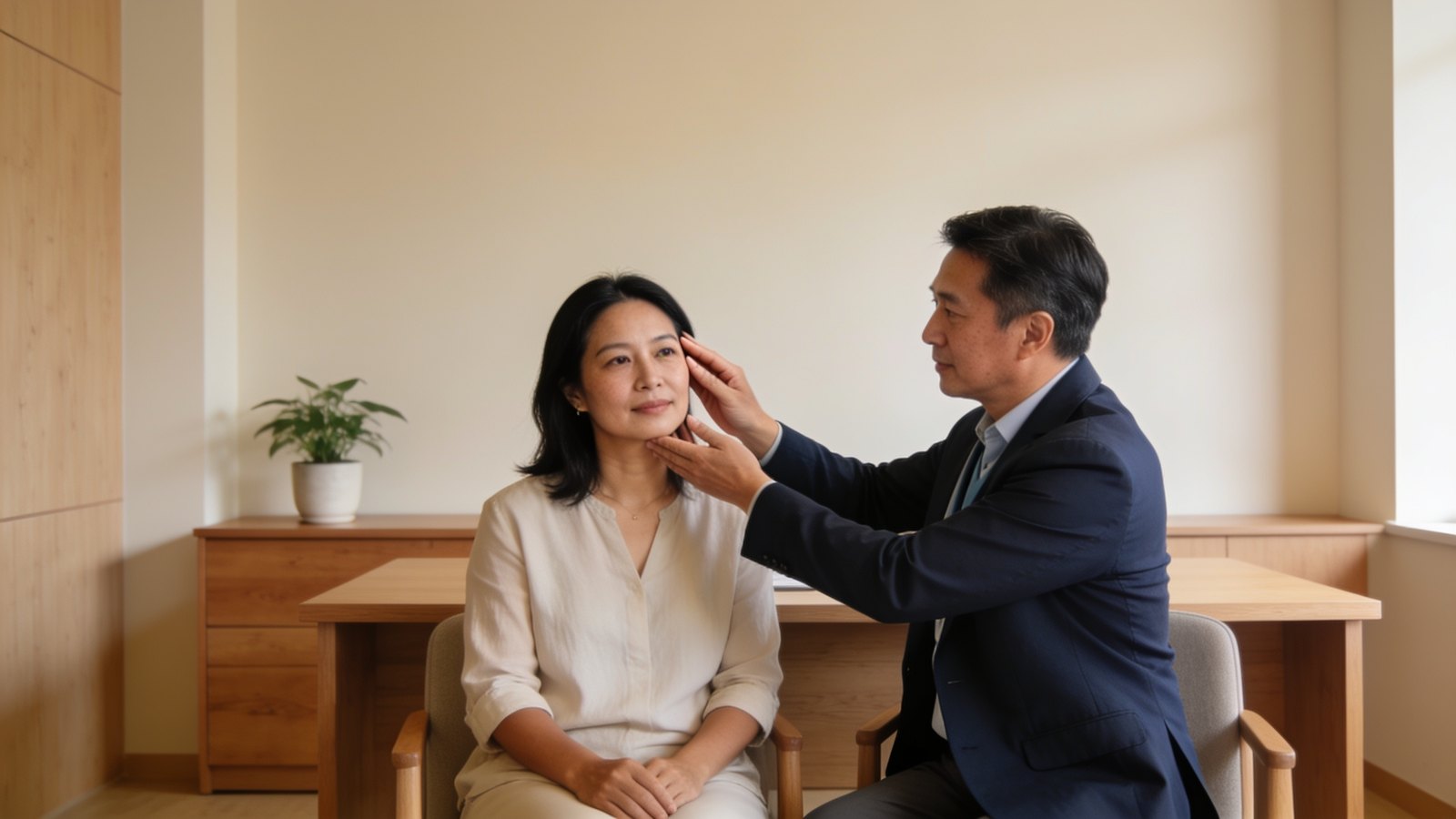
Sagging comes from skin, fat, ligaments or lost support, and each needs a different lift. At IN Eternity Clinic, Dr Sin Yong matches energy, threads or injectables to the way your face is ageing.
WhatsApp to Enquire →Key facts ↓Non-surgical face lifting works on different layers: focused ultrasound (HIFU, Ultherapy) and radiofrequency (Thermage, VF Lift – Vertical Facelift) tighten deeper tissue; Time Freeze Laser LCLR® tightens and reduces fat that drags a fuller face down; threads reposition tissue; fillers and collagen stimulators restore support. Lean and full faces need different choices. At IN Eternity Clinic, Dr Sin Yong decides by examining where your face has changed.
A face lifting treatment is any procedure that aims to move sagging tissue back up, or to make it look as if it has moved, without the incisions of a surgical facelift. Some heat the deeper layers so they contract and rebuild collagen; some place threads that hold tissue in a new position; some restore the support underneath with fillers or collagen stimulators. Each works on a different layer, so the right one depends on why your face is sagging.
Non-surgical treatments give a moderate change with little or no time off, and the change builds over weeks to months. A surgical facelift repositions deeper tissue and removes excess skin, gives a larger change and involves an operation and recovery. Many people in their thirties to fifties with early to moderate laxity are well served by non-surgical options; heavy skin excess usually is not. The wider facelift question is covered in facelift Singapore: the non-surgical guide.
Facial ageing happens in every layer at once, and in Asian faces it often shows first in the lower face and jawline.
A lean face that has lost volume and a full face with heavy jowls can show the same sag along the jaw, for opposite reasons. Treating both the same way is where many disappointing results come from.
| Option | How it works | Layer it targets | Typical recovery | Often suits |
|---|---|---|---|---|
| HIFU and Ultherapy | Focused ultrasound heats small points deep in tissue | SMAS and deep dermis | Redness or tenderness for a day or two | Early laxity, jawline, under-chin, faces with some fullness |
| Thermage FLX | Monopolar radiofrequency heats the dermis broadly | Dermis and fibrous septa | Usually mild redness | Crepey, loose skin, including the eyelids |
| VF Lift – Vertical Facelift | Volnewmer monopolar RF passed along vertical vectors | Dermis and fibrous structure | Mild redness | Lean or hollow faces wanting lift without losing volume |
| Time Freeze Laser LCLR® | Dual-wavelength laser for tightening plus point-zone fat reduction | Dermis and superficial fat | Mild swelling or redness | Fuller faces with jowls or fat obscuring the jawline |
| Thread lift | Absorbable threads with cogs reposition tissue | Subcutaneous tissue | Swelling or bruising for days | Moderate jowling, cheek descent |
| Collagen stimulators and fillers | Restore support or stimulate new collagen | Deep fat and bone level | Swelling or bruising for days | Volume loss, flattened cheeks, hollow temples |
The detailed comparison of three of these is in thread lift vs HIFU vs filler for sagging, and the energy devices are compared in Thermage vs Ultherapy and HIFU.

High-intensity focused ultrasound concentrates energy into tiny thermal points at set depths, including the SMAS, the layer a surgical facelift tightens. The heated points contract and then stimulate new collagen, so a mild lift and tightening build over two to three months. Ultherapy adds real-time ultrasound imaging so the practitioner can see the layers being treated; at IN Eternity Clinic, HIFU is also delivered on the CLASSYS Ultraformer MPT.
Focused ultrasound suits early laxity along the jaw, the under-chin and the brow. Because heat can also reduce fat, it is used more cautiously in very lean faces, where hollowing is a recognised side effect. Sensation is a deep prickling or ache over bone, managed with numbing and adjusted energy.
Thermage FLX uses monopolar radiofrequency to heat the dermis and fibrous septa more broadly than ultrasound. Collagen contracts and then remodels over months, which firms crepey skin and can soften laxity on the face, neck and eyelids. It tightens more than it lifts, so it is often paired with a lifting step.
VF Lift – Vertical Facelift is a protocol developed by Dr Sin Yong on the CLASSYS Volnewmer monopolar radiofrequency platform. Passes are planned along vertical vectors, against the direction in which that particular face has descended, rather than spread evenly. It is chosen particularly for lean or hollow faces, where the aim is lift and firmness without reducing volume that the face cannot spare. Change develops gradually over the following months, and the number of sessions is set at assessment.
Time Freeze Laser LCLR® (Laser Collagen Lipo Remodelling) is Dr Sin Yong’s dual-wavelength laser protocol. It works at two depths in one session: tightening and collagen stimulation in the dermis, and a sculpting mode that reduces superficial fat where it has sagged into the jowls, nasolabial folds or under the chin, or where it blurs the jawline. It suits fuller faces with mild to moderate laxity, where removing a little of what drags the face down helps the lift.
The same protocol is used to take away the excess where collagen stimulators such as Sculptra or Ellansé have left too much fullness. Recovery is usually mild swelling or redness. Whether it, VF Lift – Vertical Facelift or another option suits your face is decided by examining where the weight sits.
“Tightening is not lifting, and adding volume is not lifting either. The first question is which layer of the face has actually moved.”
A thread lift places absorbable threads with tiny cogs beneath the skin through fine entry points. The cogs grip the tissue so it can be repositioned upwards, and as the threads dissolve over months they leave a collagen response along their path. Threads give a more direct mechanical lift than energy treatments, which suits moderate jowling and cheek descent, at the cost of a few days of swelling, possible bruising and a period of tightness.
RVR ProLift (Refinement With Vertical Restoration) is Dr Sin Yong’s protocol in which biodegradable collagen-stimulating agents are placed along mapped vertical lifting vectors, aiming to reposition and support tissue rather than simply add volume. Thread complications and how they are avoided are covered in thread lift complications.
When the face sags because support has been lost, putting support back can lift the tissue above it. Hyaluronic acid filler placed deep over the cheekbone or along the jaw gives immediate structure; see cheek filler and dermal fillers. Collagen stimulators work more slowly, prompting the skin to make its own collagen over months: Sculptra (PLLA), Radiesse (CaHA), Ellansé (PCL) and Juvelook (PDLLA).
Injectables are placed with restraint. Adding volume to a face whose problem is laxity or heaviness can make it look larger and lower, not lifted. The difference between these products is in Sculptra vs Radiesse vs Ellansé.
The choice follows the face, not the device. As a broad guide:
For lifting around the eyes specifically, see eye lifting treatment. The wider picture of laxity and jowls is on sagging face treatment.

Non-surgical lifting has a ceiling. Heavy folds of excess skin on the neck, deep jowls that hang well below the jawline, and marked laxity after major weight loss are usually better addressed surgically, and repeated energy treatments will not substitute for removing skin. If that is the honest answer for your face, Dr Sin Yong will say so at assessment, and non-surgical treatment can still help skin quality before or after surgery.
Cost for non-surgical lifting depends on the treatment, the areas and how many are combined; the plan and its cost are set out after assessment, and the consultation fee is waived with any medical treatment.
There is no single answer, because faces sag for different reasons. Threads give a direct mechanical lift, focused ultrasound and radiofrequency tighten deeper layers, and injectables restore support. The right choice depends on whether your face is lean or full and which layer has descended.
It varies with the treatment and how your face ages. Energy treatments such as HIFU, Ultherapy or Thermage are commonly repeated every year or so, threads and collagen stimulators often around one to two years. Ageing continues, so maintenance is planned rather than assumed.
They work differently. Focused ultrasound targets deeper points including the SMAS and suits the jawline and under-chin; Thermage heats the dermis more broadly and suits crepey, loose skin. Many plans use one for lift and another for skin quality.
In lean faces, heat-based treatments that also reduce fat can deepen hollows, which is a recognised side effect. This is why lean and full faces are treated differently, and why VF Lift – Vertical Facelift is often chosen for lean faces.
VF Lift – Vertical Facelift is a protocol developed by Dr Sin Yong on the CLASSYS Volnewmer monopolar radiofrequency platform. Passes are planned along vertical vectors for each face, aiming to lift and firm without removing volume, which suits lean or hollow faces.
It depends on the method. Energy treatments usually leave mild redness or tenderness for a day or two. Threads and injectables can cause swelling or bruising for several days. Most people return to work quickly, and timing around events is planned at assessment.
There is no set age. Many people first consider them in their mid-thirties to forties when the jawline softens. Starting earlier is not required; treatment is decided by what is happening in your face, not by your birthday.

IN Eternity Clinic, 9 Scotts Road, #12-01 Pacific Plaza, Singapore 228210. By appointment with Medical Director Dr Sin Yong. Monday to Saturday, 11am to 8pm. WhatsApp or call +65 8815 3008. The consultation fee is waived with any medical treatment.
These sources describe mechanisms and general evidence. They are not a promise of any individual result; suitability is decided at an in-person assessment.