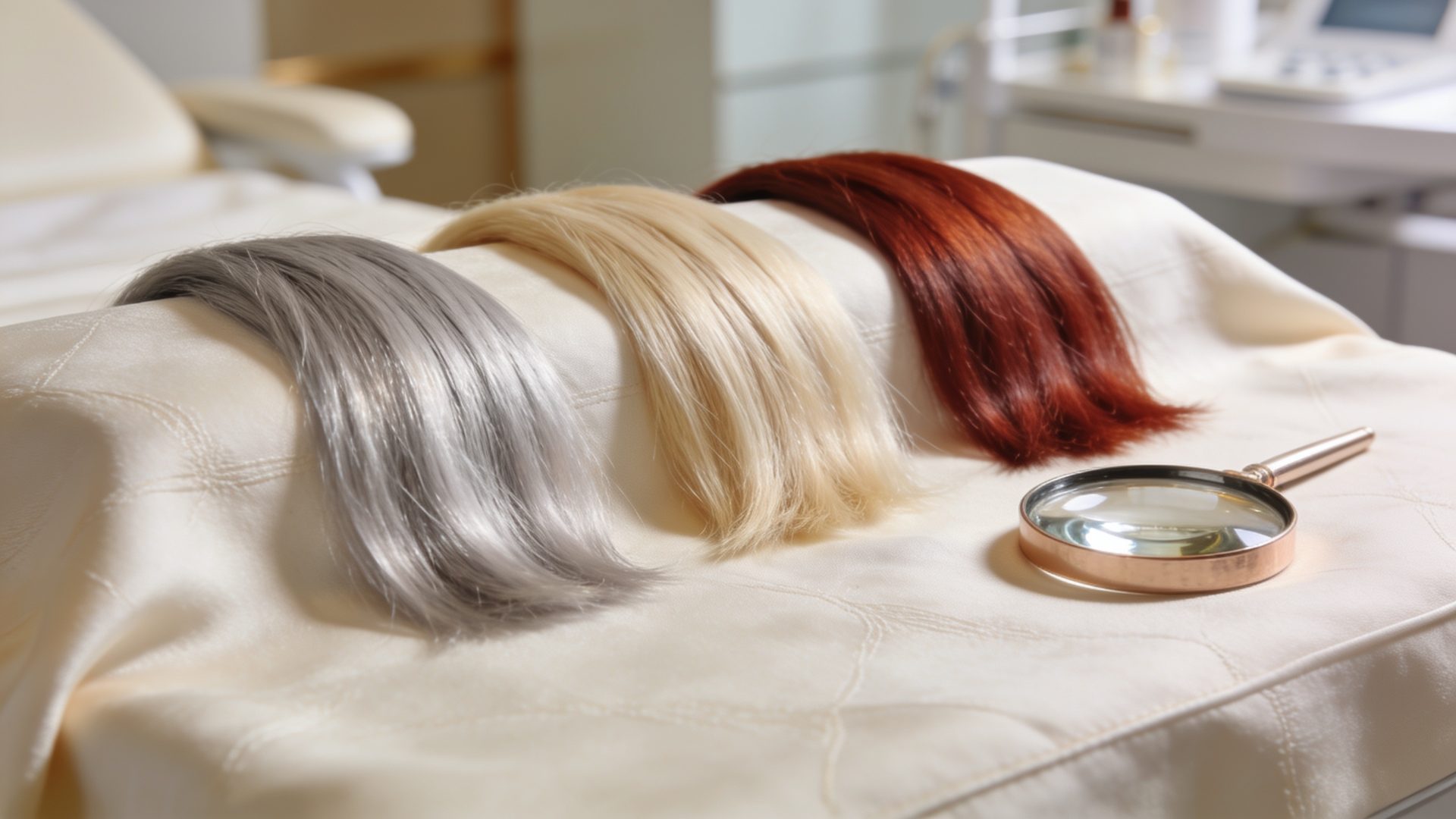
Laser Hair Removal on Grey, Blonde or Red Hair: What Works and What Does Not
Medical Director Dr Sin Yong explains why laser does not reliably treat grey, white, blonde or red hair, which light hair may still respond, and the alternatives.
WhatsApp to Enquire →Key facts ↓Laser hair removal on grey, blonde or red hair is not reliable, because lasers target dark pigment these hairs lack. Electrolysis does not need pigment. What does respond is set out in laser hair removal in Singapore.
- Light hair has less pigment: blonde, white and grey hair have less pigment, so the treatment is less effective [1].
- Red hair absorbs poorly: red hair contains a different type of melanin that does not absorb enough laser energy to damage the follicle [1].
- Adding pigment did not solve it: in a randomised trial on blond, white and grey hair, a melanin spray before diode laser reduced hair by about 14 in 100 at six months, against 10 in 100 with a saline spray; the authors called it disappointing [2].
- Electrolysis works one hair at a time: in underarm hair, alexandrite was about 60 times faster than electrolysis, which is why electrolysis suits small numbers of hairs [3].
- Lasers reduce, they do not remove every hair: an evidence review found no light system giving complete, persistent removal [4].
Does laser hair removal work on grey, blonde or red hair?
Not reliably. White and grey hair has no pigment to absorb the light, and blonde or red hair has too little of the pigment the laser targets.
Laser hair removal works by selective heating: the light passes through the skin and is absorbed by the dark pigment in the hair and its bulb, which heats and damages the follicle. Without that pigment, there is nothing in the hair to turn the light into heat. Blonde, white and grey hair have less pigment, so treatment is less effective [1]. Both wavelengths on the Lutronic Clarity II, 755 nm and 1064 nm, depend on that pigment.
| Hair colour | Pigment the laser can use | Expected response | Usual advice |
|---|---|---|---|
| Black or dark brown | Plenty | Good | Laser, wavelength set by skin type |
| Light brown or ash | Some | Partial, slower | Test area; 755 nm on fair skin; more sessions |
| Blonde | Very little | Poor or none | Usually not treated with laser |
| Red or strawberry blonde | A different, poorly absorbing pigment | Poor or none | Usually not treated with laser |
| Grey or white | None | None | Electrolysis or other methods |
| Mixed dark and grey | In the dark hairs only | Dark hairs respond; grey hairs remain | Treat while hair is pigmented |
Why does laser need dark hair?
Because the laser does not aim at the follicle directly. It aims at dark pigment, eumelanin, which carries the heat down to the root.
Hair colour comes from two kinds of melanin. Dark brown and black hair carries mainly eumelanin, which absorbs 755 nm and 1064 nm light well. Red and strawberry blonde hair carries mostly pheomelanin, a lighter pigment that absorbs poorly; grey and white hair has lost its pigment altogether. Turning the energy up does not solve this: with less pigment in the hair, more of the light is taken up by the skin instead, raising the risk of burns and marks.
Can light brown or ash blonde hair be treated?
Sometimes, partly. Light brown hair with some pigment can respond to 755 nm on fair skin, more slowly and less completely than dark hair.
A small test area shows whether the hair responds before a full course is planned. If it does, settings use a short pulse and the alexandrite wavelength, which melanin absorbs strongly, together with cryogen cooling [6]. On brown skin, the 1064 nm wavelength preferred for pigmented skin [5] is absorbed even less by light hair, so borderline hair on darker skin rarely responds. If the hair does not change after two or three sessions, continuing is unlikely to help, and you are told so. Fine light hair is covered in laser hair removal for fine hair.
Can dye or a melanin lotion make light hair respond?
Not in a useful way. A trial of melanin spray before laser on blond, white and grey hair gave only a small reduction.
In that randomised, double-blind trial, terminal hair fell by about 14 in 100 at six months with the melanin spray, against 10 in 100 with saline; the authors judged the result too small to justify the effort and cost [2]. Dyeing the hair is sometimes suggested online. The dye sits in the hair shaft above the skin, which is shaved before treatment, so it is not expected to carry heat to the root; it is not used at IN Eternity Clinic.
“White, grey, red and very fair hair is not expected to respond to the laser, and you are told that before any course is planned.”
What is electrolysis, and when is it the better option?
Electrolysis destroys each follicle with a fine probe and a small electric current. It does not depend on pigment, so it works on grey, white, blonde and red hair.
Because each hair is treated one at a time, it is slow: in a comparison on underarm hair, alexandrite laser was about 60 times faster than electrolysis and cleared more dark hair at six months [3]. That makes electrolysis practical for a small number of light hairs, such as a few white chin hairs or eyebrow shaping, and impractical for large areas. If electrolysis suits your hair better than laser, you are told so at assessment.
What other options are there for light hair?
Shaving, trimming, threading, waxing, depilatory creams and, for facial hair in women, a prescription cream that slows growth. Each is temporary.
| Method | Works on light hair? | How long it lasts | Notes |
|---|---|---|---|
| Electrolysis | Yes | Long-term, hair by hair | Slow; for small areas |
| Shaving or trimming | Yes | A day or two | Does not make hair thicker |
| Threading or plucking | Yes | A few weeks | Can irritate; ingrown hairs possible |
| Waxing | Yes | A few weeks | Avoid on irritated or thin skin |
| Depilatory cream | Yes | Days | Patch test first; can irritate |
If you also have dark hair elsewhere, laser can still be planned for those areas; see laser hair removal for pigmented hair.
Should you treat hair before it turns grey?
If greying has started, treating the hair while it still has pigment makes sense, because grey hairs will not respond later.
In mixed dark and grey areas, the dark hairs respond and the grey ones remain. People who expect to grey early, or who have scattered grey hairs on the chin or jaw, often plan laser for the dark hairs now and electrolysis for the few grey ones later. Hormone-driven hair on the face is covered in laser hair removal for the face and laser hair removal for PCOS. How long laser results last is in is laser hair removal permanent?.
What Dr Sin Yong looks for
- The colour of the hair in each area, under good light and magnification.
- Whether light brown hair has enough pigment to justify a test area.
- Mixed dark and grey hairs, and which of them laser can reach.
- Your skin type, which limits how far the energy can go on light hair.
- Whether electrolysis or another method would serve you better, so you do not pay for sessions that cannot help.
General clinical observations used at consultation; they describe what is checked, not any individual result.
Frequently asked questions
Does laser hair removal work on grey hair?
No. Grey and white hair has no pigment to absorb the light, so the follicle is not heated. Electrolysis is the usual alternative for a small number of grey hairs.
Does laser hair removal work on blonde hair?
Usually not. Blonde hair has very little pigment. Darker blonde or light brown hair may respond partly to 755 nm on fair skin, and a test area shows whether it does.
Does laser hair removal work on red hair?
Usually not. Red hair contains a different type of melanin that does not absorb enough laser energy to damage the follicle.
Can I dye my hair dark before laser?
It is not expected to help. The dye sits in the shaft above the skin, which is shaved before treatment, and does not carry heat to the root.
Is IPL better than laser for light hair?
No. IPL also depends on dark pigment in the hair, so it has the same limitation with grey, white, blonde and red hair.
Is electrolysis offered at IN Eternity Clinic?
No. If electrolysis suits your hair better than laser, you are told so at assessment, and laser can still be planned for any dark hair elsewhere.
Why did my laser stop working as my hair turned grey?
Grey hairs have no pigment for the laser to heat. The dark hairs still respond, so it can help to treat them while they are pigmented.
Book an assessment
IN Eternity Clinic, 9 Scotts Road, #12-01 Pacific Plaza, Singapore 228210. By appointment with Medical Director Dr Sin Yong. Monday to Saturday, 11am to 8pm. WhatsApp or call +65 8815 3008. At IN Eternity Clinic a consultation fee applies, and it is waived if you go ahead with any medical treatment; the fee is S$120.
International KOL — CLASSYS · HIRONIC · DEKA · ALMA · FOTONA · LUTRONIC
References
- Mayo Clinic Staff. Laser hair removal: about (tests and procedures). Mayo Clinic, 21 July 2026. Read 29 October 2026. mayoclinic.org
- Sand M, Bechara FG, Sand D, Altmeyer P, Hoffmann K. A randomized, controlled, double-blind study evaluating melanin-encapsulated liposomes as a chromophore for laser hair removal of blond, white, and gray hair. Ann Plast Surg 2007;58(5):551-554. doi:10.1097/01.sap.0000245129.53392.0e
- Görgü M, Aslan G, Aköz T, Erdoğan B. Comparison of alexandrite laser and electrolysis for hair removal. Dermatol Surg 2000;26(1):37-41. doi:10.1046/j.1524-4725.2000.99104.x
- Haedersdal M, Wulf HC. Evidence-based review of hair removal using lasers and light sources. J Eur Acad Dermatol Venereol 2006;20(1):9-20 (online 2005). doi:10.1111/j.1468-3083.2005.01327.x
- Gan SD, Graber EM. Laser hair removal: a review. Dermatol Surg 2013;39(6):823-838. doi:10.1111/dsu.12116
- Cynosure Lutronic. Clarity II, product page (cynosure.com). Read 28 October 2026. cynosure.com
These sources describe mechanisms and general evidence. They are not a promise of any individual result; suitability is decided at an in-person assessment.