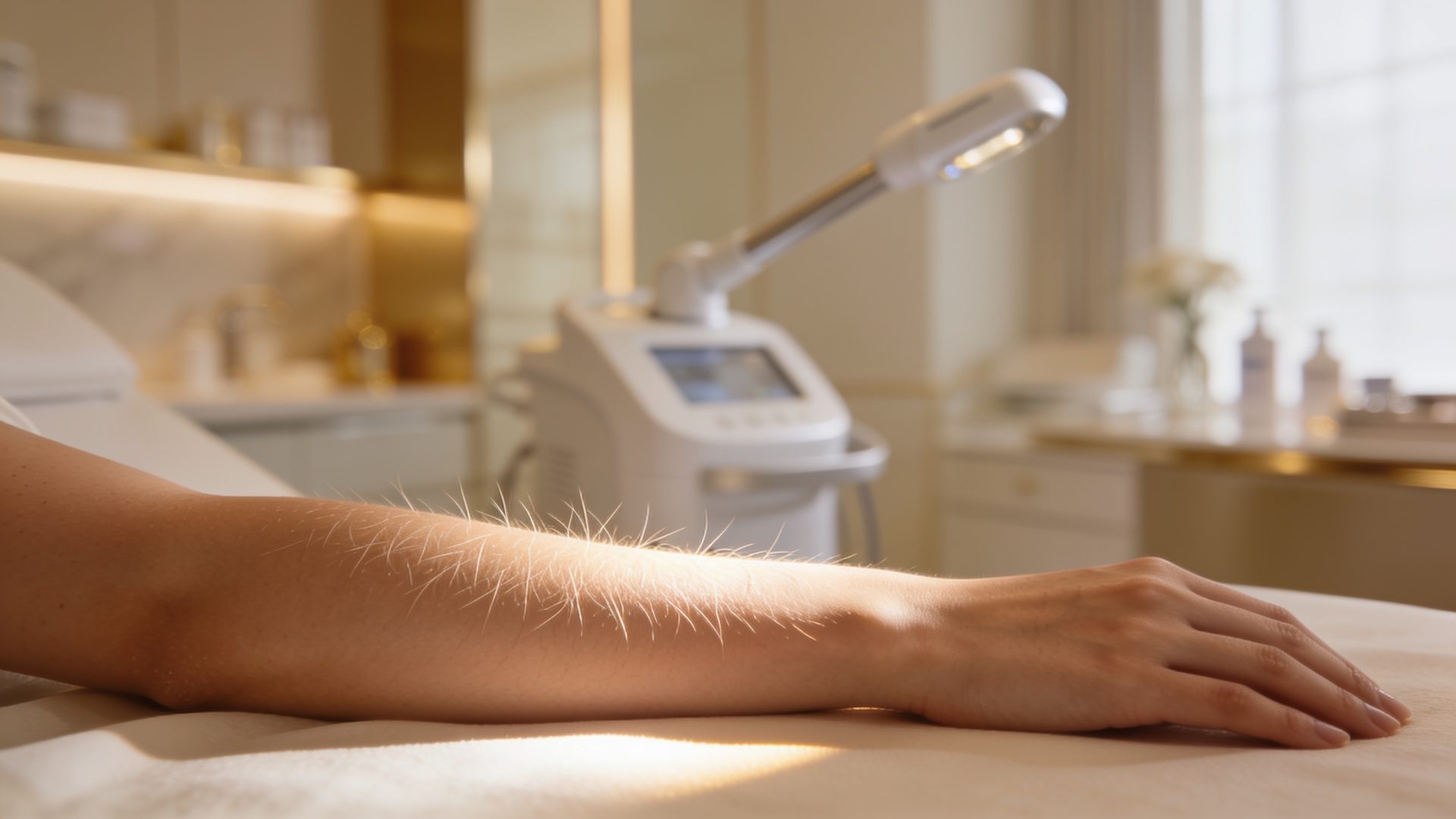
Laser Hair Removal for Fine Hair: Why It Is Harder and What Changes
Medical Director Dr Sin Yong explains why fine hair responds more slowly to laser, how the pulse and wavelength are adjusted, and when fine hair is better left alone.
WhatsApp to Enquire →Key facts ↓Laser hair removal for fine hair is harder because thin hairs hold little pigment and lose heat quickly. A short pulse and, where the skin allows, 755 nm help; see laser hair removal in Singapore for the full approach.
- A pulse for fine hair: the Clarity II offers a 1 ms pulse described for fine hair [1].
- Hair gets finer during a course: in 150 people treated with long-pulsed Nd:YAG, regrowth was slower and finer in about 79 in 100 [2].
- Paradoxical growth is uncommon: new or coarser hair near a treated area affects about 3 in 100 people, and is very rare outside the face and neck [3].
- Who is more at risk of it: paradoxical growth is reported more in skin types III to VI, with dark thick hair, or with hormonal conditions [4].
- Partial reduction is the realistic aim: an evidence review found lasting partial reduction after repeated treatment, and no system giving complete, persistent removal [6].
Does laser hair removal work on fine hair?
Fine dark hair can respond, more slowly and over more sessions. Very fine, light down usually does not respond, and is often better left alone.
Laser light is absorbed by the pigment in the hair and turned into heat at the follicle. A fine hair carries less pigment and has less mass to hold heat, so less of the follicle is damaged with each pulse. That is why the settings change for fine hair rather than staying the same as for coarse hair. The Lutronic Clarity II used at IN Eternity Clinic has two wavelengths and a short pulse for this purpose.
| Hair | Pigment | Holds heat | Usual approach | What to expect |
|---|---|---|---|---|
| Coarse, dark | High | Well | Longer pulse; 755 or 1064 nm by skin | Usually the quickest to respond |
| Medium | Moderate | Moderately | Standard pulse | Steady reduction over a course |
| Fine, dark | Lower | Poorly | Short pulse; 755 nm where the skin allows | Slower; often more sessions |
| Fine, light (vellus, peach fuzz) | Very low | Poorly | Usually not treated | Not expected to respond |
| White, grey, red or very fair | Little or none of the right pigment | n/a | Not treated with laser | Not expected to respond |
Why is fine hair harder to remove with laser?
Because a thin hair has little pigment to absorb the light and cools down quickly, so it reaches damaging temperature for less time.
A thick hair holds heat and suits a longer pulse; a thin hair loses heat fast, so the energy has to arrive in a shorter pulse to heat it before it cools. Skin pigment also competes for the light. Melanin absorbs 755 nm strongly, which helps a fine hair on lighter skin, while 1064 nm is preferred for pigmented skin [5] but is absorbed less by a thin, lightly pigmented hair. Fine hair on darker skin is therefore the slowest combination.
How do the settings change for fine hair?
The pulse is shortened, the wavelength moves towards 755 nm where the skin allows, and energy is set as high as the skin safely tolerates.
Dr Sin Yong uses two wavelengths and varied settings to target coarse, medium and fine hair and the skin type, aiming for clearance that is as thorough as each hair type allows. On fair to light olive skin, fine hair is usually treated at 755 nm with a short pulse. On brown skin, 1064 nm with a short pulse is used, accepting more sessions. The two wavelengths are not stacked on the same skin: in a randomised trial, combining them added pain and pigment change without extra benefit [7].
Why does hair get finer during a laser course?
Because follicles that are partly damaged often regrow a thinner, lighter hair. Late in a course, much of what is left is fine.
In a study of 150 people treated with long-pulsed Nd:YAG, regrowth was slower and finer in about 79 in 100 [2]. That is welcome, but it means a setting that suited session one under-treats session five, so the pulse is shortened as the hair thins. It is also why an evidence review describes lasting partial reduction rather than complete removal [6]. More in is laser hair removal permanent?.
“Coarse, medium and fine hair each need their own settings. Fine hair gets a shorter pulse and, where the skin allows, the 755 nm wavelength.”
Can laser make fine hair thicker?
Rarely. Paradoxical hair growth, finer hair turning coarser near a treated area, affects about 3 in 100 people, mostly on the face and neck.
A systematic review put the pooled figure at about 3 in 100 and found it very rare outside the face and neck [3]. It is reported more in skin types III to VI, with dark thick hair, and with hormonal conditions; heat too low to damage a follicle may stimulate it instead [4]. For that reason fine facial down is usually left alone, and treatment aims at the visible dark hairs. If it does happen, it is assessed and often treated further.
Which areas usually have fine hair?
The upper lip, cheeks and sideburns, the forearms and upper arms, and in many women the thighs. Hair left late in any course is often fine too.
Each area keeps its own plan: the face cycles faster and is often hormone-driven, while arm and thigh hair rests longer between growth phases. See laser hair removal for the face, arm laser hair removal and leg laser hair removal.
When is laser not the right tool for fine hair?
When the hair is very fine and light, white, grey, red or very fair. Laser needs dark pigment, and these hairs have too little of it.
Light, fine hair is not expected to respond to any laser, and you are told so before a course is planned. Electrolysis, which treats one follicle at a time without relying on pigment, is the usual alternative for a small number of light hairs; it is not offered at IN Eternity Clinic. More in laser hair removal on grey, blonde or red hair. Fine hair that appears quickly or turns coarse can have a hormonal cause, which is worth checking; see laser hair removal for PCOS.
What Dr Sin Yong looks for
- Whether each fine hair is dark enough to absorb the light, or too light to respond.
- Your skin type, which decides whether 755 nm can be used for the fine hair.
- Facial down that is better left untreated, because of the small risk of paradoxical growth.
- Signs that fine hair is hormone-driven, such as quick spread or coarsening.
- How the hair has changed since the last session, so the pulse is shortened when it thins.
General clinical observations used at consultation; they describe what is checked, not any individual result.
Frequently asked questions
Does laser hair removal work on peach fuzz?
Usually not. Peach fuzz is very fine and light, with too little pigment to absorb the light, and treating it carries a small risk of stimulating coarser hair. It is usually left alone.
Why is there still fine hair after six sessions?
Hair regrows finer and lighter during a course, so what remains late on is often fine. The pulse is shortened to reach it; some very light hairs may not respond at all.
Is alexandrite or Nd:YAG used for fine hair?
Alexandrite at 755 nm suits fine hair on fair to light olive skin, because melanin absorbs it strongly. On brown skin, Nd:YAG at 1064 nm with a short pulse is used, over more sessions.
Can fine hair grow back thicker after laser?
Rarely. Paradoxical growth affects about 3 in 100 people, mostly on the face and neck. It is reported more with darker skin types and hormonal conditions.
Does fine hair need more sessions?
Usually yes. Fine hair absorbs and holds less heat, so each session achieves less; the count is reviewed at every visit rather than fixed in advance.
Is electrolysis an option for fine or light hair?
Yes, for a small number of light hairs, because electrolysis does not rely on pigment. It treats one follicle at a time, so it is slow for large areas. It is not offered at IN Eternity Clinic.
Does shaving make fine hair grow back coarser?
No. Shaving cuts the hair at the surface, which can make the regrowing tip feel blunt, but it does not change the follicle. Shaving between laser sessions is fine.
Book an assessment
IN Eternity Clinic, 9 Scotts Road, #12-01 Pacific Plaza, Singapore 228210. By appointment with Medical Director Dr Sin Yong. Monday to Saturday, 11am to 8pm. WhatsApp or call +65 8815 3008. At IN Eternity Clinic a consultation fee applies, and it is waived if you go ahead with any medical treatment; the fee is S$120.
International KOL — CLASSYS · HIRONIC · DEKA · ALMA · FOTONA · LUTRONIC
References
- Cynosure Lutronic. Clarity II, product page (cynosure.com). Read 28 October 2026. cynosure.com
- Rao K, Sankar TK. Long-pulsed Nd:YAG laser-assisted hair removal in Fitzpatrick skin types IV–VI. Lasers Med Sci 2011. PMID 21519944
- Snast I, et al. Paradoxical hypertrichosis associated with laser and light therapy for hair removal: a systematic review and meta-analysis. Am J Clin Dermatol 2021. PMID 34057666
- Desai S, Mahmoud BH, Bhatia AC, Hamzavi IH. Paradoxical hypertrichosis after laser therapy: a review. Dermatol Surg 2010;36(3):291-298. doi:10.1111/j.1524-4725.2009.01433.x
- Gan SD, Graber EM. Laser hair removal: a review. Dermatol Surg 2013;39(6):823-838. doi:10.1111/dsu.12116
- Haedersdal M, Wulf HC. Evidence-based review of hair removal using lasers and light sources. J Eur Acad Dermatol Venereol 2006;20(1):9-20 (online 2005). doi:10.1111/j.1468-3083.2005.01327.x
- Davoudi SM, Behnia F, Gorouhi F, et al. Comparison of long-pulsed alexandrite and Nd:YAG lasers, individually and in combination, for leg hair reduction: an assessor-blinded, randomized trial with 18 months of follow-up. Arch Dermatol 2008;144(10):1323-1327. doi:10.1001/archderm.144.10.1323
These sources describe mechanisms and general evidence. They are not a promise of any individual result; suitability is decided at an in-person assessment.