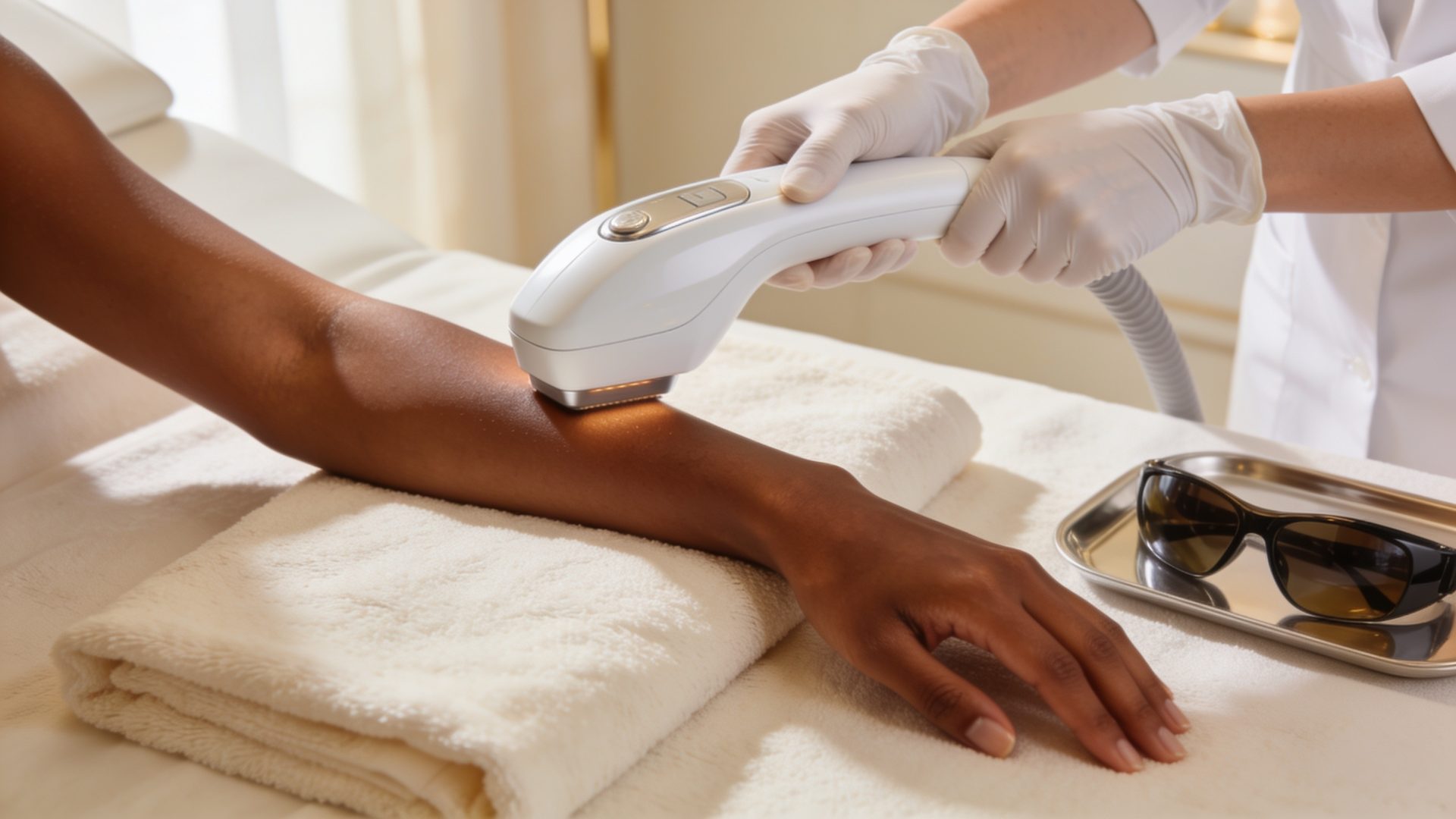
Laser Hair Removal for Dark Skin and Tanned Skin
Medical Director Dr Sin Yong explains how laser hair removal is planned for brown, deep brown and tanned skin: wavelength, settings, sessions and pigment risk.
WhatsApp to Enquire →Key facts ↓Laser hair removal for dark skin usually uses 1064 nm Nd:YAG, which skin pigment absorbs less, with longer pulses, cooling and conservative energy. It is how laser hair removal in Singapore is planned for brown and deep brown skin.
- Nd:YAG for pigmented skin: a review of hair removal lasers concluded that the longer 1,064 nm wavelength is the preferred system for pigmented skin [1].
- Conservative energy, more sessions: conservative energy spread over multiple sessions improves safety and results in darker skin types [2].
- Studied in skin types IV to VI: in 150 people treated with long-pulsed Nd:YAG, 86 in 100 had no complications, and every complication was temporary [3].
- Asian skin responds over a course: in 144 Asian patients with skin types III to V, hair reduction rose from about 32 in 100 after one treatment to 55 in 100 after three [4].
- Pigment marks are the main risk: post-inflammatory hyperpigmentation is more frequent and more severe in darker skin [5].
Can you have laser hair removal on dark skin?
Yes. Brown and deep brown skin, Fitzpatrick types IV to VI, is usually treated with 1064 nm Nd:YAG, longer pulses, cooling and conservative energy, often over a few more sessions.
Laser light is absorbed by melanin, the pigment in both the hair and the skin. In darker skin the skin competes with the hair for the light, so the wavelength, pulse and energy are chosen to heat the follicle while sparing the surface. At IN Eternity Clinic this is done on the Lutronic Clarity II, which carries both 755 nm alexandrite and 1064 nm Nd:YAG, so the wavelength can follow your skin and any tan. The table shows the usual starting points; your own settings are confirmed at assessment.
| Skin type | Typical description | Usual wavelength | How the settings change |
|---|---|---|---|
| I to III | Fair to light olive; burns, then tans | 755 nm alexandrite | Pulse matched to the hair |
| IV | Olive to light brown; tans easily | 755 nm with care, or 1064 nm by area | Test spot if borderline |
| V | Brown; rarely burns | 1064 nm Nd:YAG | Long pulse, extra cooling, energy raised step by step |
| VI | Deep brown; does not burn | 1064 nm Nd:YAG | Longest pulses, conservative energy, often more sessions |
| Any type, freshly tanned | Recent sun or self-tan | Session moved, or 1064 nm at lower energy | Skin type re-checked that day |
Why does dark skin need a different laser?
Because the pigment in darker skin absorbs light too. A wavelength that the skin absorbs strongly heats the surface as well as the hair.
Melanin absorbs 755 nm strongly, which makes alexandrite efficient on fair skin but riskier on brown skin. The longer 1064 nm wavelength is absorbed less by the skin and reaches deeper, to the hair bulb, which is why it is preferred for pigmented skin [1]. A longer pulse delivers the heat more slowly, so the thin pigmented surface layer can shed heat while the thicker hair keeps it. Cryogen spray cools the skin just before each pulse [7]. Earlier lasers suited mainly fair skin; long-pulsed Nd:YAG with better cooling made darker skin feasible with greater safety [2].
What do Fitzpatrick skin types IV to VI mean?
They describe how skin reacts to sun: type IV tans easily and seldom burns, type V rarely burns, and type VI is deep brown and does not burn.
The Fitzpatrick scale runs from I, very fair skin that always burns, to VI. Skin in Singapore commonly ranges from type III to type V, and one person can sit a step higher in summer or after a holiday. The type decides the starting wavelength and energy, so it is checked at the first visit and again before each session. If you are unsure of yours, the skin type quiz gives a first idea; the assessment confirms it.
Is laser hair removal safe for dark skin?
It can be, with the right wavelength and conservative settings. The main risks are temporary darker or lighter patches and, uncommonly, blisters.
In a study of 150 people with skin types IV to VI treated with long-pulsed Nd:YAG, 86 in 100 had no complications, all complications were temporary, and darkening of the skin was the commonest [3]. A review of adverse effects found pigment change in up to 19 in 100 people with shorter-wavelength lasers, particularly in darker skin, against 2 to 3 in 100 with Nd:YAG [8]. Darker skin is more prone to brown marks after any irritation [5], so energy is raised step by step rather than started high. Both wavelengths are not fired over the same skin: in a randomised trial in skin types III and IV, combining them added pain and pigment change without extra benefit [6]. More about pigment marks is in post-inflammatory pigmentation and darker skin tones.
“Brown and deep brown skin is usually treated at 1064 nm, with the settings varied for the hair and for the skin type, and the skin is checked again at every visit.”
How many sessions does dark skin need?
Often a few more than fair skin, because energy stays conservative. In one Nd:YAG study the average was about nine treatments, ranging from 4 to 22.
That study of skin types IV to VI recorded a mean of 8.9 treatments [3]. Dark, coarse hair still responds well, because the hair carries plenty of pigment; it is fine hair on dark skin that is slowest. In Asian skin, results build over a course: hair reduction rose from about 32 in 100 after one alexandrite treatment to 55 in 100 after three [4]. Session counts by area are on how many laser hair removal sessions.
Can you have laser hair removal with a tan?
Not over a fresh tan. The session is moved, or done at 1064 nm with lower energy, because tanned skin absorbs more of the light.
A beach weekend or a run of outdoor sport can shift your skin up a type for several weeks. Book sessions before a holiday rather than straight after, wear sunscreen on treated areas that see sun, and avoid self-tan during the course, since it also sits on the skin as pigment. Tell the clinic about recent sun when you arrive; the skin is checked before any pulse. Aftercare for Singapore weather is in laser hair removal aftercare.
Are diode lasers or IPL suitable for dark skin?
A diode laser sits between alexandrite and Nd:YAG. IPL is a broadband flash rather than a laser, and needs more caution in darker skin.
Nd:YAG remains the wavelength most often chosen for pigmented skin [1]. The comparisons are set out, without ranking, in diode laser vs alexandrite vs Nd:YAG hair removal and IPL vs laser hair removal vs SHR. Whatever the device, the questions are the same: which wavelength is used on your skin, who sets the energy, and whether a test spot is done when the skin is borderline.
Can laser help razor bumps and dark marks on darker skin?
Often. Razor bumps are common with coarse, curly hair on darker skin, and reducing the hair usually means fewer bumps and fewer new marks.
A review of hair removal in darker skin notes that people with razor bumps (pseudofolliculitis barbae) can be treated with long-pulsed lasers [2]. Existing dark marks fade separately and may need their own treatment. See laser hair removal for ingrown hairs and, for darkening under the arms, dark underarms.
What Dr Sin Yong looks for
- Your Fitzpatrick skin type today, and any recent or planned sun, which decide 1064 nm or 755 nm and the energy.
- Whether the hair in each area is coarse, medium or fine, which sets the pulse.
- Any history of dark marks after spots, shaving or past laser, which calls for a test spot and slower steps.
- Razor bumps, ingrown hairs or active inflammation that should settle first.
- How your skin responded last time, so the energy rises only when the skin allows.
General clinical observations used at consultation; they describe what is checked, not any individual result.
Frequently asked questions
Does laser hair removal work on dark skin?
Yes. Dark, coarse hair responds well on brown and deep brown skin when 1064 nm Nd:YAG is used with longer pulses, cooling and conservative energy. It may take a few more sessions than on fair skin.
Which laser is used for dark skin?
Usually the 1064 nm Nd:YAG wavelength, which skin pigment absorbs less. On the Lutronic Clarity II the same handpiece also offers 755 nm alexandrite for lighter skin.
Will laser hair removal darken my skin?
It can cause temporary darker patches, especially after a tan or with settings too high for the skin. Conservative energy, cooling and sun protection lower the risk; most marks fade over weeks to months.
Is a test spot needed for dark skin?
Often, when the skin type is borderline or there is a history of dark marks. A small area is treated and checked before the full area is done.
How long should I wait after a tan?
Usually until the tan has faded, which can take a few weeks. Your skin is checked on the day; if it is still tanned, the session is moved or the energy lowered.
Does laser hair removal help dark underarms?
It can help when the darkness comes from shaving irritation and stubble under the skin. Other causes, such as friction or skin conditions, need their own assessment.
How many sessions does dark skin need?
Often eight or more per area. One study in skin types IV to VI recorded an average of about nine Nd:YAG treatments, with a wide range between people.
Book an assessment
IN Eternity Clinic, 9 Scotts Road, #12-01 Pacific Plaza, Singapore 228210. By appointment with Medical Director Dr Sin Yong. Monday to Saturday, 11am to 8pm. WhatsApp or call +65 8815 3008. At IN Eternity Clinic a consultation fee applies, and it is waived if you go ahead with any medical treatment; the fee is S$120.
International KOL — CLASSYS · HIRONIC · DEKA · ALMA · FOTONA · LUTRONIC
References
- Gan SD, Graber EM. Laser hair removal: a review. Dermatol Surg 2013;39(6):823-838. doi:10.1111/dsu.12116
- Battle EF Jr, Hobbs LM. Laser-assisted hair removal for darker skin types. Dermatol Ther 2004;17(2):177-183. doi:10.1111/j.1396-0296.2004.04018.x
- Rao K, Sankar TK. Long-pulsed Nd:YAG laser-assisted hair removal in Fitzpatrick skin types IV–VI. Lasers Med Sci 2011. PMID 21519944
- Hussain M, Polnikorn N, Goldberg DJ. Laser-assisted hair removal in Asian skin: efficacy, complications, and the effect of single versus multiple treatments. Dermatol Surg 2003;29(3):249-254. PMID 12614418
- Davis EC, Callender VD. Postinflammatory hyperpigmentation: a review of the epidemiology, clinical features, and treatment options in skin of color. J Clin Aesthet Dermatol 2010;3(7):20-31. PMID 20725554
- Davoudi SM, Behnia F, Gorouhi F, et al. Comparison of long-pulsed alexandrite and Nd:YAG lasers, individually and in combination, for leg hair reduction: an assessor-blinded, randomized trial with 18 months of follow-up. Arch Dermatol 2008;144(10):1323-1327. doi:10.1001/archderm.144.10.1323
- Cynosure Lutronic. Clarity II, product page (cynosure.com). Read 28 October 2026. cynosure.com
- Lim SPR, Lanigan SW. A review of the adverse effects of laser hair removal. Lasers Med Sci 2006;21(3):121-125. doi:10.1007/s10103-006-0377-y
These sources describe mechanisms and general evidence. They are not a promise of any individual result; suitability is decided at an in-person assessment.