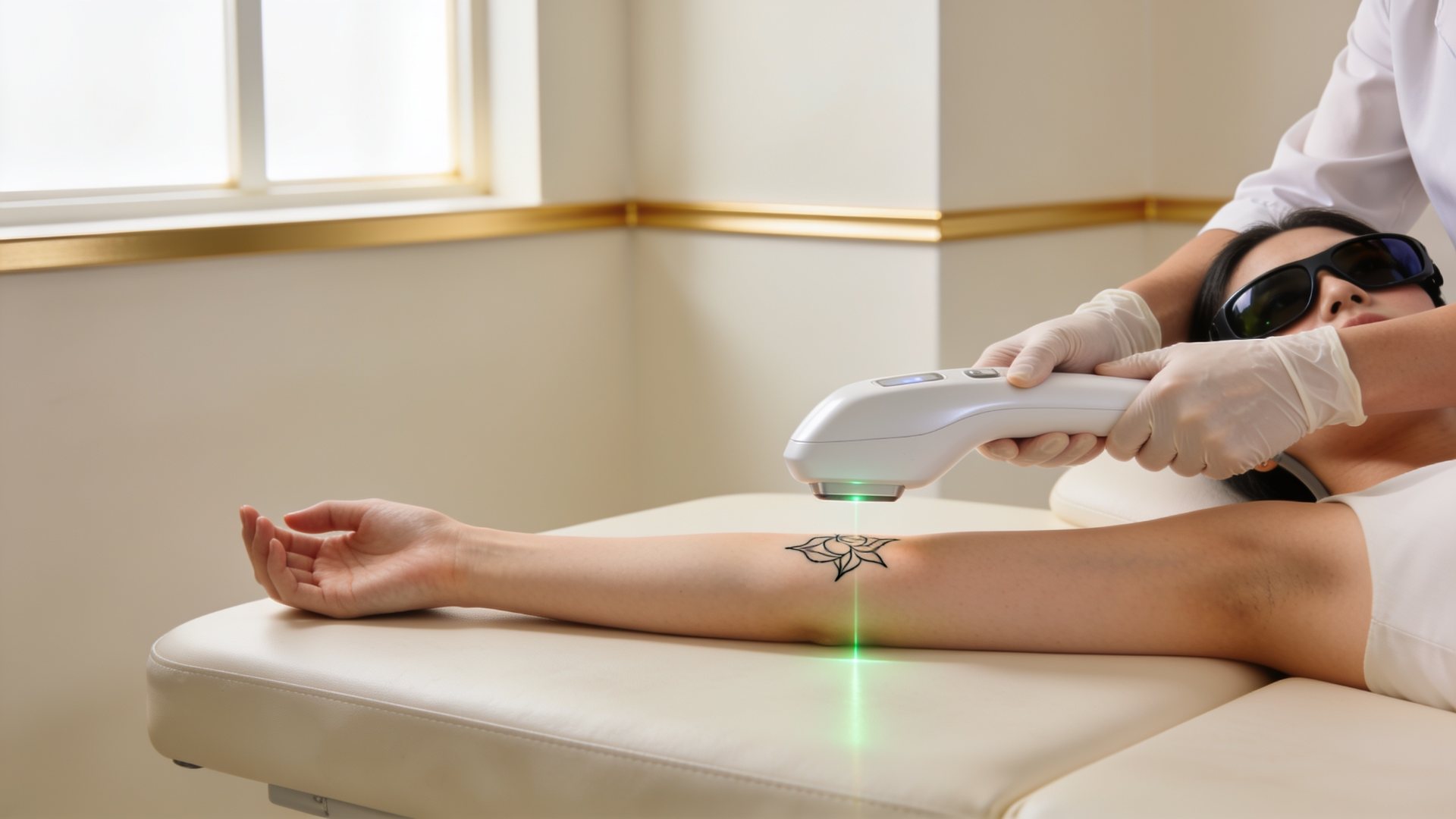
Eyebrow Tattoo Removal Singapore: Brows, Eyeliner and Lip Tattoos
Medical Director Dr Sin Yong explains how eyebrow embroidery, microblading, eyeliner and lip tattoos are lightened with pico and Q-switched laser on the DEKA TORO and Fotona StarWalker.
WhatsApp to Enquire →Key facts ↓Eyebrow tattoo removal uses picosecond or Q-switched laser to break up brow pigment over a few sessions. Cosmetic inks can darken, so a test area comes first; brow hairs usually grow back, and eyeliner needs an internal eye shield.
- Brows and liner can respond in a few sessions: in a chart review of 76 people treated for eyebrow or eyeliner tattoos, the mean number of laser treatments was 2.8, with a range of 1 to 12 [1].
- Hair is usually spared: in the same review, treated brow and lash hairs sometimes turned white for a while, and no case of lasting hair loss was recorded [1].
- Hidden colours can appear: pigment that had not been visible, such as red, orange or yellow, was unmasked in 20 of the 76 patients, and responded to a matched wavelength [1].
- Darkening happens: in 98 people treated for complex eyebrow tattoos with a picosecond laser, 18 showed an immediate grey discolouration; an average of three sessions reached their goal [2].
- Cosmetic pigments contain metal oxides: a survey of 1,352 eyebrow and eyeliner clients in Japan lists iron oxide and titanium dioxide among the pigments used [5], the compounds linked to laser darkening [3].
Can eyebrow embroidery be removed with laser?
Usually, yes. Laser can lighten or remove most eyebrow embroidery, microblading and powder brows over a few sessions, though some inks darken first and a faint shadow can remain.
Eyebrow tattoo removal is a narrower job than tattoo removal in Singapore on the body: the area is small and the ink sits fairly superficially, but the pigments are different and the eye is close by. At IN Eternity Clinic it is planned by Medical Director Dr Sin Yong and carried out on two picosecond and Q-switched platforms, the DEKA TORO and the Fotona StarWalker PQX. Dr Sin Yong calls tattoo removal on the TORO “T2 laser tattoo removal”; the platform offers a 785 nm picosecond wavelength and Q-switched 532 and 1064 nm.
| Eyebrow tattoo removal in brief | |
|---|---|
| What it treats | Eyebrow embroidery, microblading, powder and ombre brows, eyeliner and lip liner or lip blush |
| How it works | Very short laser pulses break pigment into fragments that the body clears over the following weeks |
| Before the full treatment | A small test area on cosmetic, brown, red, flesh-toned or white ink, reviewed weeks later |
| Typical course | Often a few sessions for brows, spaced weeks apart; more for dense, layered or warm-toned pigment |
| Hair | Brow hairs can whiten for a while; lasting hair loss is uncommon |
| Eyeliner | Only with an internal eye shield placed over the eye itself, and only if suitable at assessment |
Why is eyebrow tattoo removal different from body tattoo removal?
Brow pigments are often brown, reddish or skin-toned blends containing metal oxides, which can turn darker under a laser instead of fading.
Body tattoos are mostly carbon-black or bright organic colours. Cosmetic pigments are mixed to look natural on skin, and many contain iron oxide for brown and red tones and titanium dioxide to lighten or warm a shade [5]. A short laser pulse can change these compounds chemically, turning a brown brow grey or black in seconds. Darkening of this kind was described as a complication of Q-switched and other short-pulse lasers in 1993, in five cases where cosmetic ink darkened immediately and, in two, would not clear with further laser [3]. It is most often reported in cosmetic, flesh-toned, white, peach and pink inks [4].
Brow ink also tends to sit shallower than a professional body tattoo, hairs grow through it, and the eye is close by; lasers for microblading and cosmetic pigment have been reviewed as a subject of their own [6].
Microblading, embroidery, powder brows: does the type matter?
Yes. Microblading leaves fine, shallow strokes; powder and ombre brows leave denser shading; old embroidery may be layered or changed colour. Each fades at a different pace.
| Brow work | How the pigment sits | What it usually means for removal |
|---|---|---|
| Microblading (hair strokes) | Fine lines, fairly shallow | Often fewer sessions; strokes may fade unevenly |
| Powder or ombre brows | Denser shading across the brow | More pigment to clear; edges and the tail often go first |
| Old embroidery that has turned blue-grey or red | Carbon or iron oxide pigment that has shifted colour | Wavelength chosen for the colour you see now; the hidden colour may appear later |
| Corrected or covered brows | Two or more layers, sometimes a skin-toned cover pigment | More sessions; skin-toned cover pigment needs a test area |
| Warm brown or red-brown blends | Iron oxide rich | Higher chance of darkening; tested first |
More sessions were needed when warm pigments such as red, orange or yellow were visible in a picosecond series of 98 eyebrow tattoos [2]. If you want to compare the techniques themselves, see microblading vs powder brows vs ombre.
Is pico laser better for eyebrow tattoo removal?
Pico laser is often chosen for brows because its shorter pulses break pigment finely with less heat, but Q-switched pulses still suit some inks. The pigment decides.
Picosecond pulses are about a thousand times shorter than nanosecond Q-switched pulses, so more of their effect is a pressure wave and less is heat. A systematic review of 77 studies rated the evidence for picosecond tattoo removal at level I [7]. In published eyebrow and eyeliner series, picosecond devices were used for most cases [1,2].
Still, the pigment decides: black and grey can respond to 1064 nm on either pulse length, red-brown tones may need 532 nm, and blue-grey old embroidery may suit the TORO’s 785 nm picosecond wavelength. The comparison of picosecond platforms sets out the devices.
Why is a test area done before eyebrow tattoo removal?
Because some brow pigments darken when hit. A small test area shows how your ink reacts before the whole brow is treated, so a surprise stays small.
- Assessment and photographs. The brow is examined in daylight-balanced light and photographed; the pigment colour, layering and any earlier corrections are noted.
- Test area. A few pulses are placed on a small, discreet part of the brow, usually the tail or inner edge, at conservative settings.
- Review in several weeks. Lightening, darkening, any colour that has been unmasked and how the skin healed are checked against the first photographs.
- Plan. If the ink lightened, the full brow follows. If it darkened, the darkened ink is usually treated further as a dark pigment, and the course may be longer; occasionally a different approach is discussed.
In one picosecond series, immediate grey discolouration did not significantly change the number of sessions needed [2], but that is a group finding and is not assumed for your brow. Darkened ink that does not respond to laser may need another method, so the test is worth the wait [3].
Will my eyebrows grow back after laser tattoo removal?
In most cases, yes. Brow hairs can turn white or fall out for a while after treatment, but lasting hair loss is uncommon in published series.
Tattoo removal lasers are aimed at ink, not at hair follicles, and the pulses are far shorter than those used for laser hair removal. Hairs within the treated area can still absorb some energy and may whiten or singe. In a chart review of 76 eyebrow and eyeliner removals, hairs sometimes turned white temporarily, which brow tint can camouflage, and no case of lasting hair loss was recorded; a gel was applied to brow and lash hairs to protect them [1].
If your own brows are sparse, they are photographed first so any change can be judged fairly.
Can eyeliner tattoos be removed safely?
Sometimes, but only with an internal eye shield. Laser near the lash line can injure the eye, so goggles alone are not enough for eyeliner.
An internal (corneal) shield is a smooth metal shell placed over the eye itself after anaesthetic drops, so the laser cannot reach the eye through the closed lid. In the New York series, corneal metal eye shields were always used for eyeliner tattoos [1]. Whether eyeliner removal is suitable for you, and how the eye will be protected, is decided at assessment; if the liner sits within the lash line or the eye cannot be shielded comfortably, Dr Sin Yong may advise against laser.
Tell the clinic about contact lenses, dry eye, recent eye surgery or other eye conditions.
Can lip blush or lip liner tattoos be removed?
Often, but lip pigments are frequently red, pink or skin-toned blends, which are among the inks most likely to darken, so lips are always test-treated first.
Lip blush and lip liner use warm iron oxide pigments to tint the lip or sharpen its border. Darkening is most often reported in pink, peach and flesh-toned inks [4], so a small test area on the lip line comes first. If you get cold sores, say so, because laser on the lip can trigger an outbreak.
If the aim is a softer colour rather than full removal, or natural lip pigment is part of the picture, see lip blush and lip pigmentation.
How many sessions does eyebrow tattoo removal take?
Often two to four for brows, sometimes more. Dense, layered, warm-toned or corrected pigment takes longer, and eyeliner varies widely.
Two published series give a sense of scale. Across 76 eyebrow and eyeliner cases the mean was 2.8 treatments, ranging from 1 to 12 [1]; in 98 complex eyebrow tattoos treated with picosecond laser, an average of three sessions reached the patient’s goal [2]. Those are group averages, not a forecast for your brow.
| Visit | What happens | Typical gap |
|---|---|---|
| Consultation | Pigment assessed, photographs, goals agreed (full removal, lightening or reshaping) | — |
| Test area | A few pulses on a small part of the brow, liner or lip | Review after several weeks |
| Session 1 | Whole brow treated if the test lightened | Usually six to eight weeks or more |
| Sessions 2 to 4 | Remaining strokes, edges and any unmasked colours targeted | Usually six to eight weeks or more |
| Further sessions | Only if pigment keeps responding; otherwise the plan is reviewed | Agreed at review |
| Redo | New embroidery once the skin has healed fully and settled | Usually several weeks after the last session |
Lightening before a redo may need fewer sessions; the factors are explained in how many tattoo removal sessions a tattoo needs.
What does recovery look like after eyebrow tattoo removal?
Expect redness, swelling and pinpoint bleeding on the day, then light crusting for about a week. Most people return to work the next day.
Swelling can reach the upper eyelid for a day or two; sleep with the head raised, leave any small blisters and crusts alone, and keep make-up and tint off the brow until it has healed. Day-by-day advice is in tattoo removal aftercare.
“Brow ink is not tattoo ink in a smaller shape. Some of it is designed to look like skin, and skin-coloured ink can turn grey under a laser. That is why the first session on a brow is a question, not a treatment.”
Can I get new eyebrow embroidery after removal?
Yes, once the skin has healed fully and the old pigment is light enough for the new shape. Many people fade old brows specifically to start again.
A new brow is easier to place well on a clean or lightened base: the artist is not working around an old arch, a drifted tail or a colour that has turned. IN Eternity Clinic also offers eyebrow embroidery, done by our embroidery specialist rather than a doctor, so the doctor-led laser lightening and the redo can be planned together and timed so the skin has recovered first. The other brow, lip and scalp pigmentation options are compared on cosmetic tattooing at IN Eternity.
Are there non-laser ways to remove eyebrow embroidery?
Some studios offer saline or other “non-laser” lightening, which draws pigment out through a fresh wound. Evidence is limited, and it can scar.
Results vary and repeated wounding of the brow can leave texture change. Excision is rarely suitable because it moves the brow line. Laser is the usual medical approach because it leaves the skin surface intact [7].
What Dr Sin Yong looks for
- The colour of the pigment today, and whether it has shifted to blue-grey, red or orange since it was done.
- Signs of a skin-toned or white cover pigment, or an earlier correction layered over it.
- Whether it is microblading, powder shading or older embroidery.
- Your natural brow hairs: density, shape and where they would sit after removal.
- For eyeliner: lash line position, eye health and whether an internal eye shield can be placed comfortably.
- What you want: full removal, lightening for a redo, or reshaping one part.
General clinical observations used at consultation; they describe what is checked, not any individual result.
When should you contact the clinic after eyebrow tattoo removal?
Contact the clinic the same day for spreading redness, increasing pain, pus or fever, or any eye pain, change in vision or light sensitivity after eyeliner treatment.
- Redness that spreads beyond the brow, or swelling that is worse after day three rather than better.
- Pus, a yellow crust that keeps growing, or fever: possible infection.
- Eye pain, blurred vision, a gritty feeling that does not settle, or sensitivity to light after eyeliner or brow treatment: call straight away, and go to an emergency department or call 995 if vision is affected and you cannot reach the clinic.
- Itching, raised or bumpy skin in the remaining pigment weeks later, which can be an ink reaction.
IN Eternity Clinic patients: WhatsApp or call +65 8815 3008.
Frequently asked questions
How much does eyebrow tattoo removal cost in Singapore?
It depends on how much pigment there is, whether a test area is needed, how many sessions are likely and whether eyeliner or lips are included. An estimate is given after assessment. The tattoo removal cost guide explains the factors.
Does eyebrow tattoo removal hurt?
It feels like quick, hot snaps on the brow. Numbing cream is used beforehand and cooling during treatment; brows are small, so sessions are short. Eyeliner treatment uses anaesthetic eye drops before the shield is placed. See is tattoo removal painful.
Can microblading be removed completely?
Often it can be lightened until it is hard to see, but complete removal is not always possible. Warm pigments, cover pigments and older layered work can leave a faint shadow.
Why did my eyebrow tattoo turn darker after laser?
Some cosmetic inks contain iron oxide or titanium dioxide, which can change colour when hit by a short laser pulse. This is why a test area is done first. Darkened ink is usually treated further as a dark pigment, so the course becomes longer.
How soon after eyebrow embroidery can I have it removed?
Usually once the embroidery has healed fully and settled, which takes several weeks; very fresh work is not treated. If you are unhappy straight after a procedure, have it assessed first so the plan is based on the settled colour.
Is laser eyeliner tattoo removal safe?
It can be done safely with an internal eye shield placed over the eye, but it is not suitable for everyone. Suitability and eye protection are decided at assessment.
Will laser make my brow hair fall out?
Hairs can whiten or shed for a while, but lasting hair loss is uncommon in published series. Your brows are photographed beforehand so any change can be judged.
Book an assessment
IN Eternity Clinic, 9 Scotts Road, #12-01 Pacific Plaza, Singapore 228210. By appointment with Medical Director Dr Sin Yong. Monday to Saturday, 11am to 8pm. WhatsApp or call +65 8815 3008. At IN Eternity Clinic a consultation fee applies, and it is waived if you go ahead with any medical treatment; the fee is S$120.
International KOL — CLASSYS · HIRONIC · DEKA · ALMA · FOTONA · LUTRONIC
References
- Kream E, Jairath N, Bajaj S, Orbuch D, Wang JV, Geronemus RG. Laser removal of eyeliner and eyebrow tattoos: chart review, experiences, and learnings. J Clin Aesthet Dermatol 2023;16(11):47-49. jcadonline.com
- Menozzi-Smarrito C, Smarrito S. Laser removal of cosmetic eyebrow tattoos with a picosecond laser. Dermato 2023;3(3):182-192. doi:10.3390/dermato3030014
- Anderson RR, Geronemus R, Kilmer SL, Farinelli W, Fitzpatrick RE. Cosmetic tattoo ink darkening: a complication of Q-switched and other short-pulse laser treatment. Arch Dermatol 1993;129(8):1010-1014. doi:10.1001/archderm.1993.01680290082012
- Kirby W, Kaur RR, Desai A. Paradoxical darkening and removal of pink tattoo ink. J Cosmet Dermatol 2010;9(2):149-151. doi:10.1111/j.1473-2165.2010.00493.x
- Tomita S, Mori K, Yamazaki H, et al. Complications of permanent makeup procedures for the eyebrow and eyeline. Medicine (Baltimore) 2021;100(18):e25755. doi:10.1097/MD.0000000000025755
- Geisler AN, Eber A, Kim K, et al. Lasers for the treatment of eyebrow microblading and cosmetic tattoo pigment: a review of the literature. Lasers Med Sci 2023;38(1):256. doi:10.1007/s10103-023-03921-z
- Wu DC, Goldman MP, Wat H, Chan HHL. A systematic review of picosecond laser in dermatology: evidence and recommendations. Lasers Surg Med 2021;53(1):9-49 (online 2020). doi:10.1002/lsm.23244
These sources describe mechanisms and general evidence. They are not a promise of any individual result; suitability is decided at an in-person assessment.