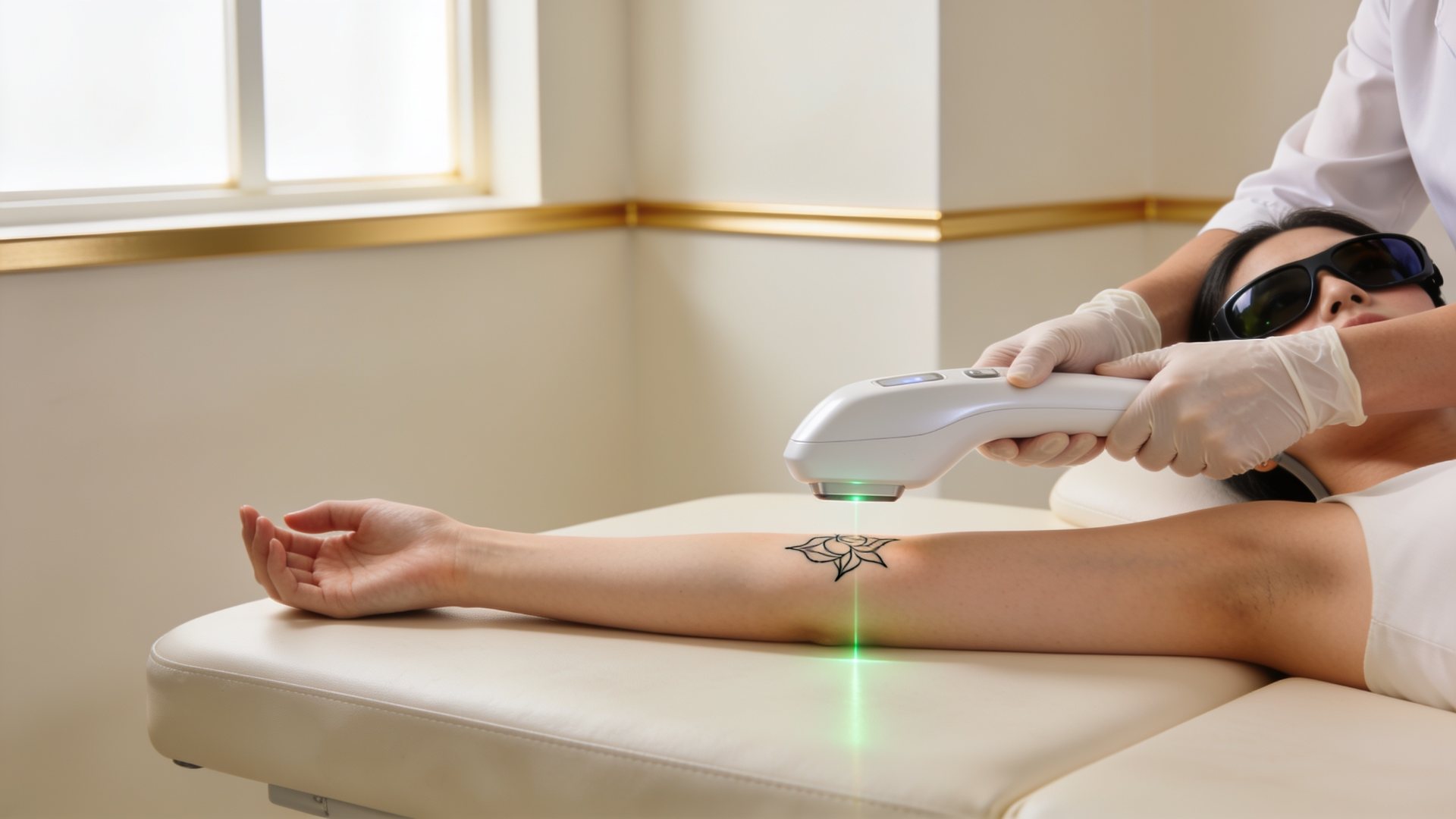
Tattoo Fading for a Cover-Up: Sessions, Timing and Your Artist
Medical Director Dr Sin Yong explains when to fade a tattoo before a cover-up, how many sessions it usually takes, and how to time it with your tattoo artist.
WhatsApp to Enquire →Key facts ↓Fading an old tattoo before a cover-up gives your artist lighter skin to work on, so the new design need not be darker or bigger. It usually takes fewer laser sessions than full removal, timed with your artist.
- A cover-up adds to any later removal: the Kirby-Desai scale gives layering, such as a cover-up over an older tattoo, 2 extra points, roughly two more sessions if the new tattoo is ever removed [1].
- Density slows fading: in 352 people treated with Q-switched lasers, high colour density and colours other than black and red were linked with a slower response [2].
- Hidden colours can surface: as darker ink cleared in 76 cosmetic tattoos, previously unseen red, orange, yellow, green or blue appeared in 20 [3], something an artist needs to know about.
- Picosecond may need fewer visits: a 2026 review of 130 tattoo patients reported a median of 3 picosecond sessions against 4 Q-switched [4].
- Regret is common and personal: 196 people seeking tattoo removal at four dermatology clinics most often linked it to distancing themselves from the past, negative comments and clothing problems [5].
Should you fade a tattoo with laser before a cover-up?
Often, yes. A few fading sessions can turn a design that would need a heavy, dark cover into one that suits a lighter or finer new tattoo.
A cover-up does not remove the old tattoo; it hides it under new ink. Dark old ink limits the new design to darker colours, denser shading and a larger size. Fading lightens the old ink first, so the artist has more freedom. Fading uses the same lasers and the same assessment as tattoo removal in Singapore, but with a different finish line. At IN Eternity Clinic it is done on the DEKA TORO, for Dr Sin Yong’s “T2 laser tattoo removal”, or the Fotona StarWalker PQX. If you are still deciding between removal and a cover-up, see tattoo regret.
Why do tattoo artists ask for laser fading first?
Because new ink cannot hide old ink that is darker than it. Fading widens the colours, size and detail the new design can use.
| Without fading | With fading first |
|---|---|
| New design usually darker than the old one | Lighter colours and negative space become possible |
| Often larger, to swallow the old outline | Size can follow the design, not the old tattoo |
| Dense shading to block old lines | Finer line work and softer shading |
| Old lines can show through as the new tattoo ages | Less old ink left to show through |
| Limited choice of placement | The new design can shift position |
Some artists also ask for one part to be faded, such as a thick outline, a solid black block or a lettering line, rather than the whole tattoo.
When can you go straight to a cover-up without laser?
When the old tattoo is small, light or faded, and the new design is darker and larger anyway. Your artist is the person to judge that.
Old, soft, blurred tattoos and light grey work can often be covered directly. Heavy black, dense tribal work, bold lettering and anything you want to cover with a lighter or finer design usually benefit from fading. If the artist is unsure, a single session and a review is a reasonable way to find out how readily the ink moves.
How many laser sessions do you need before a cover-up?
Usually fewer than for full removal; often two to four, sometimes more for dense black or colour. The target is “light enough”, agreed with your artist.
| Old tattoo | New design | Fading usually needed |
|---|---|---|
| Light, faded amateur tattoo | Darker and larger | Possibly none, or one or two sessions |
| Professional black line work | Similar size, darker | A few sessions on the lines |
| Dense black shading or tribal | Lighter or finer | Several sessions; sometimes close to removal |
| Colour tattoo | Lighter or different colours | Several sessions; some colours resist |
| Lettering or names | Any | Targeted fading of the letters |
The same factors that slow full removal slow fading: colour, density, location, skin type and layering [1,2]. The details are in how many tattoo removal sessions a tattoo needs, and colour behaviour in colour tattoo removal.
How long after laser fading can you get a cover-up tattoo?
Once the skin has fully healed and looks and feels normal, commonly at least six to eight weeks after the last session. Your artist makes the final call.
The skin must have closed, settled in colour and regained its normal texture; tattooing over skin that is still inflamed or recovering can heal unevenly. Ink fragments from the last session are also still being cleared for some weeks, so the tattoo may look lighter at eight weeks than at four. If the skin was left lighter or darker, or any area became raised, the new tattoo waits and the artist sees it first.
How do you plan fading with your tattoo artist?
Start with the artist, then the clinic: agree the new design and which parts need fading, then plan sessions and review progress with photos the artist can see.
| Step | Who | What happens |
|---|---|---|
| 1. Design idea | You and your artist | Sketch the new design over the old tattoo; mark the parts that must be lighter |
| 2. Assessment | Dr Sin Yong | Ink, colours, skin type and any scarring checked; a fading estimate given |
| 3. Fading sessions | Clinic | Targeted at the agreed areas, usually at least six to eight weeks apart |
| 4. Progress check | You, clinic and artist | Photographs at each review, shared with your artist if you wish |
| 5. Artist sign-off | Artist | Decides the old ink is light enough |
| 6. Healing gap | You | Skin left to settle fully before tattooing |
| 7. Cover-up | Artist | New tattoo placed on healed, lightened skin |
What happens at a tattoo fading session?
The same as a removal session: assessment and photographs, numbing if needed, eye protection, then laser passes over the areas agreed for fading.
- Review: the tattoo is photographed in the same light each time, and the areas your artist marked are checked.
- Comfort: numbing cream can be applied beforehand for larger areas, and cold air cooling runs throughout; see is tattoo removal painful.
- Laser: the wavelength is matched to each colour; only the agreed parts may be treated if partial fading is the plan.
- Straight after: the ink frosts white for a few minutes, then the area is red and warm; ointment and a dressing go on.
- Next steps: the healing pattern is the same as for full removal, and the next session is booked once the skin has settled.
Is fading for a cover-up different in darker skin?
The approach is the same, but settings are more conservative and gaps can be longer, because darker skin is more prone to light or dark patches after laser.
Skin type is one of the Kirby-Desai factors, and darker skin adds points [1]. A light or dark patch left by laser can show under a light cover-up, so it is allowed to fade before tattooing. Sun protection between sessions matters in Singapore, both for the fading and for the new tattoo that follows.
“Fading for a cover-up is the one tattoo removal where the finish line is set by someone else. I aim for the point at which your artist says “I can work with that”, not for clear skin.”
Does laser fading affect the new tattoo?
Not usually, if the skin has healed fully. Healthy, healed skin takes new ink normally; scarring from the old tattoo or from poor healing can affect it.
Fading does not leave anything in the skin that interferes with new ink. Texture already in the old tattoo, or a scar from an opened blister, can make new ink sit unevenly, which is why aftercare matters [6]; see tattoo removal aftercare. Two things are worth knowing for the future: colours hidden under dark ink can surface as it fades [3], and a cover-up is a layered tattoo, which makes any later removal slower [1].
What Dr Sin Yong looks for
- Which parts of the old tattoo the new design actually needs lightened.
- Dense black, lettering or outlines that will show through the new work.
- Colours that resist laser, such as yellow or light blue, where the new design is light.
- Texture or scarring already in the old tattoo that could affect new ink.
- Your skin type and sun exposure, which change how fast fading can safely go.
- Your artist’s timeline, so the last session and the healing gap fit the booking.
General clinical observations used at consultation; they describe what is checked, not any individual result.
Frequently asked questions
How many sessions to fade a tattoo for a cover-up?
Often two to four, sometimes more for dense black or colour, and occasionally none for a light tattoo. The target is set with your artist and reviewed at each visit.
How long after laser can I get a cover-up tattoo?
Once the skin has fully healed and settled, commonly at least six to eight weeks after the last session. Your artist should see the skin first.
Do I need to remove the whole tattoo before a cover-up?
No. Often only the darkest parts, such as outlines, lettering or solid blocks, need fading. Partial fading is planned around the new design.
Will the old tattoo show through the cover-up?
It can if the old ink is darker than the new design or is placed where the new tattoo is light. Fading reduces that risk.
Is fading cheaper than full removal?
It usually needs fewer sessions, so it usually costs less overall. The tattoo removal cost guide explains how estimates are made.
Can a cover-up tattoo be removed later?
Often it can be faded, but layered tattoos carry more ink at different depths and usually need more sessions than a single tattoo.
Can colour tattoos be faded for a cover-up?
Yes, though some colours fade slowly. If the new design is light over an old yellow or light blue, discuss it with your artist and the doctor first.
Book an assessment
IN Eternity Clinic, 9 Scotts Road, #12-01 Pacific Plaza, Singapore 228210. By appointment with Medical Director Dr Sin Yong. Monday to Saturday, 11am to 8pm. WhatsApp or call +65 8815 3008. At IN Eternity Clinic a consultation fee applies, and it is waived if you go ahead with any medical treatment; the fee is S$120.
International KOL — CLASSYS · HIRONIC · DEKA · ALMA · FOTONA · LUTRONIC
References
- Kirby W, Desai A, Desai T, Kartono F, Patel G. The Kirby-Desai scale: a proposed scale to assess tattoo-removal treatments. J Clin Aesthet Dermatol 2009;2(3):32-37. PMC2923953
- Bencini PL, et al. Removal of tattoos by Q-switched laser: variables influencing outcome and sequelae in a large cohort of treated patients. Arch Dermatol 2012;148(12):1364-1369. doi:10.1001/archdermatol.2012.2946
- Kream E, Jairath N, Bajaj S, Orbuch D, Wang JV, Geronemus RG. Laser removal of eyeliner and eyebrow tattoos: chart review, experiences, and learnings. J Clin Aesthet Dermatol 2023;16(11):47-49. jcadonline.com
- Chen et al. Q-switched 1064-nm laser versus picosecond 1064-nm laser in tattoo removal […]. J Cosmet Dermatol 2026. doi:10.1111/jocd.71098
- Armstrong ML, et al. Motivation for contemporary tattoo removal: a shift in identity. Arch Dermatol 2008;144(7):879-884. doi:10.1001/archderm.144.7.879
- Ho SG, Goh CL. Laser tattoo removal: a clinical update. J Cutan Aesthet Surg 2015;8(1):9-15. doi:10.4103/0974-2077.155066
These sources describe mechanisms and general evidence. They are not a promise of any individual result; suitability is decided at an in-person assessment.