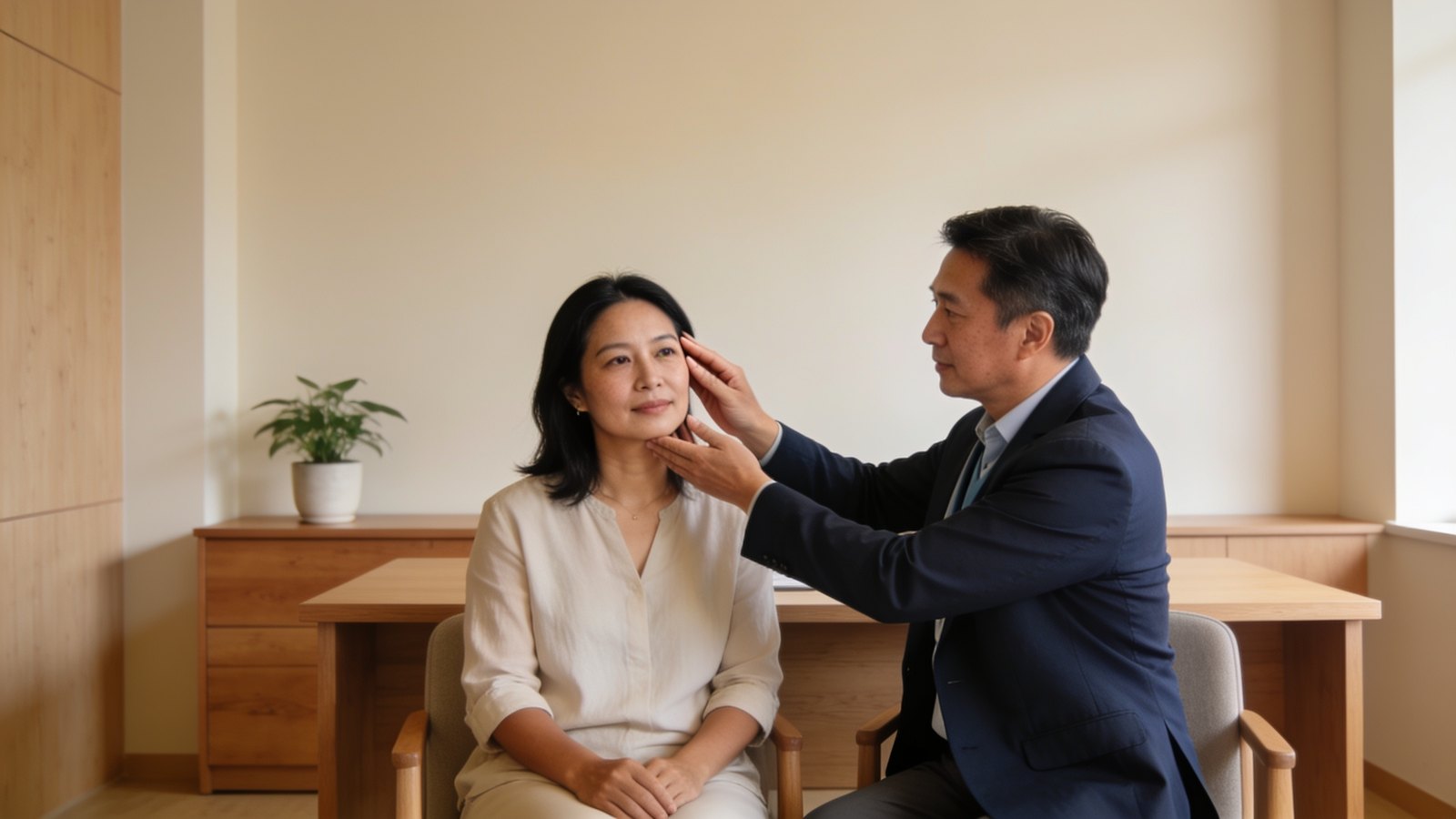
Jowl Treatment Singapore: Matching the Lift to the Cause
Medical Director Dr Sin Yong explains why jowls form, how to tell what yours are made of, which non-surgical treatment fits each cause, what each cannot do, and when surgery is the better route.
WhatsApp to Enquire →Key facts ↓Jowls form when skin loosens, fat gathers or slides above the jawline, and the bone and fat in front of the jowl, the prejowl sulcus, thin with age. Jowl treatment works when it is matched to that cause: tightening for loose skin, sculpting for fullness, restoring the prejowl hollow, or threads for descent. Jowls that hang well below the jaw may need a surgical opinion.
- Jowl fat is its own compartment: in 30 hemifacial cadaver dissections, facial fat sat in separate compartments divided by thin septa, and the jowl fat was the lowest compartment of the face [1].
- The bone in front of the jowl thins: a review of the ageing facial skeleton lists the prejowl area and the jaw among the regions that resorb predictably with age [2].
- The jaw itself changes shape: in CT scans of 120 adults across three age groups, the height of the jaw’s vertical branch fell and the jaw angle widened with age [3].
- Lean faces tend to respond better: in a study of focused ultrasound for the lower face that evaluated 93 adults at 90 days, outcomes were better in people with a lower body mass index [4].
- Radiofrequency and ultrasound compared: in a split-face trial in 20 adults, one side treated with monopolar radiofrequency and the other with focused ultrasound, laxity scores improved on both sides with no significant difference at 6 months [5].
- Threads lose their hold: a systematic review of barbed thread lifts found that, apart from two studies, the lifting effect showed only very limited durability [6].
Jowl treatment at a glance
What jowls are made of decides which treatment can reach them.
| In brief | |
|---|---|
| What it is | Non-surgical treatment for fullness or sagging along the jaw beside the chin, chosen by cause |
| Usual causes | Loose skin, fat above the jaw, a hollow prejowl sulcus, and a short chin |
| Options here | VF Lift – Vertical Facelift, HIFU, Ultherapy, Thermage FLX, Time Freeze Laser LCLR®, thread lift; filler only where it suits |
| Sessions | Often one for focused ultrasound or Thermage; usually two to four for VF Lift – Vertical Facelift; a course for Time Freeze Laser LCLR® |
| Downtime | Usually minimal after energy treatments; a few days of swelling after threads or filler |
| When change shows | Over weeks to about three months; how much varies between people |
| Who should avoid or wait | Pregnancy, an implanted electronic device (radiofrequency), active infection, heavy skin excess |
| Who plans it | Medical Director Dr Sin Yong |
What are jowls, and why do they form?
Jowls are the soft fullness that gathers along or just below the jawline beside the chin. They form when skin loosens, fat descends or builds up, and the support in front of them thins.
Skin loses collagen and recoil, faster with sun. Fat sits in separate compartments, and the jowl compartment is the lowest of them [1], so fat that slides from the cheek, or builds with weight, collects there. Ligaments tether the skin to the jaw just in front of the jowl, so tissue behind them bulges above the jawline. Bone in the prejowl area and the jaw resorbs with age [2] and the jaw angle widens [3], so the frame under the soft tissue shrinks.
| Contributor | A simple clue | Usually responds to |
|---|---|---|
| Loose skin | Thin pinch that springs back slowly | Tightening: VF Lift – Vertical Facelift (Lift), focused ultrasound, Thermage FLX |
| Fat above the jaw | Thick pinch; fullness stays when you lie back | VF Lift – Vertical Facelift (Sculpt) or Time Freeze Laser LCLR® |
| Prejowl hollow | A dip in front of the jowl, beside the chin | VF Lift – Vertical Facelift (Restore); filler where suitable |
| Descent | Lifting the cheek with a fingertip softens the jowl | Thread lift with an energy treatment |
| Short chin | The jowl looks heavier in profile | Chin projection with filler |
What is the prejowl sulcus, and why does it matter?
It is the shallow dip just in front of the jowl, beside the chin. As it deepens, the jowl behind it looks heavier even if it has not dropped further.
Bone and fat thin there with age [2], which is why some jowls look worse in side light than in a mirror. Lifting alone may leave the dip, and filling alone can add weight to a full face, so it is assessed as its own zone. Dr Sin Yong uses the Restore mode of VF Lift – Vertical Facelift here: it helps the patient’s own fat in the hollow regenerate, so volume develops over the following weeks with nothing injected. Where filler suits the dip better, that is discussed instead; see jawline filler.
How can you tell what kind of jowl you have?
Look in daylight, then lie back and look again. A jowl that softens when you lie back is mostly descent; one that stays is mostly fat or bone shape.
- Lie back with a mirror above you: tissue that slides back is descent; fullness that stays is fat or structure.
- Pinch gently: thin and slow to recover suggests loose skin; thick suggests fat.
- Run a finger along the jaw: a dip just before the chin is the prejowl sulcus.
- Look in profile: a chin behind the line of the lips makes any jowl look heavier.
This only narrows things down; at assessment the plan is built from what dominates. The same descent higher up is covered under sagging cheeks.
Which jowl treatment suits which cause?
Tightening for loose skin, sculpting for fullness, restoring for the prejowl hollow and repositioning for descent. Most plans combine two.
| If the main cause is | Usually discussed first | What it will not do |
|---|---|---|
| Early loose skin, lean or average face | VF Lift – Vertical Facelift (Lift), HIFU or Ultherapy; Thermage FLX | Remove fat or fill a hollow |
| Fullness or fat along the jaw | VF Lift – Vertical Facelift (Sculpt) or Time Freeze Laser LCLR® | Lift heavy descent on its own |
| A hollow prejowl sulcus | VF Lift – Vertical Facelift (Restore); filler where it suits | Tighten loose skin |
| Moderate descent of cheek and jowl | Thread lift, with energy for the skin | Hold its lift indefinitely |
| A short chin | Chin filler | Treat loose skin or fat |
| Jowls hanging well below the jaw | A surgical opinion | Non-surgical treatment does not remove skin |
The treatment families are compared in face lifting treatment in Singapore and skin tightening in Singapore; the whole face is on sagging face treatment in Singapore.
How does VF Lift – Vertical Facelift treat jowls?
With three radiofrequency modes on the CLASSYS Volnewmer: Lift tightens loose skin, Sculpt flattens a pouching jowl, and Restore rebuilds the prejowl hollow with your own fat.
Lift passes follow vertical vectors against the direction the face has descended, aiming for a sharper jaw. Sculpt flattens areas that pouch or bulge and does not affect facial hair, which matters for men along the beard line. Restore, the mode Dr Sin Yong values most, helps the patient’s own fat in a hollow regenerate over the following weeks. Most jowls need a mix. Nothing is injected, downtime is usually minimal, and plans usually involve two to four sessions, then maintenance; see VF Lift – Vertical Facelift.
Do HIFU, Ultherapy or Thermage work for jowls?
They can help early jowls caused mainly by loose skin. None removes fat or fills a hollow, and change builds over months.
Focused ultrasound heats small points down to the SMAS support layer at about 4.5 mm; here it is HIFU in Singapore on the CLASSYS Ultraformer MPT, and Ultherapy in Singapore adds live imaging. Thermage FLX heats the deep dermis with radiofrequency, and collagen rebuilds over three to six months. A split-face trial found radiofrequency and ultrasound similar [5], leaner faces did better in a lower-face ultrasound study [4], and lower-face tightening is hard to measure at all [7]. Dr Sin Yong usually steers people asking about Ultherapy towards VF Lift – Vertical Facelift, with the choice made at assessment.
When is Time Freeze Laser LCLR® used for jowls?
For fuller faces, where fat along the jaw drags the jowl down. It combines laser tightening with point-zone reduction of superficial fat.
Time Freeze Laser LCLR® is Dr Sin Yong’s dual-wavelength laser protocol. Its lipo-modelling passes target small zones such as the jowl and under the chin; redness usually settles within one to two hours, and collagen builds over four to eight weeks. In a lean face with a hollow prejowl, removing fat is the wrong direction, so VF Lift – Vertical Facelift is planned instead.
Can a thread lift or filler fix jowls?
Threads can reposition moderate descent, and filler can disguise an early jowl by filling the dip in front of it. Neither suits a heavy jowl alone.
A thread lift in Singapore lifts tissue with absorbable PDO or PCL threads, with a few days of swelling or bruising; evidence that the lift lasts is limited [6], so threads are usually combined with tightening. Filler is used only where it suits: a little in the prejowl dip, the jaw angle or the chin, in a face with good skin. Added to a heavy jowl it makes the lower face heavier. Serious filler events are rare [8]; see chin fillers in Singapore and filler complications.
When is surgery the better route for jowls?
When the jowl hangs clearly below the jawline even lying back, or the skin falls in folds. Surgery removes and repositions tissue; energy cannot.
A surgical facelift is done under anaesthesia, with incisions and a recovery period. Where Dr Sin Yong judges it the more realistic route, he says so and suggests a plastic surgery opinion; see facelift in Singapore: surgical vs non-surgical.
“Two jowls can look the same in a photograph and need opposite plans. One needs bulk taken away; the other needs support put back in front of it. Treat the layer that moved, not the one that is easiest to treat.”
What affects the cost of jowl treatment in Singapore?
The cost follows the plan: which layers need treatment, the device or protocol, how many sessions, and whether treatments are combined. A written plan and cost follow assessment.
- Which contributors are present: loose skin, fat, a prejowl hollow or descent, and how many zones each covers.
- The treatment chosen, from a single focused ultrasound or Thermage session to a course of VF Lift – Vertical Facelift or Time Freeze Laser LCLR®.
- Whether threads or filler are added, and in what order.
- Maintenance, which depends on how quickly your face changes.
How consultation and treatment fees are handled is explained on our fees page. At IN Eternity Clinic a consultation fee applies, and it is waived if you go ahead with any medical treatment; the fee is S$120.
How soon does jowl treatment show, and how long does it last?
Energy treatments build over weeks to about three months; threads and filler show sooner. All need maintenance, because ageing continues.
| Treatment | On the day | Weeks 1 to 4 | Months 2 to 3 | Maintenance |
|---|---|---|---|---|
| VF Lift – Vertical Facelift | Mild redness; some tightening felt | Firmness builds; Restore volume begins | Reviewed with photographs | Often about yearly |
| HIFU / Ultherapy | Little visible change | Collagen response under way | Judged at about three months | Set at review |
| Thermage FLX | Warmth; slight tightening | Gradual firming | Builds over three to six months | Often about yearly |
| Time Freeze Laser LCLR® | Redness for one to two hours | Collagen over four to eight weeks | Course continues | Set after the course |
| Thread lift | Lift visible; swelling | Swelling settles | Hold softens as threads dissolve | Combined with energy |
Is jowl treatment different for Asian faces?
Often, yes. A wider lower face, a strong jaw muscle and a shorter chin are common, so the jowl is assessed with the jaw and chin.
A broad jaw may be masseter muscle rather than jowl, treated with jaw slimming; the overall shape is planned as in V shape face in Singapore. Radiofrequency and ultrasound do not target pigment, so darkening is less likely than with many lasers in skin types III to V, and daily sunscreen protects the collagen being built.
What Dr Sin Yong looks for
- Where the jaw line breaks, and whether the jowl softens when you lie back.
- Skin recoil, and how much fat lies above the jaw.
- The depth of the prejowl sulcus and the shape of the jaw and chin.
- Masseter size, which can make a lower face look heavy without any jowl.
- Whether the change is beyond non-surgical reach.
General clinical observations used at consultation; they describe what is checked, not any individual result.
Frequently asked questions
Which treatment works for jowls?
It depends on what the jowl is made of. Loose skin responds to tightening such as VF Lift – Vertical Facelift or focused ultrasound; fullness to Sculpt or Time Freeze Laser LCLR®; a prejowl hollow to Restore or, where suitable, filler; moderate descent to a thread lift. Most plans combine two.
Can jowls be reduced without surgery?
Early to moderate jowls often can be softened by tightening, sculpting or restoring the right layer. Non-surgical treatment does not remove skin, so jowls hanging well below the jaw are usually better served by a surgical opinion.
How many sessions of VF Lift – Vertical Facelift do jowls need?
Typically two to four, depending on how much laxity, fullness and hollowing there is, then periodic maintenance. Change is reviewed against baseline photographs.
Can filler get rid of jowls?
Not on its own. A little in the dip in front of an early jowl, along the jaw angle or in the chin can smooth the jaw line, but filler added to a heavy jowl makes the lower face heavier.
Do jowls come back after treatment?
Gradually, without maintenance. Collagen made after energy treatment remains, but skin, fat and bone keep changing. Sun protection and a stable weight help the result hold.
Can face exercises get rid of jowls?
Exercise works the muscles, but jowls are mostly skin, fat and bone. It does not reduce jowl fat, rebuild bone in front of it or tighten loose skin.
Is jowl treatment suitable for men?
Yes. Plans account for thicker skin and the beard area; Sculpt in VF Lift – Vertical Facelift does not affect facial hair, and the aim is usually a defined contour.
Does jowl treatment hurt?
Most people feel deep warmth or brief heat pulses, strongest over the jaw bone, and settings are adjusted to what you report. Numbing cream can be used. Threads and filler are done under local anaesthetic or numbing.
What are the side effects of jowl treatment?
After energy treatments, redness, warmth and mild swelling or tenderness for hours to a day or two are common; blisters or temporary numbness are uncommon. Threads and filler can cause swelling and bruising for a few days. Serious events are rare and are explained before treatment.
Does weight loss make jowls worse?
It can. Significant weight loss can leave looser skin and a deeper prejowl area, while weight gain fills the jowl compartment. After weight loss, tightening is often combined with restoring support.
Book an assessment
IN Eternity Clinic, 9 Scotts Road, #12-01 Pacific Plaza, Singapore 228210. By appointment with Medical Director Dr Sin Yong. Monday to Saturday, 11am to 8pm. WhatsApp or call +65 8815 3008. At IN Eternity Clinic a consultation fee applies, and it is waived if you go ahead with any medical treatment; the fee is S$120.
International KOL — CLASSYS · HIRONIC · DEKA · ALMA · FOTONA · LUTRONIC
References
- Rohrich RJ, Pessa JE. The fat compartments of the face: anatomy and clinical implications for cosmetic surgery. Plast Reconstr Surg 2007;119(7):2219-2227. doi:10.1097/01.prs.0000265403.66886.54
- Mendelson B, Wong CH. Changes in the facial skeleton with aging: implications and clinical applications in facial rejuvenation. Aesthetic Plast Surg 2012;36(4):753-760. doi:10.1007/s00266-012-9904-3
- Shaw RB Jr, Katzel EB, Koltz PF, Kahn DM, Girotto JA, Langstein HN. Aging of the mandible and its aesthetic implications. Plast Reconstr Surg 2010;125(1):332-342. doi:10.1097/PRS.0b013e3181c2a685
- Oni G, Hoxworth R, Teotia S, Brown S, Kenkel JM. Evaluation of a microfocused ultrasound system for improving skin laxity and tightening in the lower face. Aesthet Surg J 2014;34(7):1099-1110. doi:10.1177/1090820X14541956
- Alhaddad M, Wu DC, Bolton J, et al. A randomized, split-face, evaluator-blind clinical trial comparing monopolar radiofrequency versus microfocused ultrasound with visualization for lifting and tightening of the face and upper neck. Dermatol Surg 2019;45(1):131-139. doi:10.1097/DSS.0000000000001653
- Gülbitti HA, Colebunders B, Pirayesh A, Bertossi D, van der Lei B. Thread-lift sutures: still in the lift? A systematic review of the literature. Plast Reconstr Surg 2018;141(3):341e-347e. doi:10.1097/PRS.0000000000004101
- Alam M, White LE, Martin N, Witherspoon J, Yoo S, West DP. Ultrasound tightening of facial and neck skin: a rater-blinded prospective cohort study. J Am Acad Dermatol 2010;62(2):262-269. doi:10.1016/j.jaad.2009.06.039
- Signorini M, Liew S, Sundaram H, et al. Global Aesthetics Consensus: avoidance and management of complications from hyaluronic acid fillers — evidence- and opinion-based review and consensus recommendations. Plast Reconstr Surg 2016;137(6):961e-971e. doi:10.1097/PRS.0000000000002184
These sources describe mechanisms and general evidence. They are not a promise of any individual result; suitability is decided at an in-person assessment.