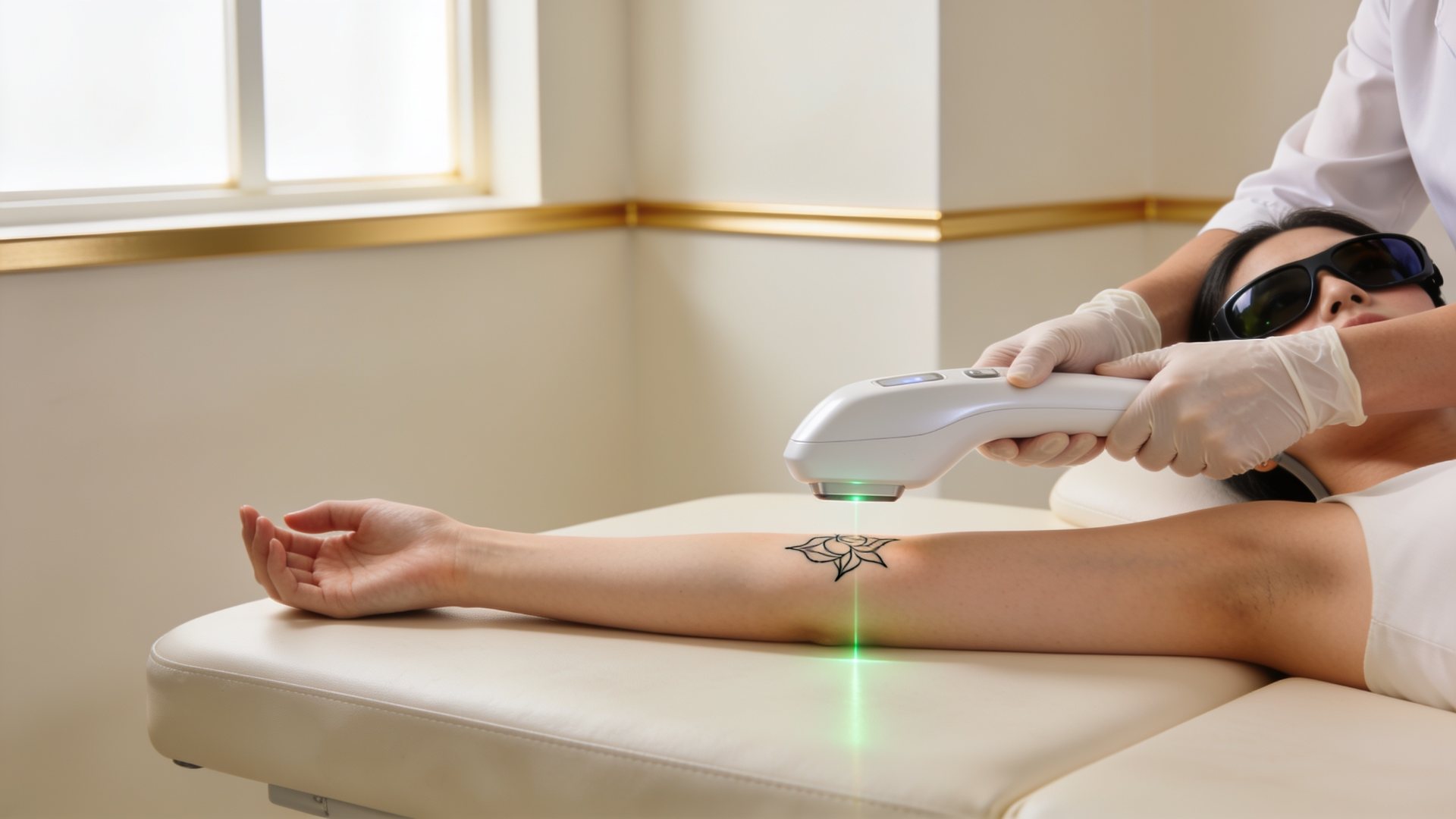
Scalp Micropigmentation and Hairline Embroidery Removal in Singapore
Medical Director Dr Sin Yong explains how scalp micropigmentation (SMP) and hairline embroidery that has gone wrong is lightened, partly removed or cleared with T2 Targeted Tattoo laser on the DEKA TORO.
Treatment page: T2 tattoo removal in Singapore.
WhatsApp to Enquire →Key facts ↓Scalp micropigmentation or hairline embroidery that has gone wrong (dots that have blurred into patches, a hairline that is too low or too harsh, or ink that has turned blue) can be lightened or removed with T2 Targeted Tattoo laser, usually 1064 nm for dark scalp ink. Treatment is often done in zones, starting with the front hairline.
- Dark scalp ink suits 1064 nm: most SMP uses black or dark grey pigment, the colour range 1064 nm is used for in T2 Targeted Tattoo removal.
- Picosecond lasers are well studied for tattoos: a systematic review of 77 studies rated picosecond laser evidence as level I for tattoo removal [1].
- Cosmetic pigments are not all carbon: some hairline and brow pigments contain iron oxides, which can darken under laser [2], so a test area comes first [3].
- Partial correction is common: the front edge of a hairline is often treated on its own, leaving density behind it in place.
- The hair loss matters too: Dr Sin Yong also looks at the hair loss behind the SMP, because treating it may change what you want the scalp to look like.
Signs your SMP or hairline embroidery has gone wrong
- Dots that have blurred: individual impressions merging into a flat, solid patch that looks painted on.
- Too dark for your hair: a shade that no longer matches as natural hair greys or as it is grown longer.
- Wrong hairline: too low, too straight or too sharp for your age and face, often the most visible problem.
- A blue or green tinge: dark pigment placed too deep or fading unevenly, showing a cool cast in daylight.
- Uneven density: blotchy areas, a visible edge where SMP meets real hair, or strokes in hairline embroidery that have spread.
Why does SMP blur or turn blue?
Scalp micropigmentation places tiny deposits of pigment in the upper skin to look like hair follicles. If the needle goes too deep, the pigment spreads and each dot grows; over time neighbouring dots merge. Deeper pigment can also look blue under the skin, the same effect that makes old body tattoos look blue-green.
Hairline embroidery and brow-style strokes on the hairline use cosmetic pigments that may contain iron oxides, which behave differently under laser from carbon black [2][3]. That is why the ink is assessed and tested before a full session.
How T2 Targeted Tattoo laser removes SMP
T2 is IN Eternity Clinic’s tattoo removal protocol on the DEKA TORO, matching the wavelength to the ink:
- 1064 nm for black and dark grey SMP pigment, the most common case.
- 785 nm picosecond pulses where a cool blue cast needs a different target.
- 532 nm only for warm brown or red tones in some hairline embroidery, after a test area.
Large areas are treated in zones. Many people start with the front hairline, the part that shows most, and decide on the crown and sides once they see how the ink responds.
Remove, lighten or redraw?
- Full removal: clearing the SMP as far as the skin allows, over several sessions.
- Lightening for a redo: fading blurred or overly dark pigment so a new, softer layer can be placed.
- Hairline correction: removing only the front edge to move a hairline back or soften it.
- Treating the hair loss: where hair is still thinning, options such as hair loss treatment may change the plan.
Which route suits you is decided at assessment, once the pigment and the hair loss pattern have both been examined.
Why a test patch comes first
A few pulses go onto a small, discreet area, usually behind the hairline, at conservative settings. Several weeks later the result is checked for lightening, darkening and how the scalp healed, before larger zones are treated [3].
What about tattoos on a shaved head or scalp?
Tattoos on the scalp, behind the ears or at the nape are treated like body tattoos: T2 matches the wavelength to each ink colour, and black ink usually responds to 1064 nm. When hair grows back over a scalp tattoo, it can be harder to see how the ink is fading, so the area is kept short around sessions. For tattoos elsewhere on the head and face, see face and neck tattoo removal.
Will laser affect the hair I still have?
The laser targets pigment in the skin, and settings are chosen to limit heat to the surrounding tissue. Short hair over the area is trimmed before treatment, and the scalp is examined first so that any active scalp condition or progressing hair loss is not missed. If you are also treating hair loss, the sequence of treatments is planned together.
How many sessions, and what is recovery like?
Dense SMP over a large area usually needs more sessions than a small brow or lip tattoo, and blurred, deep pigment takes longer than fine, shallow dots. Sessions are spaced several weeks apart, and results vary.
- Redness and a white frosting for minutes to hours.
- Pinpoint crusts on the scalp for several days; a loose cap covers them.
- Avoid scratching, swimming and heavy sweating for a few days.
- Protect the treated scalp from sun between sessions.
What Dr Sin Yong looks for
- How far the dots have spread, and whether the pigment looks blue or green in daylight.
- Whether the ink is carbon-black SMP or a cosmetic pigment with metal oxides.
- Where the hairline sits compared with what suits your face and age.
- The pattern and activity of your hair loss, and the health of the scalp.
- Whether you want a clean scalp, a lighter base for a redo or a hairline correction only.
Frequently asked questions
Can scalp micropigmentation be removed completely?
Often it can be lightened substantially and sometimes cleared, over several sessions. Dense, deep or blurred pigment takes longer, and the number of sessions is estimated after a test patch.
Can just my hairline be removed?
Yes. The front edge of an SMP or embroidered hairline can be treated on its own to move it back or soften it, leaving the density behind it in place.
Why has my SMP turned blue?
Pigment placed too deep, or fading unevenly over time, can show a blue or green cast through the skin. A matched wavelength is chosen for that colour.
Will laser make my hair loss worse?
The laser targets pigment, and settings are chosen to limit heat to surrounding tissue. The scalp and hair loss pattern are examined first, and any active hair loss is discussed as part of the plan.
Can I have SMP redone after laser?
Yes, once the skin has fully healed and the old pigment has been lightened enough. Starting a redo on a lighter base usually gives a more natural result than adding pigment over blurred dots.
How much does SMP removal cost?
It depends on the size of the area, how dense and dark the pigment is and the number of sessions likely. An estimate is given after assessment; the tattoo removal cost guide explains the factors.
Book an assessment
IN Eternity Clinic, 9 Scotts Road, #12-01 Pacific Plaza, Singapore 228210. By appointment with Medical Director Dr Sin Yong. Monday to Saturday, 11am to 8pm. WhatsApp or call +65 8815 3008. At IN Eternity Clinic a consultation fee applies, and it is waived if you go ahead with any medical treatment; the fee is S
International KOL — CLASSYS · HIRONIC · DEKA · ALMA · FOTONA · LUTRONIC
References
- Wu DC, Goldman MP, Wat H, Chan HHL. A systematic review of picosecond laser in dermatology: evidence and recommendations. Lasers Surg Med 2021;53(1):9-49. doi:10.1002/lsm.23244
- Anderson RR, Geronemus R, Kilmer SL, Farinelli W, Fitzpatrick RE. Cosmetic tattoo ink darkening: a complication of Q-switched and other short-pulse laser treatment. Arch Dermatol 1993;129(8):1010-1014. doi:10.1001/archderm.1993.01680290082012
- Geisler AN, Eber A, Kim K, et al. Lasers for the treatment of eyebrow microblading and cosmetic tattoo pigment: a review of the literature. Lasers Med Sci 2023;38(1):256. doi:10.1007/s10103-023-03921-z
Figures taken from the published papers and abstracts. Results vary between people; suitability is decided at an in-person consultation.