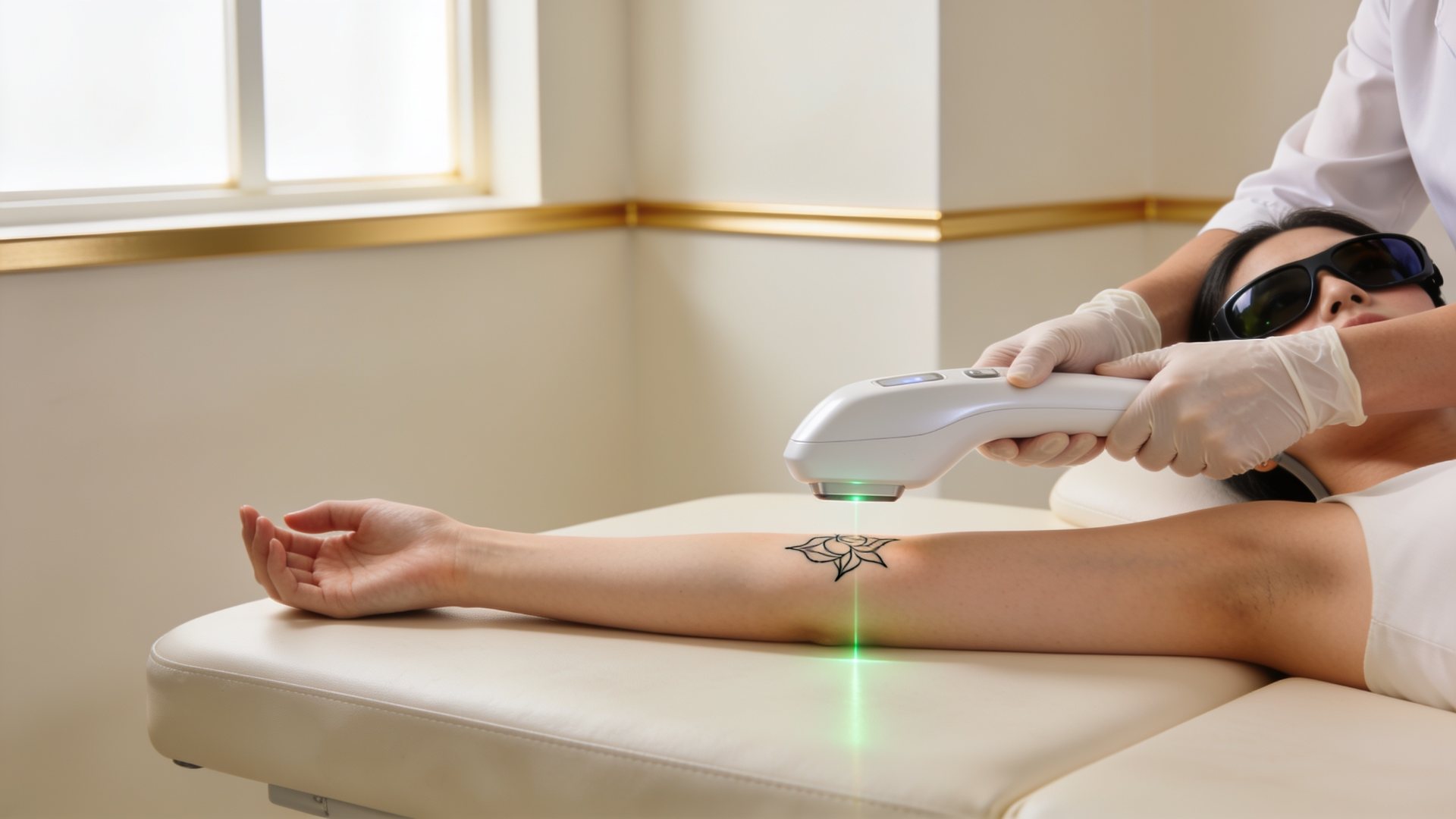
Embroidery Gone Wrong: T2 Laser Removal for Brows, Lips and Hairline
Medical Director Dr Sin Yong explains how eyebrow embroidery, lip blush and scalp or hairline micropigmentation that has gone wrong is assessed, lightened or removed with T2 Targeted Tattoo laser on the DEKA TORO.
Treatment page: T2 tattoo removal in Singapore.
WhatsApp to Enquire →Key facts ↓When eyebrow, lip or hairline embroidery has gone wrong (too dark, the wrong shape, a colour that has shifted or pigment that has spread), T2 Targeted Tattoo laser on the DEKA TORO breaks the pigment down over several sessions. Cosmetic inks can darken under laser, so Dr Sin Yong tests a small area first and matches 1064, 532 or 785 nm to the ink.
- Brows often need only a few sessions: in a chart review of 76 people treated for eyebrow or eyeliner tattoos, the mean number of laser treatments was 2.8, with a range of 1 to 12 [1].
- Hidden colours can surface: red, orange or yellow pigment that was not visible before treatment was unmasked in 20 of those 76 patients [1].
- Cosmetic inks can turn darker: iron oxide and titanium dioxide pigments used in permanent makeup can darken when hit by short-pulse lasers [2], which is why a test area comes first.
- Pink and flesh tones are the most likely to darken: darkening is most often reported in pink, peach and skin-toned inks [3], common in lip blush and colour corrections.
- Doctor-led from start to finish: every case is assessed, test-treated and planned by Medical Director Dr Sin Yong at IN Eternity Clinic, a designated DEKA Centre of Excellence.
What does embroidery gone wrong look like?
Most people know something is wrong before they can name it. These are the patterns seen most often at assessment:
- Too dark or too heavy: brows that look drawn on, a lip colour that reads as lipstick all day, or a hairline that looks painted rather than shaded.
- Wrong shape or uneven sides: brows set too high, too low or mismatched; a lip line drawn outside the natural border; a hairline that is too straight or too low for your face.
- A colour that has shifted: brown brows fading to blue-grey, red or orange; lips turning brick, purple or patchy; scalp dots taking on a blue or green tinge.
- Blurring and spread: fine strokes or dots that have merged into a solid block, or pigment that has spread beyond the edge.
- Layers of correction: skin-toned or white pigment tattooed over a mistake, which often makes the result look grey or patchy over time.
Why does cosmetic pigment change colour or spread?
Permanent makeup pigments are blends. Many contain iron oxides for brown and red tones and titanium dioxide to lighten or warm a shade [4]. As the skin clears some components faster than others, the colour you see drifts, so a warm brown can leave a cool grey behind.
Depth matters too. Pigment placed too deep spreads under the skin and blurs; pigment placed unevenly heals patchy. Repeated touch-ups and colour corrections add more pigment in more layers, which is why a result can look worse after each attempt to fix it.
The same metal oxides that make cosmetic pigment look natural are the ones that can turn darker under a short-pulse laser [2]. That single fact shapes how removal is planned.
What is T2 Targeted Tattoo laser removal?
T2 (Targeted Tattoo) is IN Eternity Clinic’s tattoo removal protocol on the DEKA TORO. It is a way of planning treatment, not a separate machine: the wavelength is matched to the ink in front of the laser.
- 1064 nm for black, dark grey and dark brown pigment, including most scalp micropigmentation.
- 532 nm for red and orange tones, used with care because warm cosmetic inks are the ones most likely to darken.
- 785 nm picosecond pulses, which DEKA positions for skin types III to V, the range common in Singapore.
The clinic also uses the Fotona StarWalker PQX where its settings suit the ink. A picosecond laser is rated with level I evidence for tattoo removal in a systematic review of 77 studies [5], but no laser removes every cosmetic pigment in one visit.
Brows, lips and hairline are treated differently
Each area has its own pigments, risks and recovery. Choose the area that applies to you:
Why a test area always comes first
A few pulses are placed on a small, discreet part of the pigment at conservative settings, then reviewed several weeks later. If it lightened, the full area follows. If it darkened, the darkened pigment is usually treated further as a dark ink and the course may be longer [2].
In 98 people treated for complex eyebrow tattoos with a picosecond laser, 18 showed an immediate grey discolouration, and an average of three sessions reached their goal [6]. That is a group result; your own ink is judged on its own test.
Remove, lighten or correct?
- Full removal: taking the pigment back as far as the skin allows, over several sessions.
- Lightening before a redo: fading old pigment so a new artist starts on a cleaner base instead of tattooing over it.
- Partial removal: treating only the part that is wrong, such as brow tails, a lip line drawn outside the border or the front edge of a hairline.
- Not more pigment on top: covering a mistake with skin-toned pigment often turns grey later and makes laser removal harder [3].
Which route suits you depends on the pigment, the colour it has shifted to and what you want the area to look like afterwards. That is decided at assessment, not from a photograph.
How many sessions does embroidery removal take?
Cosmetic tattoos usually hold less pigment than body tattoos, so fewer sessions are often needed; in one review, eyebrow and eyeliner tattoos needed a mean of 2.8 laser treatments [1]. Heavily layered corrections, warm pigments that darken and dense scalp micropigmentation take longer.
Sessions are spaced several weeks apart so the skin can clear the broken-down pigment. Results vary, and an honest estimate is given only after the test area has been reviewed.
What is recovery like?
- Redness, swelling and a white frosting for minutes to hours after each session.
- Pinpoint crusts for several days; leave them to fall off on their own.
- Sun protection on treated skin between sessions.
- Brows: hairs may lighten for a while and usually regrow [1]. Lips: swelling for a day or two. Scalp: redness and small crusts that a cap can cover.
When embroidery needs a doctor first, not a laser
A raised, itchy, swollen or lumpy reaction in tattooed skin, or redness, warmth and pus after a recent procedure, should be examined before any laser is used. An allergic or inflammatory reaction to pigment is managed differently from simple removal, and lasering it too early can make it worse.
If you notice these, message the clinic with a clear photo, or see a doctor promptly.
What Dr Sin Yong looks for
- The colour of the pigment today, and how far it has shifted from the original shade.
- Whether there is a skin-toned or white cover layer, or an earlier correction on top.
- How deep and how dense the pigment sits, and whether it has spread past the edge.
- Your skin type, any history of pigmentation after injury, and cold sores for lips.
- What you want next: a clean slate, a lighter base for a redo, or a partial correction.
Frequently asked questions
Can embroidery that has gone wrong be fixed?
Usually it can be improved. Laser lightens or removes the pigment over several sessions, either to clear the area or to give a cleaner base for a redo. How far it goes depends on the pigment and is judged after a test area.
How soon after embroidery can laser removal start?
Once the area has fully healed, which is usually several weeks after the procedure. Treating skin that is still healing raises the risk of scarring and pigment changes.
Can just part of my embroidery be removed?
Yes. Brow tails, a lip line outside the border or the front edge of a hairline can be treated on their own, leaving the rest in place.
Will laser removal leave a scar?
Scarring is uncommon when settings are matched to the ink and the skin is allowed to heal between sessions. The risk is higher where earlier procedures have already scarred the skin, which is checked at assessment.
Does embroidery removal hurt?
It feels like quick, hot snaps. Numbing cream is applied beforehand and cooling is used during treatment, and most sessions take minutes.
How much does embroidery removal cost?
It depends on the area, the amount and colour of pigment and the number of sessions likely. An estimate is given after assessment; the tattoo removal cost guide explains the factors.
Book an assessment
IN Eternity Clinic, 9 Scotts Road, #12-01 Pacific Plaza, Singapore 228210. By appointment with Medical Director Dr Sin Yong. Monday to Saturday, 11am to 8pm. WhatsApp or call +65 8815 3008. At IN Eternity Clinic a consultation fee applies, and it is waived if you go ahead with any medical treatment; the fee is S
International KOL — CLASSYS · HIRONIC · DEKA · ALMA · FOTONA · LUTRONIC
References
- Kream E, Jairath N, Bajaj S, Orbuch D, Wang JV, Geronemus RG. Laser removal of eyeliner and eyebrow tattoos: chart review, experiences, and learnings. J Clin Aesthet Dermatol 2023;16(11):47-49. jcadonline.com
- Anderson RR, Geronemus R, Kilmer SL, Farinelli W, Fitzpatrick RE. Cosmetic tattoo ink darkening: a complication of Q-switched and other short-pulse laser treatment. Arch Dermatol 1993;129(8):1010-1014. doi:10.1001/archderm.1993.01680290082012
- Kirby W, Kaur RR, Desai A. Paradoxical darkening and removal of pink tattoo ink. J Cosmet Dermatol 2010;9(2):149-151. doi:10.1111/j.1473-2165.2010.00493.x
- Tomita S, Mori K, Yamazaki H, et al. Complications of permanent makeup procedures for the eyebrow and eyeline. Medicine (Baltimore) 2021;100(18):e25755. doi:10.1097/MD.0000000000025755
- Wu DC, Goldman MP, Wat H, Chan HHL. A systematic review of picosecond laser in dermatology: evidence and recommendations. Lasers Surg Med 2021;53(1):9-49. doi:10.1002/lsm.23244
- Menozzi-Smarrito C, Smarrito S. Laser removal of cosmetic eyebrow tattoos with a picosecond laser. Dermato 2023;3(3):182-192. doi:10.3390/dermato3030014
Figures taken from the published papers and abstracts. Results vary between people; suitability is decided at an in-person consultation.