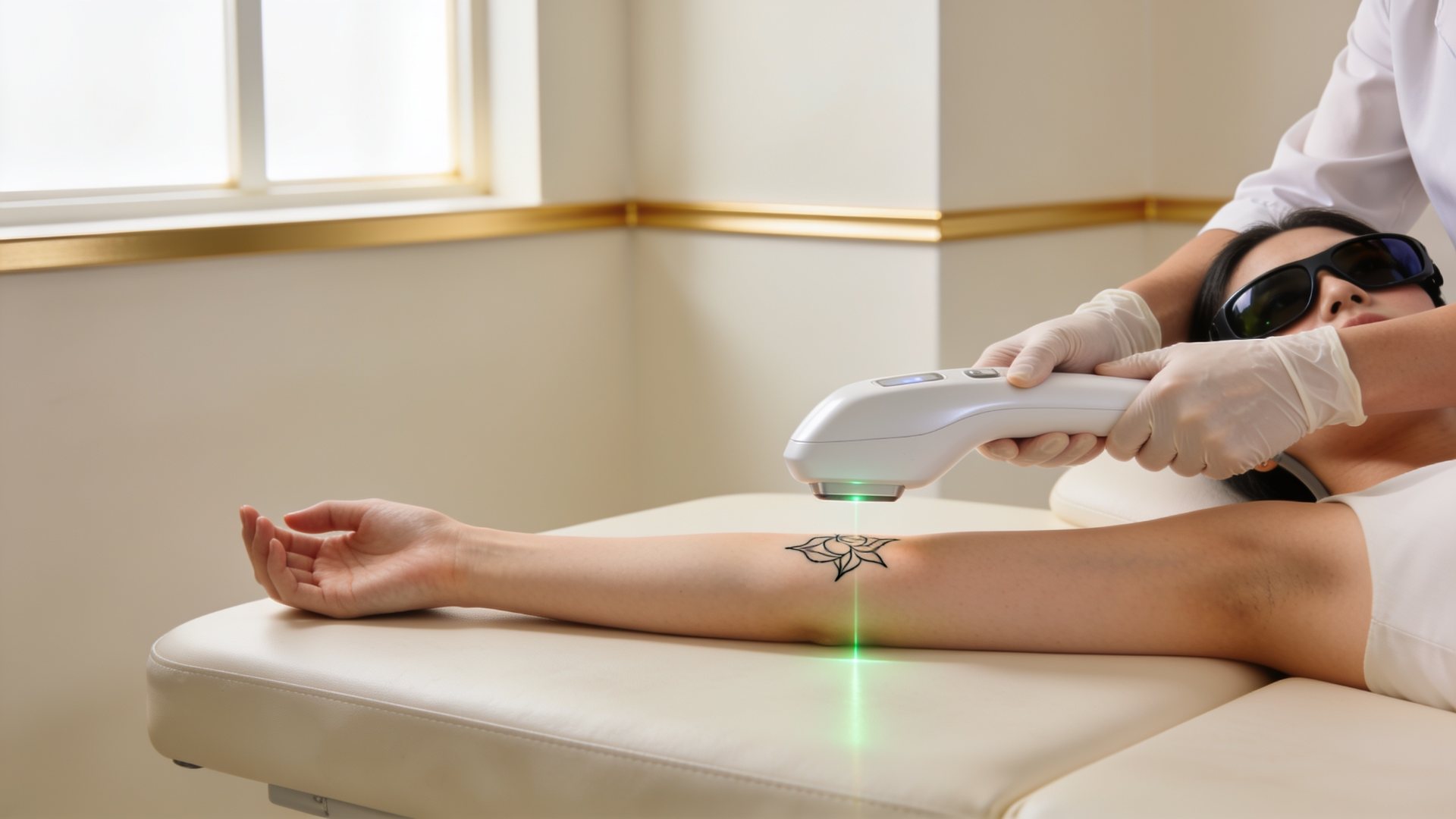
Lip Blush Removal Singapore: When Lip Blush or Lip Embroidery Goes Wrong
Medical Director Dr Sin Yong explains how lip blush, lip liner and lip embroidery that has gone wrong is lightened or removed with T2 Targeted Tattoo laser, and why lips are always test-treated first.
Treatment page: T2 tattoo removal in Singapore.
WhatsApp to Enquire →Key facts ↓Lip embroidery that has gone wrong (too dark, patchy, outside the lip line or turned brick, purple or grey) can be lightened or removed with T2 Targeted Tattoo laser over several sessions. Pink, peach and skin-toned lip pigments are among the inks most likely to darken, so a small test area on the lip comes first.
- Pink and flesh tones darken most often: paradoxical darkening is most often reported in pink, peach and skin-toned tattoo inks [1], the shades used in lip blush.
- Metal oxides are the reason: iron oxide and titanium dioxide in cosmetic pigments can turn darker under short-pulse lasers [2].
- Hidden colours can surface: in a review of 76 cosmetic tattoo patients, red, orange or yellow pigment was unmasked during treatment in 20 [3].
- Cold sores need planning: laser on the lip can trigger an outbreak in people who get cold sores, so a history is taken and preventive medicine may be prescribed.
- Doctor-led: lip removal at IN Eternity Clinic is assessed, test-treated and performed by Medical Director Dr Sin Yong.
Signs your lip embroidery has gone wrong
- Too dark or too bright: a colour that reads as heavy lipstick instead of a natural tint.
- Patchy healing: uneven colour across the lip, or areas that took and areas that did not.
- Lip line outside the border: a liner drawn beyond the natural edge, which shows when the lips move.
- A colour shift: pinks fading to orange or brick, or a purple, grey or dark tone appearing months later.
- Neutralising gone wrong: warm or skin-toned pigment used to “lighten” naturally dark lips, which can turn grey or ashy.
Why is lip embroidery harder to remove than brows?
Lip pigments are mostly warm blends: reds, pinks and peaches built from iron oxides, often lightened with titanium dioxide. These are the inks most likely to darken when a short-pulse laser hits them [2][1], so a lip that looks pink today can flash grey under the laser before it fades.
The lip itself heals quickly but swells easily, and its border is the part that matters most to how the mouth looks. Treatment is planned zone by zone, usually starting where the problem is most visible.
How T2 Targeted Tattoo laser treats lip pigment
T2 is IN Eternity Clinic’s tattoo removal protocol on the DEKA TORO. For lips, the wavelength is chosen for the pigment that is there now, not the shade you were promised:
- 1064 nm for pigment that has turned dark, grey or purple.
- 532 nm for red and orange tones, used cautiously and only after a test area.
- 785 nm picosecond pulses where settings suit the ink and skin type.
A picosecond laser has level I evidence for tattoo removal in a systematic review [4], but warm cosmetic pigments behave less predictably than black body-tattoo ink, so each session is reviewed before the next.
Why lips are always test-treated first
A few pulses go onto a small, discreet part of the lip line at conservative settings. Several weeks later the result is checked: lighter, darker, or a new colour unmasked. If the ink darkened, the darkened pigment is treated as a dark ink and the course may be longer [2].
The test keeps any surprise small, and it is the only reliable way to know how your particular pigment will respond.
Do you get cold sores?
Tell the clinic before any lip treatment. Laser energy on the lip can trigger a cold sore outbreak in people who carry the virus. Dr Sin Yong may prescribe an antiviral medicine to start before the session, and treatment is postponed if a cold sore is active.
Is it the tattoo, or your natural lip colour?
Some people had lip blush to lighten naturally dark lips. When the tattoo fades or shifts, the natural pigment underneath shows again and can be mistaken for the tattoo going wrong. Separating the two matters, because natural lip pigmentation is treated differently from tattoo ink. This is checked at assessment; see lip pigmentation treatment for how natural dark lips are approached.
How many sessions, and what is recovery like?
Lip tattoos hold less pigment than body tattoos, but warm inks and layered corrections can need more sessions than brows. Sessions are spaced several weeks apart, and results vary.
- Swelling for a day or two after each session.
- Fine crusting on the lip for a few days; keep it moisturised with a plain balm and avoid picking.
- Avoid very hot food and drinks while the lip is tender.
- Sun protection on the lips between sessions.
What Dr Sin Yong looks for
- The colour of the pigment now, and whether it has darkened, shifted or patched.
- Whether skin-toned or white pigment was used to neutralise dark lips.
- Where the lip line was drawn compared with your natural border.
- Your natural lip colour under the tattoo, and any history of cold sores.
- Whether you want full removal, lightening or a correction of the border only.
Frequently asked questions
Can lip blush be removed completely?
Often it can be lightened substantially and sometimes cleared, over several sessions. Warm lip pigments can darken first, which is why a test area comes before treatment and why the number of sessions varies.
My lip blush turned dark or grey. Can laser fix it?
Darkened lip pigment is usually treated as a dark ink with a matched wavelength. It may take more sessions than the original colour would have. The test area shows how your ink responds.
Can just the lip liner be removed?
Yes. A liner drawn outside the natural border can be treated on its own, leaving the colour inside the lip.
Will laser make my lips swell?
Some swelling for a day or two after each session is expected. Cooling and a plain balm help, and most people return to normal activities the same day.
I get cold sores. Can I still have lip tattoo removal?
Usually yes, with planning. Dr Sin Yong may prescribe an antiviral medicine before the session, and treatment is not done while a cold sore is active.
How much does lip embroidery removal cost?
It depends on the amount and colour of pigment and the number of sessions likely. An estimate is given after assessment; the tattoo removal cost guide explains the factors.
Book an assessment
IN Eternity Clinic, 9 Scotts Road, #12-01 Pacific Plaza, Singapore 228210. By appointment with Medical Director Dr Sin Yong. Monday to Saturday, 11am to 8pm. WhatsApp or call +65 8815 3008. At IN Eternity Clinic a consultation fee applies, and it is waived if you go ahead with any medical treatment; the fee is S
International KOL — CLASSYS · HIRONIC · DEKA · ALMA · FOTONA · LUTRONIC
References
- Kirby W, Kaur RR, Desai A. Paradoxical darkening and removal of pink tattoo ink. J Cosmet Dermatol 2010;9(2):149-151. doi:10.1111/j.1473-2165.2010.00493.x
- Anderson RR, Geronemus R, Kilmer SL, Farinelli W, Fitzpatrick RE. Cosmetic tattoo ink darkening: a complication of Q-switched and other short-pulse laser treatment. Arch Dermatol 1993;129(8):1010-1014. doi:10.1001/archderm.1993.01680290082012
- Kream E, Jairath N, Bajaj S, Orbuch D, Wang JV, Geronemus RG. Laser removal of eyeliner and eyebrow tattoos: chart review, experiences, and learnings. J Clin Aesthet Dermatol 2023;16(11):47-49. jcadonline.com
- Wu DC, Goldman MP, Wat H, Chan HHL. A systematic review of picosecond laser in dermatology: evidence and recommendations. Lasers Surg Med 2021;53(1):9-49. doi:10.1002/lsm.23244
Figures taken from the published papers and abstracts. Results vary between people; suitability is decided at an in-person consultation.