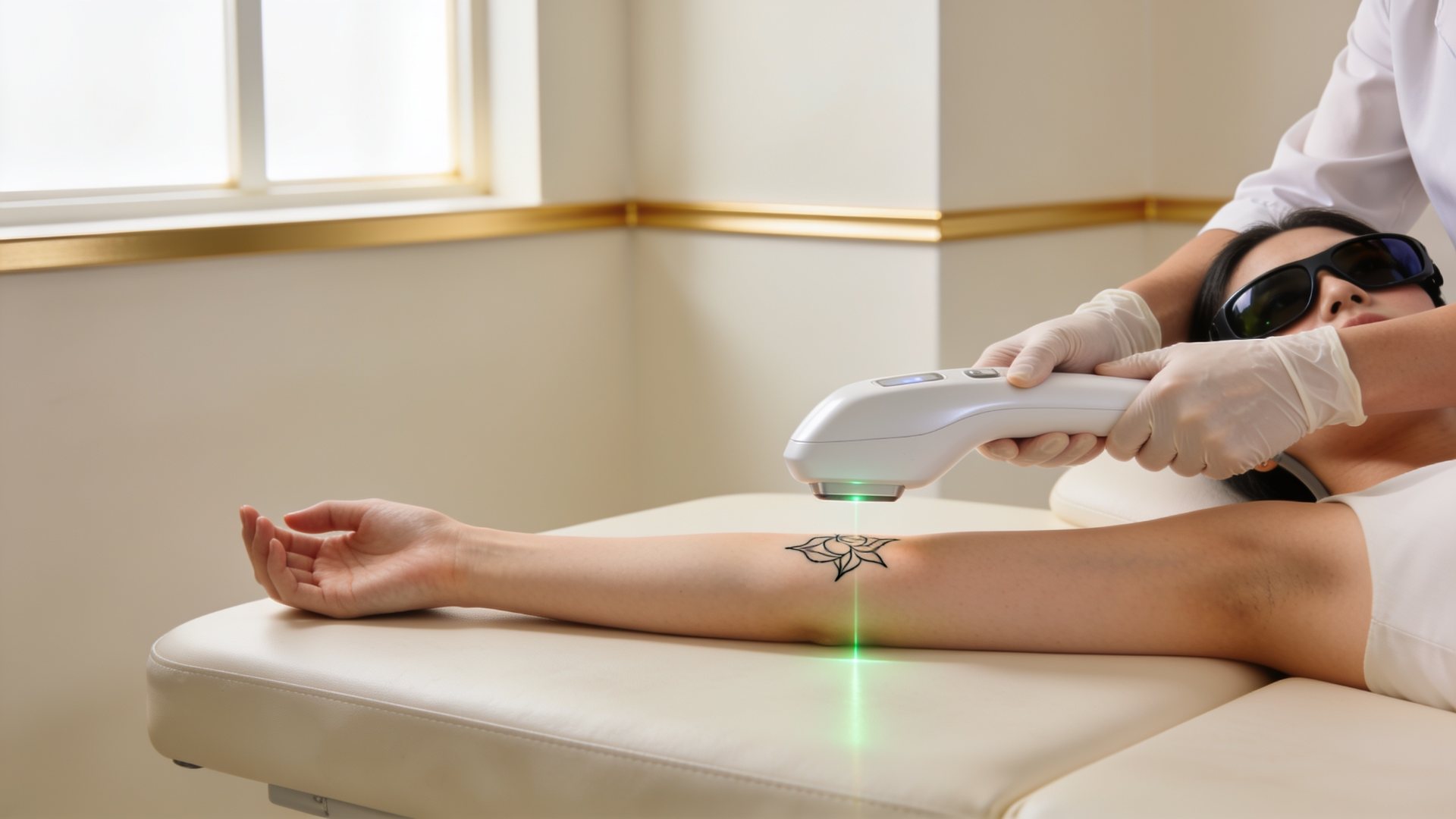
Face and Neck Tattoo Removal: When a Facial Tattoo Goes Wrong
Medical Director Dr Sin Yong explains how tattoos on the face, neck and behind the ears, including cosmetic freckle and beauty-mark tattoos, are removed or lightened with T2 Targeted Tattoo laser, with extra care for skin that always shows.
Treatment page: T2 tattoo removal in Singapore.
WhatsApp to Enquire →Key facts ↓Face and neck tattoos that have gone wrong, including small facial tattoos, cosmetic freckle and beauty-mark tattoos and tattoos behind the ear, can be removed or lightened with T2 Targeted Tattoo laser. Because the skin always shows and Asian skin can darken after inflammation, settings are conservative, cosmetic inks are test-treated first and sun protection is essential.
- Cosmetic face inks can darken: brown, skin-toned and pink cosmetic pigments, used for freckle and beauty-mark tattoos, contain metal oxides that can darken under laser [1][2].
- Picosecond evidence is strong: a systematic review rated picosecond laser evidence as level I for tattoo removal [3].
- Location changes the course: the Kirby-Desai scale scores the head and neck as the location that tends to clear in the fewest sessions [4].
- Near the eyes needs shields: tattoos close to the eyelids or eyeliner are treated only with appropriate eye protection, and some need an internal eye shield.
- Doctor-led: face and neck tattoo removal at IN Eternity Clinic is assessed and performed by Medical Director Dr Sin Yong.
Face and neck tattoos that people want removed
- Small facial tattoos: dots, symbols or lines that have blurred, spread or no longer suit you.
- Freckle and beauty-mark tattoos: cosmetic dots that have faded unevenly, turned grey or look artificial.
- Neck and behind-ear tattoos: designs that show at work, or that were done quickly and healed poorly.
- Tattoos near the eyes: eyeliner and tattoos close to the eyelids; see eyebrow and eyeliner tattoo removal.
Why is face tattoo removal planned differently?
Facial skin heals well, and in tattoo removal scoring the head and neck tend to clear in fewer sessions than the hands or feet [4]. But the face always shows, so even a temporary mark matters, and darker skin types can develop post-inflammatory darkening after laser. Settings are therefore conservative, sessions are spaced to allow full recovery, and sun protection is part of the plan.
Cosmetic face tattoos, such as freckles and beauty marks, use brown or skin-toned pigments that can darken when hit by a short-pulse laser [1][2], so they are test-treated before a full session.
How T2 Targeted Tattoo laser treats face and neck tattoos
T2 is IN Eternity Clinic’s tattoo removal protocol on the DEKA TORO. Small spot sizes allow precise work on fine lines and dots; the wavelength is matched to each ink: 1064 nm for black, 532 nm for red and orange, and 785 nm picosecond pulses, which DEKA positions for skin types III to V [3].
Why cosmetic face tattoos are test-treated
A single freckle dot or a small part of the tattoo is treated first at conservative settings and reviewed several weeks later. If the pigment lightened, the rest follows; if it darkened, it is usually treated further as a dark ink and the course may be longer [1].
Tattoos near the eyes
Laser near the eyelids can injure the eye. Tattoos close to the eyes are treated only with appropriate eye shields, and eyeliner tattoos need an internal eye shield placed after numbing drops. Some tattoos very close to the lash line may not be suitable for laser at all; this is decided at assessment.
How many sessions, and what is recovery like?
Small black facial tattoos and amateur work may clear in relatively few sessions; dense colour and cosmetic pigments take longer [4]. Sessions are spaced several weeks apart, and results vary.
- Redness and swelling for a day or two; the face may look puffy near the eyes.
- Fine crusts for several days; do not pick or scrub.
- Strict daily sunscreen and shade between sessions to reduce the risk of darkening.
- Make-up can usually be used once the crusts have settled.
What Dr Sin Yong looks for
- Whether the ink is a body tattoo ink or a cosmetic pigment.
- Your skin type and any history of darkening after acne, injury or treatment.
- How close the tattoo is to the eyes, lips or hairline.
- Any scarring or raised skin from the original tattoo.
- Whether you want full removal or lightening only.
Frequently asked questions
Can face tattoos be removed completely?
Many can be removed or substantially lightened over several sessions. Cosmetic pigments and dense colour are less predictable, which is why a test area comes first.
Will removing a face tattoo leave a mark?
Temporary redness and crusting are expected. Lasting marks are uncommon with conservative settings and good sun protection, but darker skin types can develop temporary darkening, which is checked between sessions.
Can freckle or beauty-mark tattoos be removed?
Usually, yes. These cosmetic pigments can darken under laser, so a single dot is test-treated first.
Can tattoos near the eyes be lasered?
Only with appropriate eye shields, and eyeliner needs an internal eye shield. Some tattoos very close to the lash line may not be suitable; this is decided at assessment.
How long until I can wear make-up?
Usually once the crusts have settled, after several days. Until then, keep the area clean and protected from sun.
How much does face tattoo removal cost?
It depends on size, colours and the number of sessions likely. An estimate is given after assessment; the tattoo removal cost guide explains the factors.
Book an assessment
IN Eternity Clinic, 9 Scotts Road, #12-01 Pacific Plaza, Singapore 228210. By appointment with Medical Director Dr Sin Yong. Monday to Saturday, 11am to 8pm. WhatsApp or call +65 8815 3008. At IN Eternity Clinic a consultation fee applies, and it is waived if you go ahead with any medical treatment; the fee is S
International KOL — CLASSYS · HIRONIC · DEKA · ALMA · FOTONA · LUTRONIC
References
- Anderson RR, Geronemus R, Kilmer SL, Farinelli W, Fitzpatrick RE. Cosmetic tattoo ink darkening: a complication of Q-switched and other short-pulse laser treatment. Arch Dermatol 1993;129(8):1010-1014. doi:10.1001/archderm.1993.01680290082012
- Kirby W, Kaur RR, Desai A. Paradoxical darkening and removal of pink tattoo ink. J Cosmet Dermatol 2010;9(2):149-151. doi:10.1111/j.1473-2165.2010.00493.x
- Wu DC, Goldman MP, Wat H, Chan HHL. A systematic review of picosecond laser in dermatology: evidence and recommendations. Lasers Surg Med 2021;53(1):9-49. doi:10.1002/lsm.23244
- Kirby W, Desai A, Desai T, Kartono F, Geeta P. The Kirby-Desai Scale: a proposed scale to assess tattoo-removal treatments. J Clin Aesthet Dermatol 2009;2(3):32-37. PubMed 20729941
Figures taken from the published papers and abstracts. Results vary between people; suitability is decided at an in-person consultation.