
Exosome Skin Booster Explained: What It Is and Why It Is Topical Only
An exosome treatment, or exosomes skin booster, is a topical product containing cell-derived vesicles, applied straight after microneedling or fractional laser. None is HSA-registered for injection, so IN Eternity Clinic uses them topically only. Injectables: Skin Booster Singapore.
WhatsApp to Enquire →Key facts ↓Exosomes are tiny membrane-bound packets, typically tens to around a hundred and fifty nanometres across, that cells release to carry proteins, fats and fragments of RNA to other cells as signals. In skin care they appear in topical exosome skin boosters, applied straight after microneedling or fractional laser. No exosome product is registered by Singapore's HSA for injection into the skin, so IN Eternity Clinic uses them topically only. Registered injectables: skin boosters. See also our guide to polynucleotide treatment.
No exosome product is registered by Singapore’s HSA for injection into the skin. An “exosome skin booster” is usually a topical product containing extracellular vesicles, applied straight after microneedling or fractional laser while tiny channels are open. Evidence is early, so IN Eternity Clinic uses them topically only. Registered injectables: skin booster treatment in Singapore.
Redness and rosacea care, from creams to the 675 nm laser, is explained on rosacea treatment in Singapore.
Treatment page: skin boosters in Singapore.
On this page
Exosome skin booster vs injectable skin boosters
How a topical exosome product differs from the registered injectables usually meant by “skin booster”. This guide is part of the treatments explained.
| Topical exosome product | Polynucleotide booster (e.g. Rejuran) | Hyaluronic acid booster (e.g. Profhilo) | |
|---|---|---|---|
| How it reaches the skin | Spread over the skin straight after microneedling or fractional laser | Injected into the dermis | Injected into the dermis |
| HSA position | No exosome product is registered for injection; used on the skin only | Registered injectable; the pack is checked before use | Registered injectable; the pack is checked before use |
| Evidence | Early: small, product-specific split-face studies | Laboratory work, consensus reports and a growing number of clinical studies | Prospective studies and consensus reports |
| Usually chosen for | Supporting recovery after a procedure | Thin, sensitised or slow-to-recover skin | Dehydration and fine crepey lines |
| At IN Eternity Clinic | Used topically as part of a procedure | Offered | Offered |
- What exosomes are: tiny membrane-bound vesicles released by cells, carrying proteins, lipids and RNA that act as signals between cells.
- Naming: researchers prefer the broader term extracellular vesicles, because most preparations cannot prove every particle is a true exosome.
- Sources in skin products: human cell cultures such as adipose-derived stem cells, plant-derived vesicles, and other biological sources; content varies widely.
- How they are used: applied to the skin after microneedling or fractional laser, when the barrier is temporarily open, to support recovery.
- Regulatory status: exosome products are not registered by HSA for injection; in several markets they are sold as topical cosmetics.
- Evidence so far: small randomised split-face studies, for example with fractional CO2 laser for acne scars and with microneedling for ageing skin, report encouraging results.
- What is unknown: standard dosing, consistent content between batches and long-term safety of the many products on the market.
- At IN Eternity Clinic: exosome products are used topically after procedures only; registered injectables such as polynucleotides or hyaluronic acid are used when an injectable booster is needed.
- Split-face trial: 25 patients had three fractional CO2 laser sessions with an exosome gel on one side; over 12 weeks that side showed greater acne-scar improvement and milder redness (Kwon et al., Acta Derm Venereol 2020).
- Product labelling: the first 20 exosome cosmetics found in an online shopping search for a 2026 review gave little information on how the vesicles were isolated or processed, or on shelf life (Knauer et al., Aesthet Surg J 2026).
- A 2023 review found that the benefits of exosomes for wound healing, scars, hair and skin rejuvenation come mainly from pre-clinical studies, that exosomes had been approved only for topical use, and that safety, potency and dosing still need robust human trials (J Cosmet Dermatol 2023)
What are exosomes?
Almost every cell releases tiny membrane-bound packages into its surroundings. These extracellular vesicles carry proteins, fats and fragments of RNA, and other cells take them up as signals. Exosomes are one subtype, typically tens to around a hundred and fifty nanometres across, formed inside the cell before release. In wound healing research, vesicles released by stem cells and skin cells appear to influence inflammation, blood vessel growth and collagen production, which is why they attracted interest in skin medicine.

The science is genuine, but the vocabulary is loose. Isolating pure exosomes is technically hard, and the International Society for Extracellular Vesicles recommends the broader term “extracellular vesicles” unless a preparation has been characterised in detail. Many products labelled “exosome” are better described as vesicle-containing solutions or cell-culture extracts. That matters for patients, because two products with the same label may contain very different things.
What does an exosome skin booster contain?
Products sold to aesthetic clinics vary in source and in how they are made. Some are derived from human cell cultures, most often adipose-derived or other stem cells, with the vesicles separated from the culture fluid and freeze-dried. Others are plant-derived vesicle preparations, and some use other biological sources. Many are mixed with peptides, growth-factor-like ingredients or hyaluronic acid.
Labels often state a particle count, but counts measured by different methods are not directly comparable, and a high number does not show what the particles carry or whether they are active. Storage, freeze-drying and reconstitution all affect the final product. This is one reason a review of exosomes in cutaneous aesthetics concluded that, although early findings are promising, standardisation and larger controlled studies are still needed.
“If I cannot tell you what is in the vial and what it is registered for, it does not go under your skin. Exosomes stay on the surface.”
Can exosomes be injected in Singapore?
No exosome product is registered by Singapore’s Health Sciences Authority (HSA) for injection into the skin. Injecting biological material of uncertain source and content raises questions about sterility, contamination and immune reactions that topical use largely avoids. Elsewhere, the United States Food and Drug Administration has not approved any exosome product for aesthetic use and has warned consumers about unapproved exosome products marketed for injection. In several Asian markets, exosome skin products are sold as cosmetics intended for application to the skin.
For that reason, IN Eternity Clinic does not inject exosome preparations; the reasoning is set out on treatments explained. If a clinic offers to inject an exosome product as a skin booster, it is reasonable to ask what the product is, where it is made, what it is registered for and what happens if you react to it. HSA registration explained describes how to check.
How are topical exosome boosters used?
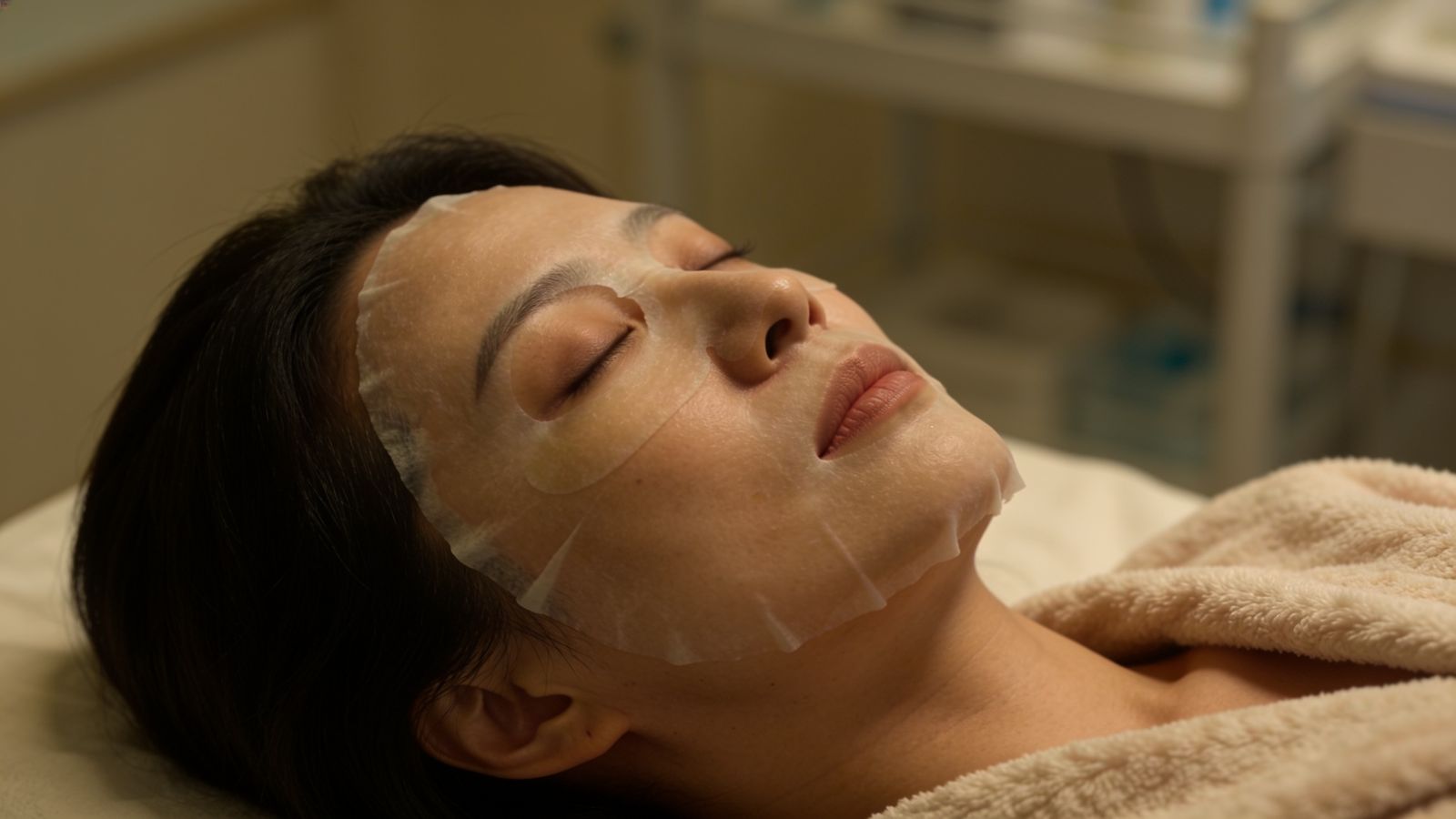
On intact skin, vesicles have limited ability to cross the outer barrier. Their use in aesthetics is therefore mostly immediately after a procedure that opens temporary channels in the skin, such as microneedling, RF microneedling or fractional laser. The product is spread over the treated area in the minutes after the procedure, sometimes followed by a soothing mask, and occasionally provided for use over the next day or two.
The aim is to support the recovery phase: calming redness, helping the barrier rebuild and supporting the repair response the procedure has started. A randomised split-face study combining an adipose stem cell-derived exosome solution with fractional CO2 laser for acne scars reported better scar improvement and less post-treatment redness on the exosome side; a similar split-face study with microneedling for ageing skin reported improvements in wrinkles and elasticity. Both were small, and both used one specific product, so the findings do not automatically apply to other brands.
What happens at an exosome skin booster session, and how often is it repeated?
The exosome product is applied straight after microneedling or fractional laser, while the tiny channels are open. Sessions follow the spacing of that procedure, usually weeks apart, rather than a separate exosome schedule.
| Step | What happens | Why |
|---|---|---|
| Skin check | Active acne, infection, cold sores and recent tans are looked for first | These postpone microneedling or laser |
| Cleanse and numb | Make-up removed; numbing cream for comfort | The procedure, not the exosome, is what needs numbing |
| Microneedling or fractional laser | Fine channels are made in the surface | This is the treatment; the topical product rides on it |
| Topical exosome product | Applied straight away, while channels are open | More passes the surface in this short window |
| Afterwards | Gentle cleansing that evening; no make-up for the period advised; daily sunscreen | Open channels close over a day or two |
If the underlying procedure is microneedling in Singapore, the session spacing, downtime and number of sessions are those of microneedling. The exosome product does not change them.
What the evidence does and does not show
What is reasonably supported: vesicles from certain cell sources influence skin cells in the laboratory, and a handful of small human studies report faster settling and some added improvement when a characterised exosome product is applied after microneedling or laser. What is not yet established: the right dose, how often to apply it, how one product compares with another, whether results last, and long-term safety across the wide range of products sold.
That places exosome boosters as an adjunct, not a stand-alone treatment. Applied to unbroken skin as a serum, they are unlikely to do more than a well-formulated moisturiser. Used after a procedure, they may help recovery. They are not a substitute for the procedure itself, for sun protection, or for an injectable booster where the skin genuinely needs dermal support. Their use in scalp care is covered in exosomes for the scalp, further down this page.
It is also worth knowing who funds the research. Much of the early clinical work has been carried out with a single manufacturer’s product, often in small groups followed for weeks rather than years. That does not make the findings wrong, but it does mean they need confirming in larger, independent studies before firm conclusions are drawn about exosomes as a class.
How Dr Sin Yong uses exosomes, and the alternatives
At IN Eternity Clinic, exosome products are used topically after selected procedures, such as fractional resurfacing, RF microneedling or scalp treatments, where supporting recovery is useful. They are not injected, and they are not sold as a stand-alone booster session. Products are obtained through authorised suppliers, as described on product sourcing.
If the goal is a skin booster in the usual sense, improving hydration, texture and resilience in the dermis, registered injectables are used instead. Polynucleotides such as Rejuran suit thin or sensitised skin, hyaluronic acid boosters suit dehydration, and PDLLA boosters such as Juvelook suit texture. For people who prefer to avoid injections, the needle-free Deep Synergy Booster uses ultrasound delivery. Dr Sin Yong will tell you at assessment which option suits your skin and why.
Can exosomes help hair loss, and where do they fit in a scalp plan?
Exosomes are not a hair-loss treatment on their own; a topical product may be applied after scalp microneedling as an adjunct while the cause is treated. Hair loss has many causes, including pattern hair loss, shedding after illness or childbirth, patchy autoimmune loss, and thyroid or iron problems, and some need blood tests before anything else.
The treatments with the strongest evidence for pattern hair loss are medical ones, prescribed after assessment. Where a topical exosome product is used on the scalp, it sits alongside that plan rather than replacing it, and the evidence for it is early and small. The options, and how they are combined, are set out on our page on hair loss treatment in Singapore.
How are exosome products made, and why does the source matter?
Exosome products are made by growing cells, often stem cells from fat tissue, bone marrow or umbilical cord, or by using plants, and collecting the vesicles released into the culture fluid. They are separated by ultracentrifugation, filtration or chemical precipitation, and each method yields a different mixture of particles and proteins.
That is why international research guidelines ask scientists to state exactly how vesicles were isolated and characterised, and why one product’s results cannot be assumed for another. A 2026 review that looked at the first 20 exosome cosmetics found online reported little information on isolation, processing or shelf life. For anyone considering a product, the useful questions are practical: what the source cells are and how donors were screened, how it is made sterile, what its registration status is in Singapore, and whether it was tested for use on freshly treated skin rather than as a cosmetic serum.
Exosome booster claims: what the label says and what is established
Most exosome claims describe laboratory or early clinical findings. What is established is narrower: topical use after a procedure, early small studies, and no HSA registration for injection.
| Claim you may see | What is established | What to ask |
|---|---|---|
| “Stem cell treatment” | Exosomes are vesicles released by cells, not cells; products are cell-free | What the source is: plant, yeast or human-cell culture |
| “Regenerates collagen” | Laboratory and small early clinical studies; size and durability unclear | Which study, in whom, compared with what |
| “Injectable exosome booster” | No exosome product is registered by HSA for injection | What the product is registered for |
| “Works on its own as a serum” | Intact skin lets little through; use is usually after a procedure | Whether it is applied after microneedling or laser |
| “No side effects” | Redness and irritation come mostly from the procedure; reactions to any topical are possible | What happens if the skin reacts |
Exosome booster or registered skin booster: which suits your goal?
Most people asking about an exosome skin booster want better hydration, texture or recovery. At IN Eternity Clinic, exosome products are used only on the skin as part of a procedure, and the injected options are registered skin boosters, compared on our page on skin booster in Singapore.
| Goal | What is usually used | Why |
|---|---|---|
| Calmer recovery after fractional laser or microneedling | A topical exosome product applied as part of that procedure | It is used while the skin barrier is temporarily open |
| Dehydration and fine, crepey lines | Profhilo (hyaluronic acid) | A registered injectable that binds water in the dermis |
| Thin, sensitised or slow-to-recover skin | Rejuran (polynucleotides) | A registered injectable used to support repair |
| Texture, pores and early acne scars | Juvelook (PDLLA) or RF microneedling | Collagen stimulation |
| Wanting to avoid needles | Needle-free skin booster | Delivered without injections |
How these injectables differ is set out in skin boosters explained.
What are the side effects of an exosome skin booster?
Topical exosome boosters usually cause only redness, warmth and stinging from the procedure they follow; allergy, delayed firm bumps and infection from a non-sterile product are uncommon. In the split-face acne-scar trial, the exosome side had milder redness and slightly shorter downtime than the control side (Kwon et al., 2020). How this compares with the bumps and bruising of injected boosters is set out in skin booster side effects.
Reported side effects of topical exosome products in studies have been mild, but the studies are small and short, and products differ.
Common, and usually short-lived
- redness, warmth and swelling, mostly from the procedure itself rather than the product;
- stinging when a product is applied to freshly treated skin.
Uncommon
- irritation or an allergic reaction to the product or its added ingredients;
- firm red bumps appearing weeks later (granulomatous reactions), which have been reported when unsuitable topical products were applied to microneedled skin;
- infection if a product is not sterile;
- unknown long-term effects, and variation between batches.
When to contact the clinic straight away
- firm red bumps or nodules appearing weeks after treatment;
- spreading redness, pus or a fever;
- swelling of the lips or eyes, or wheezing, which needs emergency care (call 995).
Injected exosome products carry more uncertainty, because a biological material of variable source is placed inside the skin. No exosome product is registered by HSA for injection, and IN Eternity Clinic does not inject them.
Home exosome serums vs exosomes after a procedure: what differs, and how long do effects last?
Home exosome serums are cosmetics applied to intact skin, which lets little through, so they behave much like a good moisturiser. In clinic, exosomes are applied straight after microneedling or laser. How long any benefit lasts has not been established; what you see mostly follows the procedure itself.
| Home exosome serum or ampoule | Exosomes after an in-clinic procedure | |
|---|---|---|
| How it reaches the skin | Spread over intact skin | Spread over skin with fresh channels from microneedling or fractional laser |
| What it is mainly for | Comfort, hydration, a smoother feel | Supporting recovery after the procedure |
| What drives visible change | The rest of the formula and daily use | Mostly the procedure; exosomes are an add-on |
| How long effects last | While you keep using it | Not established; change from the procedure builds over weeks to months |
| Regulation in Singapore | Sold as a cosmetic | Topical use only; no exosome product is registered by HSA for injection |
Why the duration question has no clean answer: published studies are small and short, and they measure exosomes alongside a procedure. Change after microneedling or laser builds as collagen remodels, so it is hard to separate the add-on from the treatment it was paired with. Claims of a fixed number of months should be read with that in mind.
Exosomes and retinoids do different jobs. A prescribed or cosmetic retinoid acts on the skin day after day with a long record of study; an exosome serum is newer and less studied. They are not interchangeable, and retinoids are usually paused around microneedling or laser. Where the goal is lasting change in hydration or texture, registered options are compared on skin boosters in Singapore, and the procedure itself on microneedling in Singapore. Results vary, and suitability is decided at assessment.
Frequently asked questions about exosome skin booster
Exosome treatment Singapore: is it injected?
No. Exosome products are applied to the skin surface, typically after microneedling or fractional laser, and are not injected. Ask what product is used and how it is regulated before treatment.
What is an exosomes treatment?
An exosomes treatment applies a serum containing exosomes, tiny packets that cells release to signal to other cells, onto the skin, usually straight after microneedling or laser so it can pass through the channels. It is topical, not injected, and the evidence is still early.
What do exosomes do for the skin?
In wound-healing research, vesicles released by stem cells and skin cells appear to influence inflammation, blood vessel growth and collagen production. Small randomised split-face studies reported added improvement and calmer recovery when a specific exosome solution was applied after fractional CO2 laser or microneedling. The studies are small and product-specific, so exosomes are better seen as an adjunct to a procedure, not a treatment on their own.
What does an exosome skin booster contain?
Contents vary by product. Some are derived from human cell cultures, often adipose-derived or other stem cells, with the vesicles separated from the culture fluid and freeze-dried. Others are plant-derived vesicle preparations. Many are mixed with peptides, growth-factor-like ingredients or hyaluronic acid. None contains living cells, and it is reasonable to ask what the source is and what the product is registered for.
What is an exosome skin booster?
It is usually a topical product containing extracellular vesicles, tiny signalling packages released by cells, applied straight after microneedling or fractional laser while the skin is temporarily open. The aim is to support recovery and the repair response the procedure starts. Despite the name, it is not an injectable booster in the way Rejuran or Profhilo is.
Do exosome skin boosters work?
Small randomised split-face studies have reported added improvement and calmer recovery when a specific exosome solution was applied after fractional CO2 laser or microneedling. The studies are small and product-specific, and dosing is not standardised. Exosomes are better seen as an adjunct to a procedure than as a treatment on their own.
Are exosome skin boosters HSA-registered?
No exosome product is registered by HSA for injection into the skin. Products applied to the skin after a procedure are a different category from injectables. Before any treatment, ask what the product is, who makes it and what it is registered or notified for.
How soon will I see results from an exosome skin booster?
Because exosome products are used with a procedure, the timeline follows that procedure. Small studies reported calmer, faster recovery in the first days after fractional laser when an exosome solution was added. Changes in texture and scarring come mainly from the laser or microneedling itself and build over weeks to months.
Does an exosome skin booster treatment hurt?
The product itself does not hurt; it is spread over the skin. The discomfort comes from the procedure it is paired with. Microneedling and fractional laser are done after numbing cream, and the skin may feel warm and tight for a few hours. A brief sting when the product is applied is common.
What are the side effects of an exosome skin booster?
Most of what people notice, such as redness, warmth and swelling, comes from the laser or microneedling it follows, and stinging is common as it goes on. Irritation, allergy, firm red bumps weeks later and infection from a non-sterile product are uncommon. Swelling of the lips or eyes, or wheezing, needs emergency care.
Book an assessment
IN Eternity Clinic, 9 Scotts Road, #12-01 Pacific Plaza, Singapore 228210. By appointment with Medical Director Dr Sin Yong. Monday to Saturday, 11am to 8pm. WhatsApp or call +65 8815 3008.
International KOL — CLASSYS · HIRONIC · DEKA · ALMA · FOTONA · LUTRONIC
References
- Olumesi KR, Goldberg DJ. A review of exosomes and their application in cutaneous medical aesthetics. J Cosmet Dermatol 2023;22(10):2628-2634. doi:10.1111/jocd.15930
- Théry C, Witwer KW, Aikawa E, et al. Minimal information for studies of extracellular vesicles 2018 (MISEV2018): a position statement of the International Society for Extracellular Vesicles and update of the MISEV2014 guidelines. J Extracell Vesicles 2018;7(1):1535750. doi:10.1080/20013078.2018.1535750
- Kwon HH, Yang SH, Lee J, et al. Combination Treatment with Human Adipose Tissue Stem Cell-derived Exosomes and Fractional CO2 Laser for Acne Scars: A 12-week Prospective, Double-blind, Randomized, Split-face Study. Acta Derm Venereol 2020;100(18):adv00310. doi:10.2340/00015555-3666
- Park GH, Kwon HH, Seok J, et al. Efficacy of combined treatment with human adipose tissue stem cell-derived exosome-containing solution and microneedling for facial skin aging: A 12-week prospective, randomized, split-face study. J Cosmet Dermatol 2023;22(12):3418-3426. doi:10.1111/jocd.15872
- Health Sciences Authority, Singapore. Infosearch — registered medical devices and health products. hsa.gov.sg
- Knauer et al. Clinical evidence and commercial landscape of topical exosomes for skin rejuvenation: a scoping review. Aesthet Surg J 2026. doi:10.1093/asj/sjag141
- Soltani-Arabshahi R, Wong JW, Duffy KL, Powell DL. Facial allergic granulomatous reaction and systemic hypersensitivity associated with microneedle therapy for skin rejuvenation. JAMA Dermatol 2014;150(1):68-72. doi:10.1001/jamadermatol.2013.6955
These sources describe mechanisms and general evidence. They are not a promise of any individual result; suitability is decided at an in-person assessment.