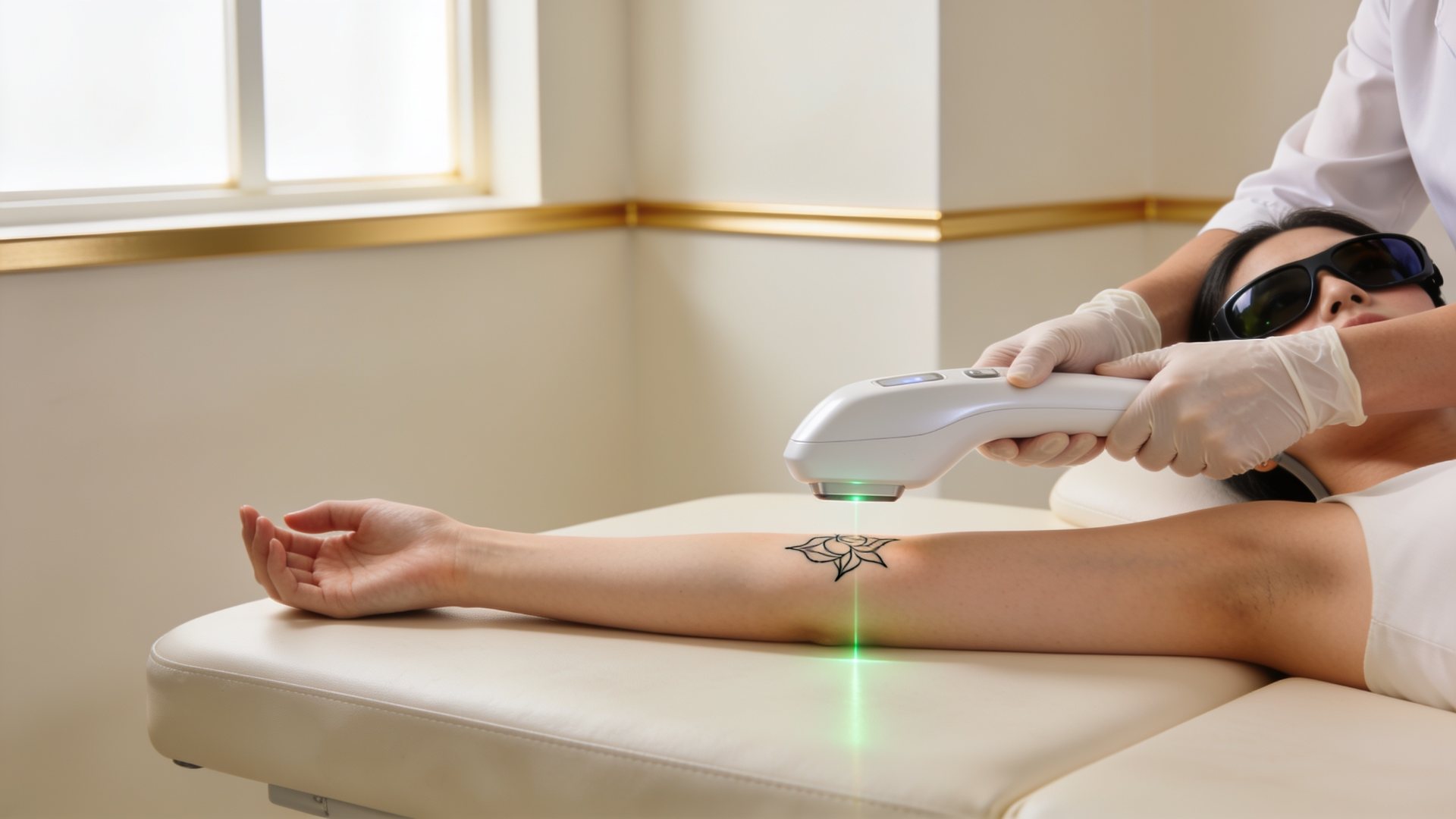
Tattoo Blowout Removal in Singapore: Fixing Blurred, Spread Ink
Medical Director Dr Sin Yong explains what a tattoo blowout is, why it happens, and how T2 Targeted Tattoo laser can lighten the blurred halo, fade the tattoo for a rework or remove it.
Treatment page: T2 tattoo removal in Singapore.
WhatsApp to Enquire →Key facts ↓A tattoo blowout is ink that has spread under the skin into a blurry halo around the lines, usually because it was placed too deep or at an angle. T2 Targeted Tattoo laser can lighten just the halo, fade the whole tattoo so an artist can rework it, or remove it, once the tattoo has fully healed.
- It shows early: blowouts usually appear within days to weeks of the tattoo, once swelling settles, rather than years later.
- It is a depth problem: ink pushed below its intended layer spreads sideways, so the halo sits deeper than the lines.
- The halo can be treated alone: small spot sizes allow the blurred edge to be lightened while the main lines are left for the artist.
- Session numbers depend on ink and depth: the Kirby-Desai scale lists layering, ink amount, location and scarring among the factors that predict how many sessions are needed [1].
- Picosecond evidence is strong: a systematic review rated picosecond laser evidence as level I for tattoo removal [2].
What is a tattoo blowout?
A blowout happens when ink is deposited deeper than the layer it is meant for, or at an angle, and spreads sideways under the skin. The result is a soft, bluish or grey haze around lines that should be crisp. It is most common where skin is thin or stretchy: the inner arm, wrist, ankle, ribs and top of the foot.
A blowout is not an infection or allergy, and it does not fade away by itself, though it may soften a little as the skin settles in the first weeks.
How can a blowout be fixed?
- Lighten the halo only: laser with a small spot size on the blurred edge, leaving the lines intact.
- Fade, then rework: a few sessions to lighten the whole tattoo so an artist can redraw it cleanly or design a cover-up.
- Full removal: when you would rather start with clear skin.
- Cover-up alone: possible for some designs, but a darker, larger design is often needed, and fading first gives more choice.
How T2 Targeted Tattoo laser treats blowout
T2 is IN Eternity Clinic’s tattoo removal protocol on the DEKA TORO. Most blowouts are black or dark grey ink, which responds to 1064 nm; coloured blowouts are matched colour by colour. Because blowout ink sits deeper than the lines, settings and spot size are chosen for the halo specifically, and progress is reviewed between sessions [2].
When should a blowout be treated?
Wait until the tattoo has fully healed, usually several weeks, so that swelling has settled and the true extent of the blowout is clear. Treating while the skin is still healing risks scarring. If you plan a rework, agree the order with your artist: laser first, rework after the skin has recovered.
How many sessions, and what is recovery like?
Lightening a halo before a rework often needs fewer sessions than full removal. Dense, deep or coloured blowouts take longer [1]. Sessions are spaced several weeks apart, and results vary.
- Redness, swelling and a white frosting for minutes to hours.
- Pinpoint crusts or small blisters for several days; leave them to heal.
- Keep the area clean and protected from sun between sessions.
What Dr Sin Yong looks for
- How far the ink has spread, and whether the lines themselves are still sharp.
- The ink colours and how deep the blurred area sits.
- Any scarring or raised skin from the original tattoo.
- Whether you plan a rework or cover-up, and what your artist needs.
- Your skin type and healing history.
Frequently asked questions
What are the signs of a tattoo blowout?
A soft blue or grey haze spreading out from the lines, lines that look thicker or fuzzier than they did on day one, and blurring that appears within days to weeks once the swelling settles. Bruising fades within two weeks; blowout does not.
Is tattoo blowout common?
It is one of the more common technical problems, especially on thin or stretchy skin such as the inner arm, the elbow ditch, the wrist, the ribs and the top of the foot.
Is a tattoo blowout my fault?
Usually not. Blowout is mainly about needle depth and angle, which is the artist’s technique, although very thin skin and stretching the skin during tattooing make it more likely.
Can white ink fix a tattoo blowout?
Covering a blowout with white or skin-toned ink is not recommended. These pigments often contain titanium dioxide, which can shift colour over time and can darken when lasered later, making a future fix harder.
Will a tattoo blowout fade on its own?
It may soften slightly in the first weeks as swelling settles, but the spread ink does not disappear by itself.
Can laser remove just the blowout and keep the tattoo?
Often, yes. The blurred halo can be lightened with a small spot size while the main lines are left in place, either on its own or before an artist reworks the design.
How soon can a blowout be treated?
Once the tattoo has fully healed, usually several weeks after it was done.
Is a cover-up better than laser for a blowout?
Some blowouts can be covered, but usually with a darker or larger design. Fading first with laser gives the artist, and you, more choice.
Does blowout laser hurt?
It feels like quick, hot snaps. Numbing cream is applied beforehand and cooling is used during treatment.
How much does tattoo blowout removal cost?
It depends on the size of the area, the ink and the number of sessions likely. An estimate is given after assessment; the tattoo removal cost guide explains the factors.
Book an assessment
IN Eternity Clinic, 9 Scotts Road, #12-01 Pacific Plaza, Singapore 228210. By appointment with Medical Director Dr Sin Yong. Monday to Saturday, 11am to 8pm. WhatsApp or call +65 8815 3008. At IN Eternity Clinic a consultation fee applies, and it is waived if you go ahead with any medical treatment; the fee is S
International KOL — CLASSYS · HIRONIC · DEKA · ALMA · FOTONA · LUTRONIC
References
- Kirby W, Desai A, Desai T, Kartono F, Geeta P. The Kirby-Desai Scale: a proposed scale to assess tattoo-removal treatments. J Clin Aesthet Dermatol 2009;2(3):32-37. PubMed 20729941
- Wu DC, Goldman MP, Wat H, Chan HHL. A systematic review of picosecond laser in dermatology: evidence and recommendations. Lasers Surg Med 2021;53(1):9-49. doi:10.1002/lsm.23244
Figures taken from the published papers and abstracts. Results vary between people; suitability is decided at an in-person consultation.