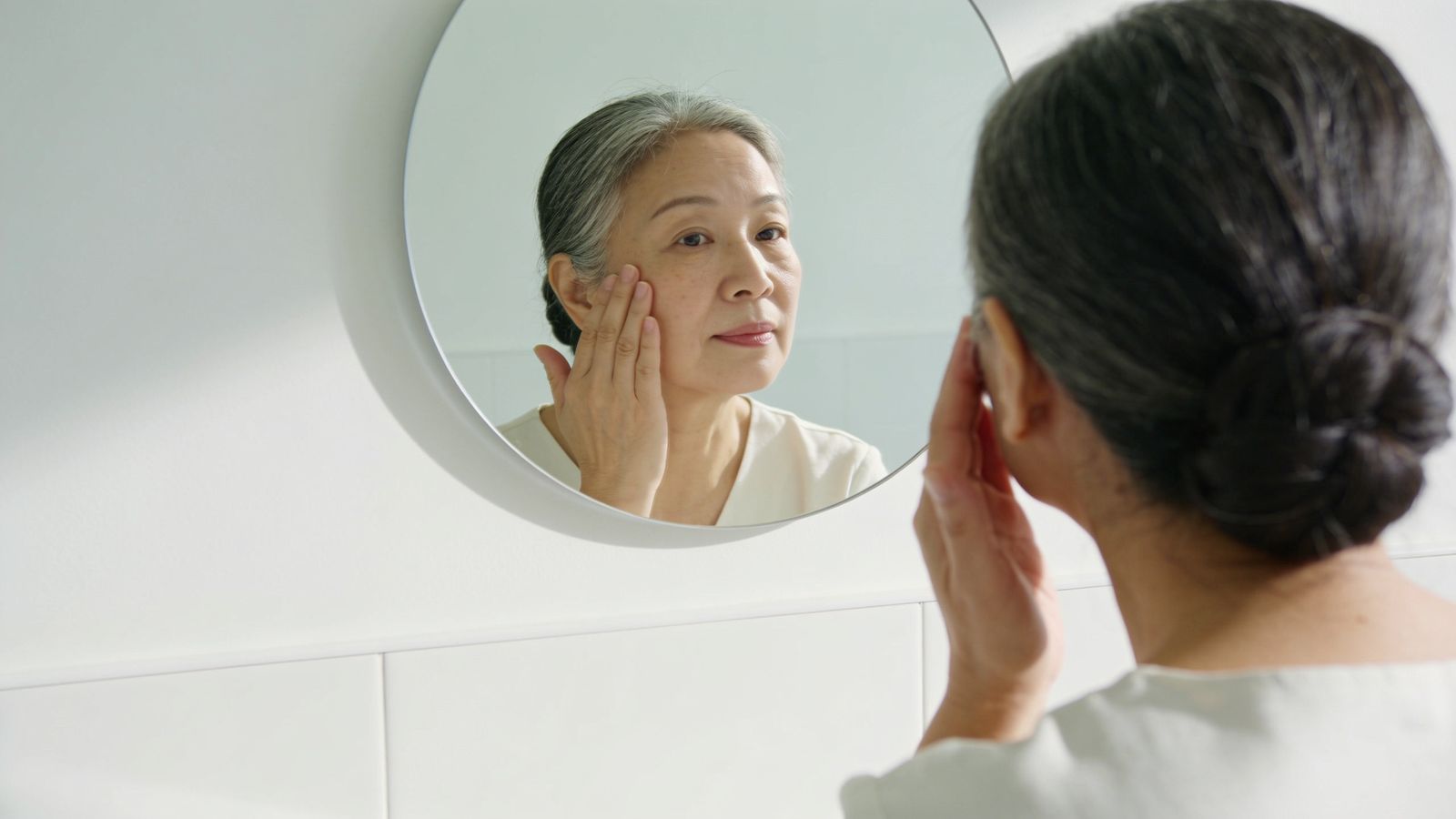
Age spots are flat brown marks left by years of sun. At IN Eternity Clinic on Orchard Road, Dr Sin Yong examines each one before choosing a laser, because not every brown spot is a sun spot.
WhatsApp to Enquire →Key facts ↓Age spots, also called sun spots or solar lentigines, are flat brown marks with sharp edges caused by years of UV exposure. They are usually removed with a picosecond or Q-switched pigment laser, often in one to three sessions, with fine crusts for about a week. Each spot is checked first, and daily sunscreen helps prevent new ones forming.
“Age spot” is an everyday name, and people use it for several different marks. The true age spot is a solar lentigo: flat, evenly brown, with an edge you can trace, appearing in adulthood on sun-exposed skin and staying the same through the year. The table shows how it differs from the spots it is most often confused with.
| Spot | Typical clues | Usual approach |
|---|---|---|
| Age spot / sun spot | Flat, sharp edges, adult onset, stable all year | Pigment laser, one to three sessions |
| Freckle | Small, since childhood, darker in sun, lighter without it | Light pigment laser; returns with sun |
| Melasma | Symmetrical patches with blurred edges, hormone- and heat-sensitive | Medical care first; gentle laser only |
| Seborrhoeic keratosis | Raised, waxy or rough, “stuck-on” look | Superficial resurfacing |
| Hori’s naevus | Grey-brown dots over both cheekbones, deeper in the skin | Longer wavelengths, several sessions |
Any spot that is new, changing, irregular in shape or colour, itchy, bleeding or unlike your other spots is examined with a dermatoscope before anything else is done. Laser destroys pigment without leaving tissue to examine, so a spot that is uncertain is not lasered; it is referred for specialist assessment or removed for laboratory examination instead. Pigmented moles are covered on mole removal.

Age spots sit near the surface, in the lower epidermis, which makes them one of the more responsive pigment problems. They are treated with very short laser pulses that are absorbed by melanin and break it into fragments. The fragments rise with the healing skin and flake away over the following week, and the remainder is cleared by the body. A 532 nm wavelength is commonly used because it is absorbed strongly by surface melanin; a longer wavelength may be chosen for darker skin or deeper spots.
IN Eternity Clinic uses picosecond and Q-switched pulses on the DEKA TORO and the Fotona StarWalker PQX. Picosecond pulses deliver the energy faster and with less heat. In a randomised split-face study of solar lentigines in Asian patients, a 532 nm picosecond laser cleared pigment at least as well as a 532 nm Q-switched laser, with less post-inflammatory hyperpigmentation; Q-switched laser has also compared favourably with fractional CO2 for lentigines in Asian skin. Dr Sin Yong chooses the pulse and wavelength for each spot and for your skin type. The wider approach is described on pico laser Singapore.
Spots on the backs of the hands and forearms are treated in the same way, with more cautious settings and a longer healing time, because skin there heals more slowly. Rough or raised spots that turn out to be seborrhoeic keratoses are usually treated with superficial CO2 laser on the DEKA SmartXide Tetra PRO rather than pigment laser. Where many small spots sit on a background of blotchy tone, spot treatment may be followed by gentle laser toning.
“A brown spot is not automatically a sun spot. If I am not certain what it is, I do not laser it.”
Each pulse feels like a quick snap of a rubber band, with brief heat. Because only the spots are treated, a session is short, often ten to twenty minutes for the face. Spots on the upper lip, nose and over bone feel sharper. Numbing cream is applied for 20 to 30 minutes beforehand where many spots are treated, and cold air or a cool compress is used during and after. Protective eyewear is worn throughout, and you can ask to pause at any time.

Day 0. Each treated spot turns briefly white-grey, then darker, with a small rim of redness. It stings like mild sunburn for an hour or two. Ointment and sunscreen are applied before you leave.
Days 1–3. The spots look darker than before and slightly raised, like fine coffee grounds. This is fragmented pigment coming up with the healing surface. Keep the area clean and moisturised and do not pick.
Week 1. Micro-crusts on the face lift between days five and ten, leaving pink skin. Crusts on the hands can stay for up to two weeks. Pause retinoids, acids and scrubs until the skin has settled.
Weeks 2–4. The pink fades. A faint brown shadow can appear in this period, especially in darker skin or after sun exposure; it is post-inflammatory and usually temporary, and is treated early. Daily sunscreen matters most now.
Review. At six to eight weeks the spots are reviewed. Many have cleared or lightened markedly; stubborn spots may have a second session, at least six weeks after the first.

Removing existing spots does not change the skin’s tendency to make new ones. Singapore’s UV index is high all year, so daily broad-spectrum sunscreen on the face, neck and backs of the hands, reapplied when outdoors, is what protects the result. A hat and shade add to it, and driving exposes the hands and the side of the face nearest the window. Topical products containing antioxidants or gentle pigment-modifying ingredients can help keep tone even, and a periodic check lets new spots be treated while they are small.
If you have many sun spots, it is also a reason for an occasional skin check, because the same sun exposure that causes lentigines raises the risk of skin cancer. The pigmentation hub covers every type of pigment treated at IN Eternity Clinic.
They are the same thing. Age spots, sun spots and liver spots are everyday names for solar lentigines: flat, sharply edged brown spots caused by years of UV exposure. They are not caused by age itself or by the liver. Unlike freckles they do not fade in winter or with less sun, and unlike melasma they are not symmetrical patches.
Many age spots lighten markedly after one session, and most respond within one to three sessions spaced at least six weeks apart. Darker or thicker spots, spots on the hands and spots in darker skin may need more. The plan is reviewed at each visit, and spots that do not behave as expected are re-examined rather than simply treated again.
A treated spot usually stays lighter, but the tendency to form spots remains. Further sun exposure can bring back pigment in the same place or create new spots nearby. Daily sunscreen, shade and a hat protect the result, and small new spots can be treated early at a review visit.
Yes. Spots on the backs of the hands respond to the same pigment lasers, with gentler settings. Healing is slower than on the face, and crusts can last up to two weeks. Hands are exposed to sun every day, including while driving, so sunscreen on the hands afterwards is essential. Volume loss on the hands is a separate concern with separate treatments.
Usually, with adjustments. Darker skin is more prone to post-inflammatory hyperpigmentation after any laser, so wavelength and energy are chosen for your skin type, spots may be treated in stages, and a test spot is sometimes done first. Avoiding sun in the weeks around treatment, and not picking the crusts, lowers the risk considerably.
Cost depends on how many spots are treated, their size and location, whether the face, hands or other areas are included, the laser used and how many sessions are likely to be needed. Some spots turn out to need a different treatment once examined. Dr Sin Yong gives a written quote after assessment, and the consultation fee is waived with any medical treatment.
IN Eternity Clinic, 9 Scotts Road, #12-01 Pacific Plaza, Singapore 228210. By appointment with Medical Director Dr Sin Yong. Monday to Saturday, 11am to 8pm. WhatsApp or call +65 8815 3008.
These sources describe mechanisms and general evidence. They are not a promise of any individual result; suitability is decided at an in-person assessment.