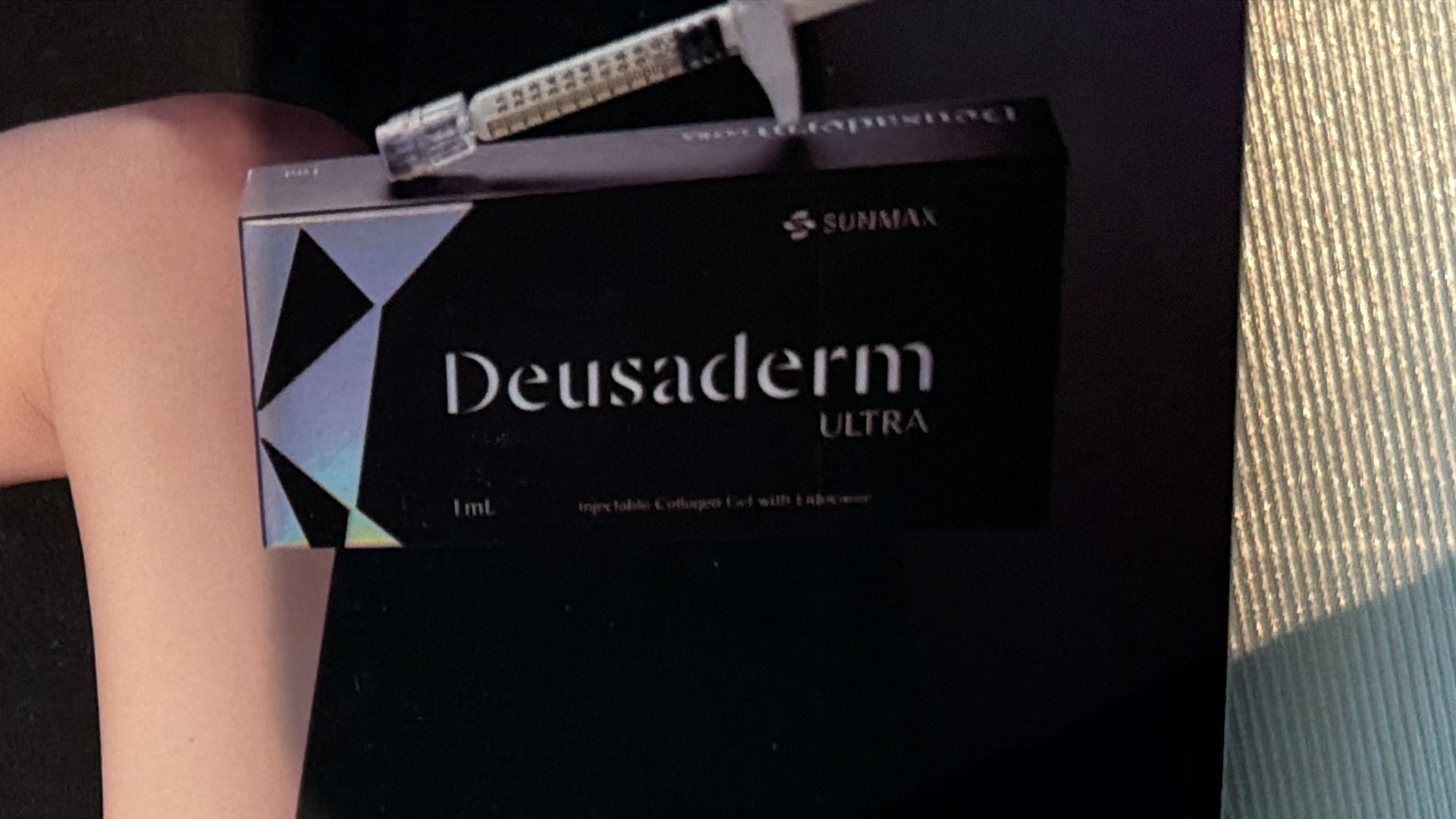
Deusaderm and Collagen Injection Complications: Lumps, Nodules, Bulges and Whitish Areas
Deusaderm (SUNMAX, Taiwan) is a cross-linked porcine type I atelocollagen gel with lidocaine. It is placed, not stimulated, and it does not respond to hyaluronidase. Medical Director Dr Sin Yong explains the complications people report after collagen injection, how each is diagnosed, and the realistic options for correcting them, wherever the injection was done.
Related: filler correction and dermal filler complications.
WhatsApp to Enquire →Key facts ↓Deusaderm is an injectable collagen filler: cross-linked porcine type I atelocollagen (35 mg/mL) with lidocaine, made by SUNMAX. Because it is collagen rather than hyaluronic acid, it cannot be dissolved with hyaluronidase. The complications people describe are lumps and nodules, a bulge or ridge along the line of placement, a whitish or pale area where opaque collagen sits too close to the surface, swelling and bruising, and rarely allergy or vascular problems. Most mild problems settle as the collagen is resorbed over months. Persistent lumps are mapped by ultrasound first, then managed with targeted injections, careful massage protocols and time; surgical removal is a last resort. Dr Sin Yong assesses collagen complications from any clinic. Results vary between people.
- Collagen is opaque and does not draw water: so it does not give the blue Tyndall tint of hyaluronic acid, but superficial placement can show as a whitish or pale line instead [1].
- The published trial was in nasolabial folds: a randomised, double-blind, multicentre study followed participants to 52 weeks; most adverse events were injection-site reactions that resolved within a month [2].
- Hyaluronidase has no effect on collagen: the enzyme breaks down hyaluronic acid only, so correction relies on diagnosis, resorption over months and targeted treatment [3].
- Ultrasound comes first: high-frequency ultrasound identifies the material, its depth and whether a lump is collagen, hyaluronic acid, a cyst or scar before anything is injected or added [4].
- Collagen fillers have a known complication list: injection-site reactions, discolouration and uneven placement early; granulomas and foreign-body reactions later; rarely skin necrosis or vision loss [3].
What Deusaderm is, in one paragraph
Deusaderm is a cross-linked, purified collagen gel from specific-pathogen-free porcine skin, predominantly type I with a type III fraction, at 35 mg/mL, with 3 mg/mL lidocaine [2]. Cross-linking slows its breakdown compared with native collagen. It is used in thin-skinned areas such as the tear trough, fine periorbital and perioral lines and crepey skin, where hyaluronic acid can swell or show blue. It adds collagen directly; it is not a volumiser and not a collagen stimulator.
The distinction matters for complications. Hyaluronic acid problems are usually reversible with hyaluronidase. Collagen problems are not, so prevention, conservative placement and accurate diagnosis carry more weight.
The five problems people describe after collagen injection
- Lumps and nodules. Small firm nodules at or near the injection points, usually from a bolus placed too superficially or too much in one spot. Early nodules are often swelling and settle; persistent ones are product that will resorb over months, or rarely a foreign-body reaction or granuloma [3].
- A bulge or ridge. A visible line or fullness along the path of a cannula or needle, most often in the tear trough or lip lines, from product tracking in a plane that is too shallow or from overcorrection. Collagen does not swell afterwards, so a bulge seen at two weeks is product, not fluid.
- A whitish or pale area. Collagen is opaque and white. Placed very superficially, it can show through thin skin as a pale or whitish streak, the collagen equivalent of the blue Tyndall effect seen with hyaluronic acid [1]. It fades as the material is resorbed.
- Swelling, bruising, redness, itch. The commonest reactions, usually settling in days to a few weeks; in the trial most resolved within a month [2].
- Rare but serious. Allergy to porcine collagen (uncommon; a history of pork or collagen allergy still matters), infection, and vascular occlusion, which can cause pale or dusky skin, pain or vision change and is an emergency [3].
Why hyaluronidase does not help, and what does
Hyaluronidase is an enzyme that cleaves hyaluronic acid. Collagen has a different structure, so the enzyme has no effect on Deusaderm, Sculptra, Radiesse or Ellansé. A clinic that injects hyaluronidase into a collagen lump will see no change and may add swelling. The first step is therefore to confirm what the lump is.
At IN Eternity Clinic that means high-frequency ultrasound: collagen, hyaluronic acid, calcium hydroxylapatite and polycaprolactone each look different on the scan, and the depth and spread of the material are measured before any plan is made [4]. If the scan shows hyaluronic acid from an earlier treatment, that part can be dissolved; if it shows collagen, the options below apply.
Realistic options for Deusaderm lumps, bulges and whitish areas
- Time. Cross-linked collagen is resorbed over months. A small nodule or pale line that is not inflamed is usually watched, with review at six to eight weeks.
- Guided massage protocols. For soft, recent lumps, a structured massage plan over the first weeks can redistribute product; it is not used on inflamed nodules.
- Targeted injections. Inflamed or persistent nodules may be treated with small, ultrasound-guided anti-inflammatory injections to soften them. Saline infiltration can help a tight bolus disperse.
- Laser or radiofrequency. In selected cases, energy devices are used to speed remodelling around a firm deposit or to tighten skin over a bulge once the product has settled.
- Needle release or aspiration. A recent superficial bolus can sometimes be expressed through a needle; this is a judgement made on ultrasound, not by feel.
- Surgical removal. A last resort for a persistent, visible nodule in a cosmetically important site, referred to a surgeon.
- What is not done: adding more product on top of a lump to “smooth it out”, or injecting hyaluronidase into collagen.
How complications are avoided in the first place
Most collagen complications trace back to placement: too superficial, too much in one point, or the wrong plane for the area. Conservative volumes, a deeper plane in the tear trough, staged sessions with review before anything is added, and avoiding injection in a face that already carries unknown filler all reduce the risk. A history of pork, collagen or multiple filler reactions is asked about before treatment, and anyone on blood thinners is counselled on bruising.
If you have had Deusaderm or another collagen injection elsewhere and something feels or looks wrong, a review with ultrasound is the sensible first step. Pale or dusky skin, severe pain, vision change, a growing or hot lump, or spreading redness with fever need same-day contact.
Deusaderm next to the other non-dissolvable injectables
- Deusaderm: collagen placed directly; opaque; no water swelling; resorbs over months; complications are nodules, bulges and pale lines.
- Sculptra: poly-L-lactic acid scaffold; collagen forms over months; nodules usually from under-dilution or superficial placement; managed with injections, massage and time.
- Radiesse: calcium hydroxylapatite in gel; immediate fill then collagen; nodules uncommon, visible on ultrasound as bright deposits.
- Ellansé: polycaprolactone microspheres; immediate fill then collagen; longest-lasting of the group, so complications also last longest.
- Hyaluronic acid: the only one that can be dissolved, which is why it is the first choice for most beginners and for areas where reversibility matters.
Frequently asked questions
Can Deusaderm be dissolved?
No. Hyaluronidase dissolves hyaluronic acid only; it has no effect on collagen. Deusaderm lumps or bulges are managed with time, guided massage, targeted injections and, in selected cases, laser or needle release, after ultrasound has confirmed what the lump is.
How long do Deusaderm lumps last?
Early lumps that are swelling settle within days to a few weeks. Lumps that are product resorb over months as the cross-linked collagen breaks down; the exact time varies with the amount, depth and the person. Inflamed nodules are treated rather than waited out.
Why does my collagen injection look white or pale?
Collagen is opaque and white. Placed very close to the surface under thin skin, it can show as a pale or whitish streak. It fades as the collagen is resorbed and can be camouflaged in the meantime; nothing should be injected on top of it.
Is a bulge after collagen injection normal?
A soft bulge in the first week is often swelling. A firm bulge that persists at two to three weeks is usually product in a shallow plane or overcorrection. Collagen does not absorb water, so it will not enlarge later; it is assessed with ultrasound and managed as above.
Can collagen injection cause an allergic reaction?
Porcine atelocollagen is processed to remove the parts of collagen most likely to provoke allergy, and the published trial did not require a skin test. Allergy is uncommon but not impossible, and a history of pork, collagen or filler allergy is asked about before treatment.
Is Deusaderm the same as Sculptra or Ellansé?
No. Deusaderm places collagen directly; Sculptra and Ellansé stimulate your own collagen over months. All three are non-dissolvable, so the approach to complications is similar, but the materials look different on ultrasound and behave differently over time.
Do you treat Deusaderm complications from other clinics?
Yes. Dr Sin Yong assesses collagen, hyaluronic acid and collagen-stimulator complications regardless of where the injection was done. The assessment starts with ultrasound mapping; a written plan follows. No price list is published.
When is a collagen injection complication an emergency?
Pale or dusky skin, severe or increasing pain, vision change or pain on eye movement, a rapidly growing or hot lump, or spreading redness with fever. Contact the clinic the same day; vascular problems are time-critical.
Book an assessment
IN Eternity Clinic, 9 Scotts Road, #12-01 Pacific Plaza, Singapore 228210. By appointment with Medical Director Dr Sin Yong. Monday to Saturday, 11am to 8pm. WhatsApp or call +65 8815 3008. At IN Eternity Clinic a consultation fee applies, and it is waived if you go ahead with any medical treatment; the fee is S
International KOL — CLASSYS · HIRONIC · DEKA · ALMA · FOTONA · LUTRONIC
References
- Complications of collagen fillers. Facial Plastic Surgery 2014;30(6). Review of injection-site reactions, discolouration, uneven placement, granulomas and rare vascular events after collagen fillers.
- Yang CY, Chang YC, Tai HC, et al. Randomised, double-blind, multicentre trial of a cross-linked porcine collagen dermal filler with lidocaine for nasolabial folds, 52-week follow-up. Clinical, Cosmetic and Investigational Dermatology 2024;17:1621–1631. See also: An evaluation of skin and immunological responses after a novel cross-linked porcine-based injectable collagen with lidocaine. Journal of Clinical Medicine 2024.
- SUNMAX Biotechnology. Deusaderm product specification: cross-linked porcine type I atelocollagen 35 mg/mL with lidocaine HCl 3 mg/mL. Manufacturer information; hyaluronidase acts on hyaluronic acid only.
- Wortsman X. Identification and complications of cosmetic fillers: sonography first. Journal of Ultrasound in Medicine 2015;34(7):1163–1172. doi:10.7863/ultra.34.7.1163
Figures taken from the published papers and abstracts. Results vary between people; suitability is decided at an in-person consultation.