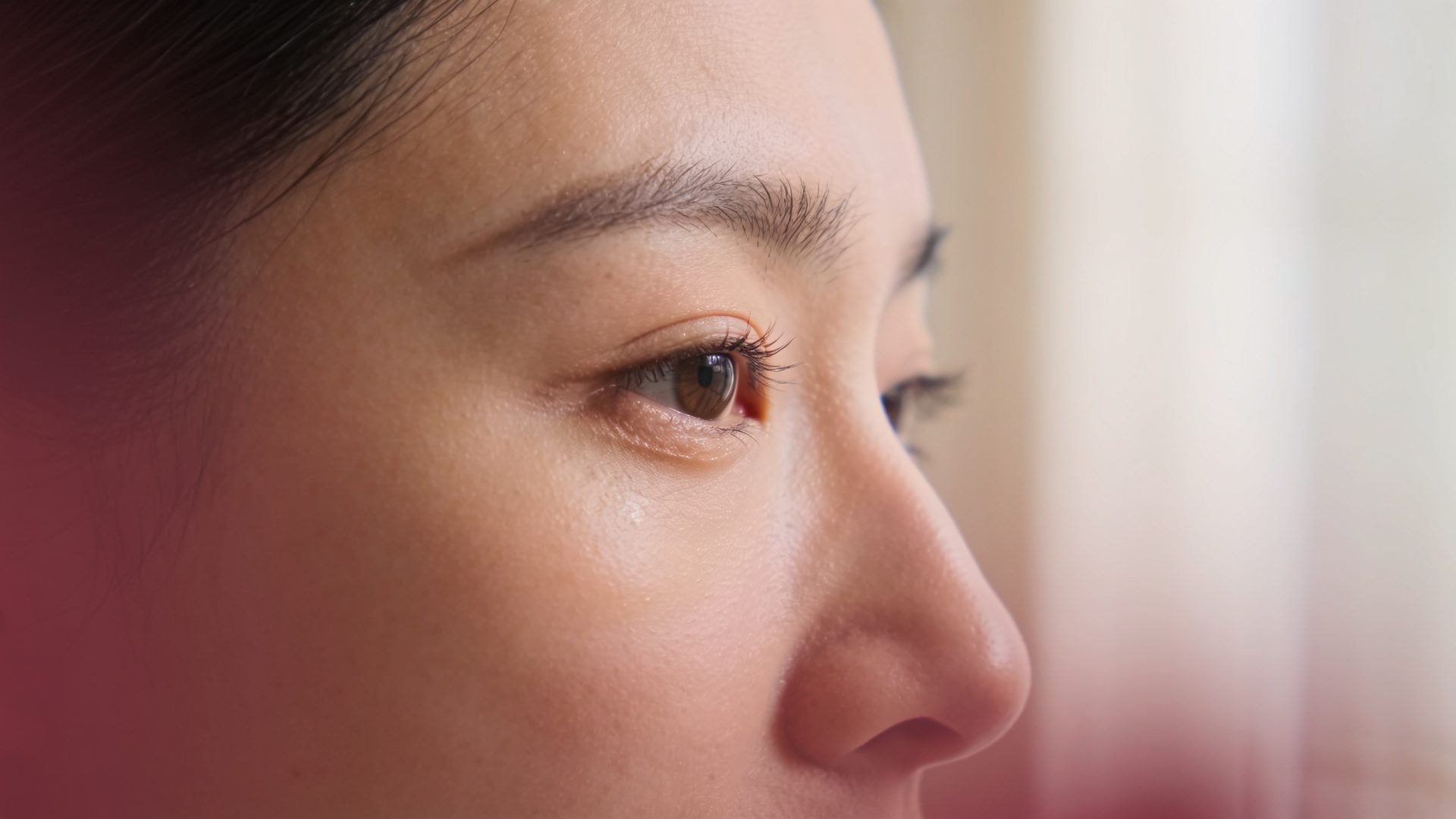
Eye Bags, Dark Circles or Hollows: Which Do You Have?
Medical Director Dr Sin Yong explains how eye bags, dark circles and tear trough hollows differ, and how each is matched to a treatment at IN Eternity Clinic.
WhatsApp to Enquire →Key facts ↓An eye bag is a bulge, usually fat pushing forward from behind the eye. A hollow is a groove under the eye that casts a shadow. A dark circle is colour: brown pigment, or blue-purple vessels showing through thin skin. Most people have a mix. Tear trough filler can soften a hollow but can make a true bag look worse. See eye bag removal in Singapore.
- No single cause: in 114 people seeking surgery for lower eyelid bags, a hollow tear trough with cheek descent and bulging orbital fat contributed most, followed by skin laxity and eyelid fluid; no one category dominated for most patients [1].
- Age: in the same study, tear trough depression and skin laxity were more common after the age of 50 [1].
- Dark circles: a review lists excess pigment, thin translucent lid skin over the muscle, and shadowing from laxity and the tear trough as causes, often several at once [2].
- Family and sleep: in one population study, family history was the strongest risk factor for dark circles, average onset was about 24 years, and sleep did not correlate with severity [3].
- Filler later: a review of 52 delayed problems after tear trough filler found swelling in 22 and lumps in 13, appearing on average 16.8 months after treatment [5].
What is the difference between eye bags, dark circles and hollows?
They look alike in the mirror but come from different layers. A true eye bag is fat from behind the eye bulging forward because the membrane holding it back has weakened. A tear trough hollow is the opposite: a groove beneath normal fullness, where volume and bony support have receded, so light falls into it and leaves a shadow.
A dark circle is about colour rather than shape. Brown or grey-brown pigment sits in the skin; a blue or purple tint is vessels and muscle showing through thin lid skin. A review of dark circles describes pigment, thin translucent skin and shadowing from laxity and the tear trough as the main causes, and notes that most people have more than one [2].
| Type | What you see | A simple clue | What usually helps |
|---|---|---|---|
| Eye bag (orbital fat) | A defined bulge under the lid | Bigger when looking up; constant through the day | Surgical opinion if it dominates; filler can make it look worse |
| Tear trough hollow | A dark crescent along a groove | Fades when you tilt your face up to an overhead light | Soft hyaluronic acid placed deep, where suitable [4] |
| Pigmented dark circle | Brown or grey-brown band | Stretching the skin does not lighten it | Gentle laser over a course, sun protection |
| Vascular dark circle | Blue, purple or reddish tint | Lightens a little when stretched | Skin-quality treatment such as Rejuran Eye |
| Puffiness (fluid) | Soft swelling, worse on waking | Changes with sleep, salt, alcohol and allergy | Treat the cause; filler is avoided |
Why do most people have more than one?
Because the lower lid ages in several ways at once. In a study of 114 consecutive people who came for eyelid bags, each was scored on six features. Cheek descent with a hollow tear trough and bulging orbital fat contributed most, with skin laxity and eyelid fluid next, and no single feature explained the appearance in most people [1]. Hollows and laxity were more common after 50.
Dark circles also start earlier than many expect. In one population study the average onset was about 24 years, family history was the strongest risk factor, and sleep did not correlate with severity; melanin was the main contributor to darkness, with blood oxygen second [3]. The study was in Brazil, so the mix of causes in Asian skin may differ, but the point holds: late nights make circles look worse, and rarely cause them alone.
When does tear trough filler suit, and when does it not?
Filler suits a hollow. A small amount of soft hyaluronic acid placed deep along the tear trough supports the groove so less shadow forms. A review of the anatomy describes non-surgical correction with hyaluronic acid as effective and safe when patients are chosen carefully and technique is precise [4].
Filler does not suit a bag, pigment or puffiness. Adding volume around a fat bulge makes the whole lid look heavier, and the lower lid already drains fluid slowly. Problems can also appear late: a systematic review of 52 delayed complications after tear trough filler found swelling in 22 and lumps or nodules in 13, on average 16.8 months after treatment [5]. At IN Eternity Clinic under-eye filler is soft hyaluronic acid only, usually placed by cannula in small staged amounts, and it can be dissolved. Results often last around nine to eighteen months, varying between people. See under-eye filler.
How is each cause treated at IN Eternity Clinic?
The cause is named first. Dr Sin Yong examines the under-eye at rest, looking up and in different light, because fat, hollows and fluid behave differently in each position. Where herniated fat dominates, he says so and refers to an oculoplastic or plastic surgery specialist for a surgical opinion rather than offering an injection.
Loose, crepey lid skin may be tightened with Thermage FLX using the eye tip, or with the Time Freeze Laser LCLR® under-eye zone. Thin skin may suit a short Rejuran Eye course. Brown pigment is treated with gentle pico or Q-switched laser over several sessions, with strict sun protection. For a hollow, the options are conservative tear trough filler or, for those who prefer no filler, VF Lift. Suitability is decided at assessment and results vary. See dark eye circle treatment and eye bag removal.
What Dr Sin Yong looks for
- Whether the fullness is a bulge, a groove or a mix, checked at rest and looking up.
- How the darkness changes in different light and when the skin is gently stretched.
- Puffiness that varies from day to day, and any allergy, sinus or thyroid history.
- Existing filler under the eyes, and when and where it was placed.
- One-sided, sudden or painful swelling, which is a medical finding and is referred.
General clinical observations used at consultation; they describe what is checked, not any individual result.
Frequently asked questions
How do I know if I have eye bags or dark circles?
An eye bag is a bulge that is bigger when you look up. A dark circle is a colour: brown pigment that stays when the skin is stretched, or a bluish tint from vessels. A hollow is a shadow that fades when you tilt your face up to a light. Many people have more than one.
Can filler fix eye bags?
Filler softens a hollow, not a bag. Adding volume around a fat bulge can make the lid look heavier, so filler is declined where herniated fat is the main problem and a surgical opinion is discussed instead.
Are dark circles caused by lack of sleep?
Sleep makes them look worse but is rarely the main cause. In one study, family history was the strongest risk factor and sleep did not correlate with severity; pigment and visible vessels mattered more.
How long does tear trough filler last?
At IN Eternity Clinic under-eye filler often lasts around nine to eighteen months, varying between people. Earlier filler is checked before more is added, because product can remain longer than it looks.
What is the difference between a tear trough and an eye bag?
A tear trough is a groove along the lid and cheek junction that casts a shadow. An eye bag is fat pushing forward above it. They often occur together, and the bulge above can deepen the shadow below.
When should under-eye swelling be checked by a doctor?
Swelling that appears suddenly, affects one side only, or comes with redness, pain, double vision or a bulging eye should be checked medically before any cosmetic treatment.
Book an assessment
IN Eternity Clinic, 9 Scotts Road, #12-01 Pacific Plaza, Singapore 228210. By appointment with Medical Director Dr Sin Yong. Monday to Saturday, 11am to 8pm. WhatsApp or call +65 8815 3008. At IN Eternity Clinic a consultation fee applies, and it is waived if you go ahead with any medical treatment; the fee is S$120.
International KOL — CLASSYS · HIRONIC · DEKA · ALMA · FOTONA · LUTRONIC
References
- Goldberg RA, McCann JD, Fiaschetti D, Ben Simon GJ. What causes eyelid bags? Analysis of 114 consecutive patients. Plast Reconstr Surg 2005;115(5):1395-1402. doi:10.1097/01.prs.0000157016.49072.61
- Roh MR, Chung KY. Infraorbital dark circles: definition, causes, and treatment options. Dermatol Surg 2009;35(8):1163-1171. doi:10.1111/j.1524-4725.2009.01213.x
- Matsui MS, Schalka S, Vanderover G, et al. Physiological and lifestyle factors contributing to risk and severity of peri-orbital dark circles in the Brazilian population. An Bras Dermatol 2015;90(4):494-503. doi:10.1590/abd1806-4841.20153520
- Hirmand H. Anatomy and nonsurgical correction of the tear trough deformity. Plast Reconstr Surg 2010;125(2):699-708. doi:10.1097/PRS.0b013e3181c82f90
- Trinh LN, McGuigan KC, Gupta A. Delayed complications following dermal filler for tear trough augmentation: a systematic review. Facial Plast Surg 2022;38(3):250-259. doi:10.1055/s-0041-1736390
These sources describe mechanisms and general evidence. They are not a promise of any individual result; suitability is decided at an in-person assessment.