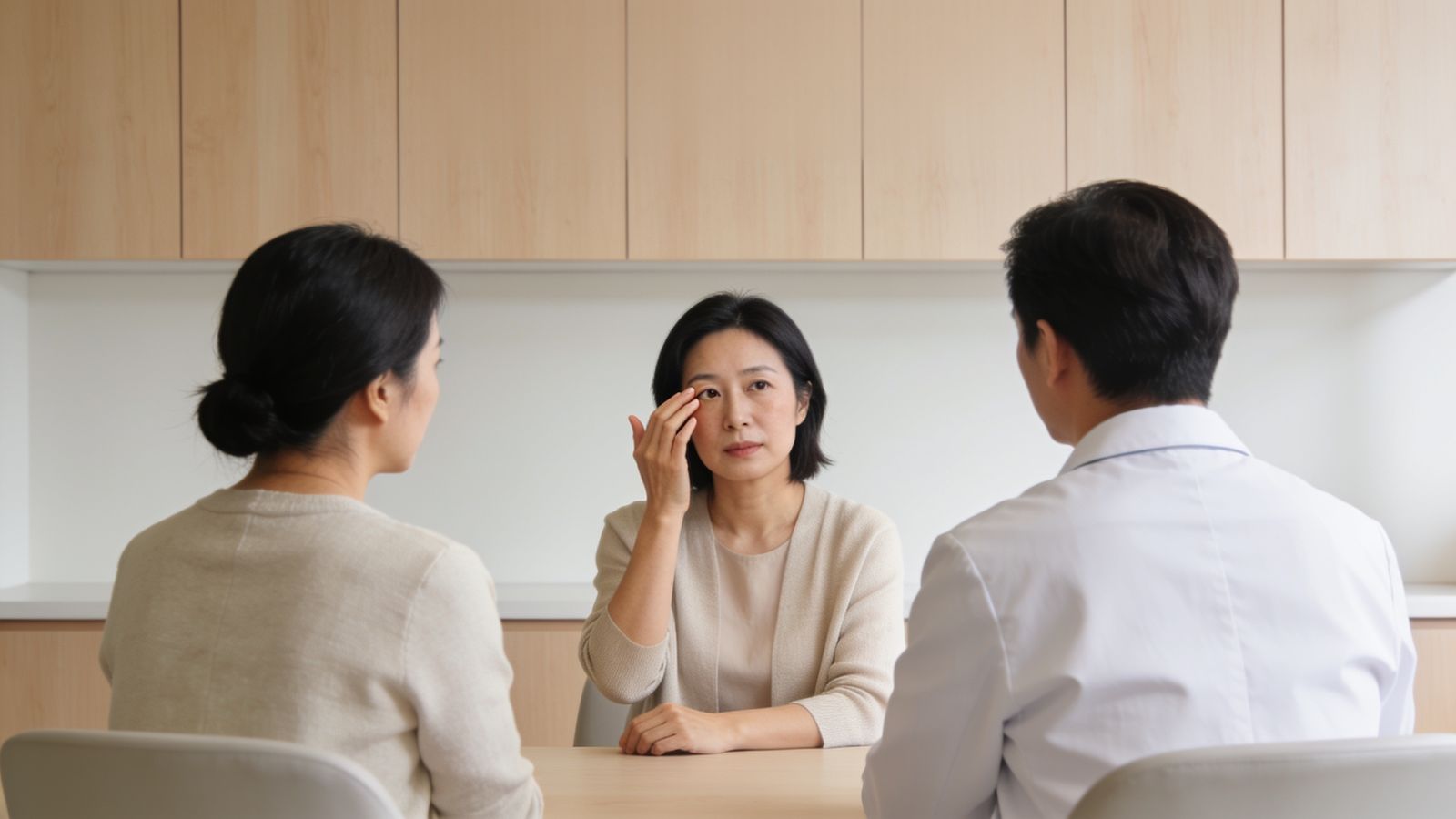
Dark circles are several problems that look alike. At IN Eternity Clinic, Dr Sin Yong works out which type you have before choosing gentle laser, conservative filler or a skin booster.
WhatsApp to Enquire →Key facts ↓Dark eye circles are treated by cause. Brown pigment responds to gentle, low-energy laser over a course; a hollow tear trough casts a shadow that only volume can soften; bluish vessels showing through thin skin respond better to skin-quality treatment such as Rejuran Eye. Most people have a mix, so at IN Eternity Clinic Dr Sin Yong identifies the type before choosing any treatment.
The skin of the lower eyelid is among the thinnest on the body, and almost everything beneath it shows through. That is why one word, “dark circles”, covers several different problems. Some are colour in the skin, some are colour under the skin, and some are not colour at all but shadow.
Pigment. Extra melanin in the lower lid gives a brown or grey-brown band. In Asian skin it often runs in families, and it is made worse by sun, by rubbing from hay fever or eczema, and by the low-grade inflammation that follows irritation. This is the type most people in Singapore assume they have, and it is often only part of the picture.
Vessels. A network of small veins and the orbicularis muscle sit just under the thin lid skin. When the skin is thin or translucent, they show as a blue, purple or reddish tinge that deepens with tiredness, a blocked nose or a late night. Nothing is wrong with the vessels; they are simply visible.
Structure. With age, and in some faces from the twenties, the tear trough and lid–cheek junction deepen as fat and bony support recede. Overhead light then casts a shadow under the eye. Eye bags make this worse: a bulge above a groove throws a darker shadow into it.
Lifestyle. Poor sleep, allergies, fluid retention after salty food or alcohol, and constant rubbing all exaggerate whichever type is already there. They rarely create dark circles on their own, but they decide how bad a given morning looks.

Most people have a mix. The table below is a guide to what each type contributes, not a diagnosis; Dr Sin Yong examines the under-eye in different lighting, with the skin gently stretched and with the head tilted, before suggesting anything.
| Type | What it looks like | A simple check | What usually helps |
|---|---|---|---|
| Pigmented | Brown or grey-brown band, often extending onto the upper lid | Gently stretch the skin: the colour stays | Low-energy laser over a course, sun protection, treating rubbing and allergy |
| Vascular | Blue, purple or reddish tint, worse when tired | Stretching makes it lighter but it does not disappear; it may blanch with pressure | Skin-quality treatment such as Rejuran Eye; managing congestion and sleep |
| Structural (hollow) | A dark crescent that follows the tear trough groove | Tilt your face up to an overhead light: the darkness fades | Conservative tear-trough filler where suitable |
| Eye bag shadow | A bulge with a dark groove beneath it | The bulge is more visible looking up | Treating the bag itself; see eye bag removal |
| Mixed | Two or more of the above | Different parts of the circle behave differently | A staged plan, one cause at a time |
If the darkness changes with the angle of the light, a hollow is probably involved. If a brown colour stays whatever you do, pigment is involved. If you see a blue tinge through thin, almost translucent skin, the vessels are. This is why a single “dark circle treatment” rarely works for everyone.

“Removal” is the word people search for, but dark circles are reduced by treating each cause, not erased. The options used at IN Eternity Clinic are chosen to match the type found at assessment.
Under-eye pigment in Asian skin darkens easily after any inflammation, including inflammation caused by the laser itself. Post-inflammatory hyperpigmentation is the main risk of treating this area, and it is why the approach at IN Eternity Clinic is deliberately conservative: low energy, protective eye shields, sessions spaced three to four weeks apart and strict daily sun protection between them.
Low-fluence Q-switched 1064 nm Nd:YAG on the DEKA TORO passes through the surface and breaks up melanin a little at a time with minimal heat. Where pigment is deeper or patchier, picosecond pulses on the Fotona StarWalker PQX or DEKA TORO may be used, again at cautious settings. Either way, a single session does little on its own; change builds over a course and is judged against baseline photographs taken in the same light.
Laser is offered only where pigment is a real contributor. Treating a hollow or a vascular circle with a pigment laser spends sessions and risks irritation for no gain.
“Filler cannot lighten pigment, and laser cannot fill a hollow. Naming the type of dark circle is most of the treatment.”
Filler helps when the dark circle is a shadow. A soft hyaluronic acid gel placed deep along the bone, usually through a fine blunt cannula, lifts the floor of the groove so that overhead light no longer falls into it. Very small volumes are used, because the tear trough holds less product than most people expect and overfilling shows quickly here.
It suits people with a defined groove, reasonable skin quality and little or no fat bulge. It suits less well when there is a prominent eye bag, puffiness that comes and goes, very thin skin with visible vessels, or a history of swelling in the area. In those situations filler can make the under-eye look heavier or give a bluish tinge where gel shows through thin skin (the Tyndall effect).
Bruising and swelling are the common side effects. Vascular complications are rare but serious, which is why this area is treated only by the doctor, with anatomy-led technique and a dissolving agent on hand. The full approach is set out on under-eye filler, and recovery is described in tear trough filler recovery, day by day.
When the main problem is thin, crepey skin that lets vessels show through, the aim is better skin rather than more volume. Polynucleotide boosters made for the eye area, such as Rejuran Eye, are placed in small amounts just under the surface. They are thought to support repair and hydration, and over a course some people see smoother, slightly thicker-looking skin in which the colour beneath is less obvious.
A course of two to four sessions a few weeks apart is common, with change building gradually afterwards. Small bumps settle within a day or two, and bruising is possible because the area has many small vessels. The comparison between these options is in under-eye filler vs Rejuran Eye vs laser.

Each treatment works on its own clock, so a combined plan is staged rather than done in one visit. Volume is usually corrected first, skin quality next, and pigment laser once any swelling has settled, so each step can be judged on its own.
| Treatment | Usual course | When change shows | Typical recovery |
|---|---|---|---|
| Laser toning or pico laser | A course of gentle sessions, about 3–4 weeks apart | Gradually across the course | Mild redness for hours |
| Tear-trough filler | Usually one session, with a review | Once swelling settles, often within 1–2 weeks | Swelling or bruising for several days |
| Rejuran Eye | Commonly 2–4 sessions, 2–4 weeks apart | Builds over weeks after the course | Bumps for a day; possible bruising |
| Allergy, sleep and sun care | Ongoing | Weeks | None |
Pigment can return with sun exposure, rubbing or hormonal change, filler softens over months, and the skin keeps ageing. Maintenance is discussed honestly rather than assumed.
Cost depends on which types are present and how many need treating: filler for a hollow, a course of laser for pigment, a booster course for thin skin, or a combination staged over time. A plan that combines treatments is costed by stage. At IN Eternity Clinic the plan and its cost are set out after assessment, before anything is agreed, and the consultation fee is waived with any medical treatment. The factors are explained further in under-eye filler cost.
They can usually be reduced, but rarely removed for good. Pigment can return with sun, rubbing or hormonal change, filler softens over months, and the under-eye keeps ageing. A plan that treats the actual cause, followed by sensible maintenance, gives the most lasting change.
It can be, when the settings are low, protective eye shields are used, sessions are spaced out and sun protection is strict. The main risk in Asian skin is darkening after inflammation, which is why laser is used conservatively and only where pigment is a real contributor.
Only the part caused by a hollow. Filler reduces the shadow that a groove casts; it does not lighten brown pigment or hide visible vessels. Where several causes are present, filler is one step in a staged plan.
It can help where thin, crepey skin is letting vessels show through, by supporting skin quality over a course of sessions. It does not fill hollows, remove eye bags or lighten pigment, so it is used when thin skin is a main contributor.
Creams help hydration and mild surface pigment, and a cold compress helps puffiness. They cannot fill a hollow, remove a fat bulge or reach deeper pigment, which is why persistent dark circles usually need a medical plan.
Fluid shifts overnight, nasal congestion and poor sleep make the vessels under thin lid skin more visible and add puffiness that deepens shadows. These factors change how dark circles look from day to day but not the underlying type.
Yes. The causes are the same in men, and the assessment and options are identical. Men often have thicker skin and more prominent eye bags, which is taken into account when choosing between filler, laser and other treatments.
By the type of dark circle you have. Filler is for a hollow, laser for brown pigment, and Rejuran Eye for thin skin. Many people need two of these in sequence. Dr Sin Yong confirms which applies at an in-person assessment.
IN Eternity Clinic, 9 Scotts Road, #12-01 Pacific Plaza, Singapore 228210. By appointment with Medical Director Dr Sin Yong. Monday to Saturday, 11am to 8pm. WhatsApp or call +65 8815 3008. The consultation fee is waived with any medical treatment.
These sources describe mechanisms and general evidence. They are not a promise of any individual result; suitability is decided at an in-person assessment.