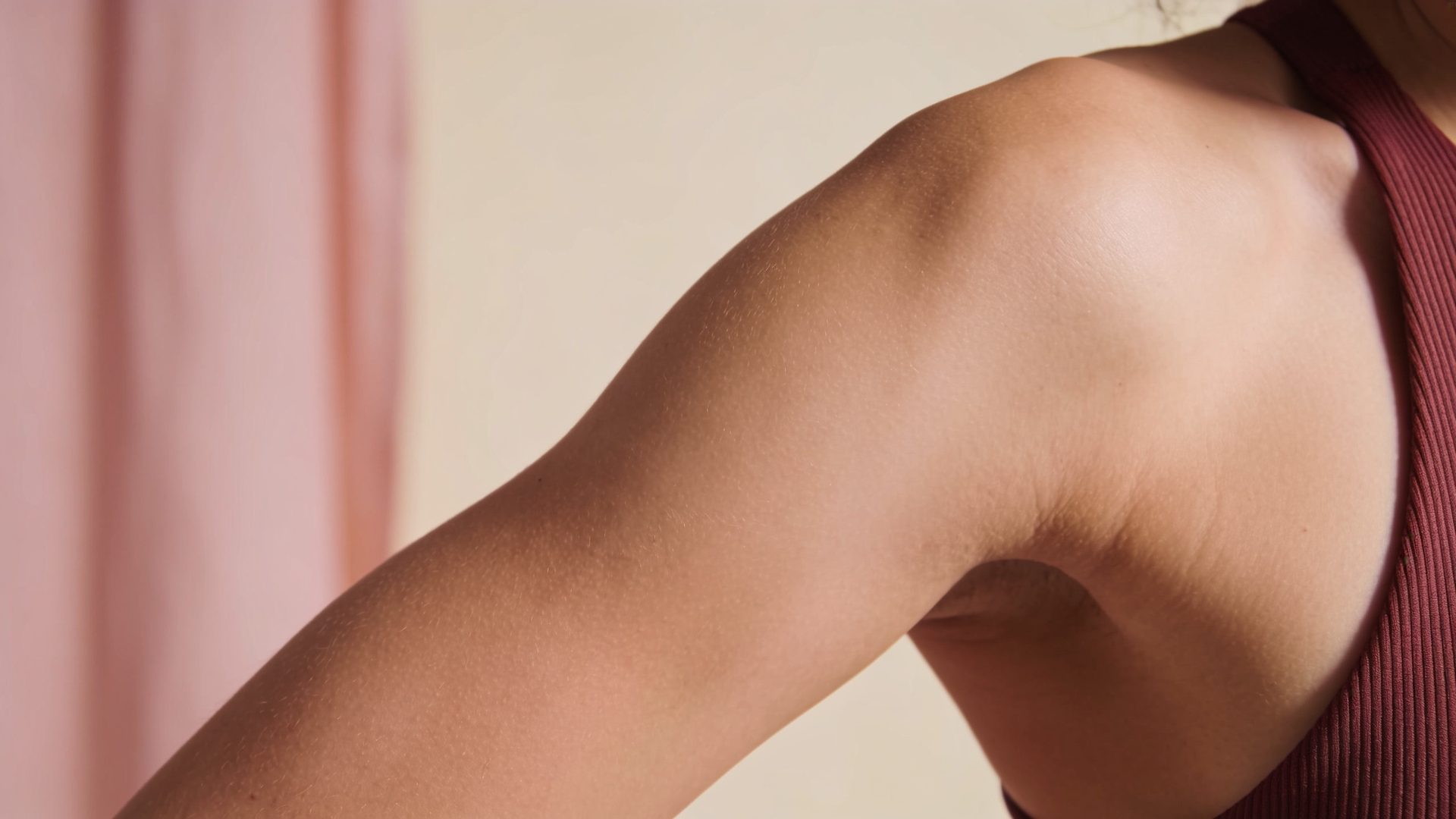
Stretch Marks After Weight Loss, Weight Gain or Muscle Building
Medical Director Dr Sin Yong explains why stretch marks follow weight change or training, how red and white marks differ, and what is considered at IN Eternity Clinic.
WhatsApp to Enquire →Key facts ↓Stretch marks form when skin stretches faster than its collagen and elastic fibres can adapt, so rapid weight gain or loss, or fast muscle building, can leave them on the abdomen, flanks, thighs, chest, shoulders or arms. Red, early marks usually respond better than white ones. Creams have limited evidence; fractional laser or RF microneedling can soften marks but not erase them. See stretch mark treatment.
- Common causes: stretch marks occur in puberty, pregnancy and obesity, in a number of medical conditions and after some treatments [1].
- Creams: a review of 11 studies of topical products found no formulation shown to clearly eradicate or improve stretch marks, and cocoa butter and olive oil showed no effect [2].
- Early marks: in a randomised trial of 22 people, 8 of 10 using prescription 0.1% tretinoin for six months had definite or marked improvement in early marks, against 1 of 12 using a plain cream [3].
- RF microneedling vs CO2: a meta-analysis found similar improvement with fractional microneedle radiofrequency and fractional CO2 laser, with less darkening after inflammation in the RF microneedling groups [4].
Why do weight change and muscle gain cause stretch marks?
A stretch mark is a scar in the dermis, the layer under the surface. When skin is stretched faster than its collagen and elastic fibres can adapt, the dermis tears internally and heals as a thin line. Reviews list puberty, pregnancy and obesity among the usual settings, along with some medical conditions and treatments [1]. Genes play a large part: some people change size a lot without marks, others mark easily.
With weight gain, marks usually appear on the abdomen, flanks, upper arms and thighs; with fast muscle gain, on the shoulders, chest and upper arms. The rate of change matters more than the amount, and rapid weight loss can leave marks as well as gain. Loose skin after large weight loss is a separate problem and is assessed on its own; see loose skin. For marks from pregnancy, see pregnancy stretch marks.
Red, white or brown: what does the colour tell you?
Stretch marks start red or purple, while the tissue is still remodelling, and fade over months to white or silvery. The stage changes what is realistic.
| Type | What it looks like | What it means for treatment |
|---|---|---|
| Red (striae rubrae) | Red, pink or purple, sometimes raised or itchy | Still active; usually when treatment works better |
| White (striae albae) | White or silvery, flat or slightly sunken | Settled scars; can be softened, not erased |
| Brown, in darker skin | Brown marks left as red marks settle, or white marks in tanned skin | Pigment care first; laser settings kept conservative |
| Wide and purple, unexplained | Wide marks in unusual places, often with other symptoms | Cause checked medically before cosmetic treatment |
What helps: creams, habits or treatment?
Creams. The evidence is thin. A review of 11 studies found no topical product shown to clearly eradicate or improve stretch marks, and cocoa butter and olive oil showed no effect [2]. Prescription tretinoin is the exception for early red marks: in a small randomised trial, 8 of 10 people using it for six months improved, against 1 of 12 on a plain cream [3]. It can irritate, is not used in pregnancy or breastfeeding, and is prescribed after assessment.
Habits. Gradual weight change, whether bulking, cutting or dieting, gives the skin more time to adapt. Moisturising keeps the skin comfortable, and strong steroid creams should not be used without a reason, because steroids thin the dermis.
In-clinic treatment. These work by creating a controlled healing response in the dermis, so the mark looks flatter, narrower and closer to your skin colour. A meta-analysis found similar improvement with RF microneedling and fractional CO2, with less darkening after RF microneedling [4], which matters in Asian skin.
| Option | How it works | Usually suits |
|---|---|---|
| Non-ablative fractional laser (FSX, 1540 nm and 1927 nm) | Heats microscopic columns without removing the surface | Red and early marks; texture of white marks |
| Fractional CO2 laser (DEKA Tetra CO2) | Vaporises fine columns of skin; about a week of recovery | White, mature, wider marks |
| RF microneedling (Secret Duo) | Radiofrequency heat at set depths in the dermis | White marks; darker skin types |
| Microneedling | Fine channels trigger repair | Mild texture change; often alternated with laser |
When should you treat, and when should marks be checked first?
A course is usually several sessions, four to eight weeks apart, often combining methods, with progress judged on photographs after two or three sessions. If you train, most people avoid intense workouts, swimming and saunas for a few days after each session, longer after CO2, so sessions are easier before a rest day. Treatment waits if the skin is freshly tanned, and planned weight change can mean waiting until your weight is steadier.
Some marks should be checked by a doctor before anything cosmetic: wide, deep purple marks on the abdomen or flanks with weight gain in the face and trunk, easy bruising, muscle weakness or high blood pressure; marks that appeared after strong steroid creams or tablets, including products bought without a prescription; and many marks in a teenager without obvious growth or weight change.
What Dr Sin Yong looks for
- Colour and stage: red or purple, white, or brown.
- Width and depth: narrow, shallow lines or wide, depressed bands.
- Site and area: abdomen, flanks, thighs, chest, shoulders or arms.
- Skin type, any recent tan and any history of dark marks after spots or treatment.
- The cause and whether it is ongoing: training phase, weight plans and any steroid use.
General clinical observations used at consultation; they describe what is checked, not any individual result.
Frequently asked questions
Why did I get stretch marks from the gym?
Fast gains in muscle bulk stretch the skin over the shoulders, chest and upper arms faster than its collagen and elastic fibres can adapt. Genes play a large part, so some people mark easily and others do not.
Do stretch marks go away after weight loss?
No. Stretch marks are scars in the dermis, so losing weight does not remove them. Red marks usually fade to white or silvery over months, and treatment can make them less noticeable.
Can creams remove stretch marks?
No cream has been shown to remove them. Prescription tretinoin improved early red marks in a small trial, but most over-the-counter creams, including cocoa butter and olive oil, have not shown an effect.
Are red or white stretch marks easier to treat?
Red, early marks usually respond better because the tissue is still remodelling. White, mature marks can be softened in texture and colour but not erased.
Can I keep training during stretch mark treatment?
Yes, with short breaks. Intense workouts, swimming and saunas are usually avoided for a few days after each session, longer after CO2 laser, so many people book sessions before a rest day.
When should stretch marks be checked by a doctor?
When marks are wide and deep purple with weight gain in the face and trunk, easy bruising or muscle weakness, when they followed steroid use, or when many marks appear in a teenager without an obvious cause.
Book an assessment
IN Eternity Clinic, 9 Scotts Road, #12-01 Pacific Plaza, Singapore 228210. By appointment with Medical Director Dr Sin Yong. Monday to Saturday, 11am to 8pm. WhatsApp or call +65 8815 3008. At IN Eternity Clinic a consultation fee applies, and it is waived if you go ahead with any medical treatment; the fee is S$120.
International KOL — CLASSYS · HIRONIC · DEKA · ALMA · FOTONA · LUTRONIC
References
- Al-Himdani S, Ud-Din S, Gilmore S, Bayat A. Striae distensae: a comprehensive review and evidence-based evaluation of prophylaxis and treatment. Br J Dermatol 2014;170(3):527-547. doi:10.1111/bjd.12681
- Ud-Din S, McGeorge D, Bayat A. Topical management of striae distensae (stretch marks): prevention and therapy of striae rubrae and albae. J Eur Acad Dermatol Venereol 2016;30(2):211-222. doi:10.1111/jdv.13223
- Kang S, Kim KJ, Griffiths CE, et al. Topical tretinoin (retinoic acid) improves early stretch marks. Arch Dermatol 1996;132(5):519-526. doi:10.1001/archderm.1996.03890290053007
- Aktoz F, Yilmaz N. Comparing fractional microneedle radiofrequency and fractional CO2 laser for striae distensae treatment: a systematic review and meta-analysis. Lasers Med Sci 2024;39(1):271. doi:10.1007/s10103-024-04231-8
These sources describe mechanisms and general evidence. They are not a promise of any individual result; suitability is decided at an in-person assessment.