
Clarity II Laser Hair Removal
Two laser wavelengths on one platform, so the setting is chosen for your skin and hair rather than for the machine the clinic happens to own. Assessed by Medical Director Dr Sin Yong. Female doctor available on request for intimate areas.
- Dual-wavelength laser
- Doctor-assessed
- Female doctor on request
- Underarms, face, legs, Brazilian
Assessment with Dr Sin Yong · Mon–Sat 11am–8pm · Pacific Plaza, 9 Scotts Road
The short answer
How does laser hair removal work, and is it permanent?
Laser energy is absorbed by the pigment (melanin) in the hair and conducted down to the follicle, where heat damages the structures that regrow hair. Only hairs in the active growth phase respond at any one time, so treatment is given as a course of sessions spaced four to eight weeks apart. The accurate term is permanent hair reduction: most people see a large, long-lasting reduction, with occasional maintenance. At IN Eternity Clinic the Lutronic Clarity II offers a 755 nm Alexandrite laser, which suits finer hair and lighter skin, and a 1064 nm Nd:YAG laser, which is gentler on darker skin types. Dr Sin Yong chooses between them for your skin and hair.
Areas we treat
Face, body and intimate areas
Every area is assessed for skin type, hair colour and coarseness before the wavelength and settings are chosen.
Underarms
Coarse, dark underarm hair responds well; reducing hair can also reduce the shadowing many people notice.
Upper lip, chin and jawline
Treated with careful settings, since facial areas carry a higher chance of paradoxical regrowth than the body.
Bikini line, extended bikini and Brazilian
Female doctor available on request. Settings are adjusted for the darker skin typical of these areas.
Arms and legs
Large areas are covered efficiently with a large spot size; legs often take a longer course than underarms.
Back, chest, beard line and Boyzilian
Coarse male hair responds well; beard-line shaping is planned conservatively.
Ingrown hairs and razor bumps
Reducing hair density can ease recurrent ingrown hairs and irritation from frequent shaving.
Key facts
Eight things worth knowing before laser hair removal
- It targets pigment in the hairLaser hair removal works by selective photothermolysis: melanin in the hair absorbs the light and heat damages the follicle, so dark hair responds best and white or grey hair does not.
- Wavelength should match skin type755 nm Alexandrite is absorbed strongly by melanin; 1064 nm Nd:YAG penetrates deeper with less absorption by skin pigment, making it the safer choice for darker skin.
- Both wavelengths workIn a randomised trial, Alexandrite and Nd:YAG both reduced leg hair by roughly 74–84% at 18 months; combining the two added no benefit and caused more side effects.
- The value is choosing correctlyBecause stacking wavelengths adds risk without benefit, a dual-wavelength platform matters for choice, not for firing twice.
- Results build with sessionsIn Asian skin, hair reduction rose from 32% after one treatment to 55% after three at nine months — one reason treatment is given as a course.
- Only growing hairs respondFollicles cycle, and only those in the active (anagen) phase are affected, so sessions are spaced about 4–6 weeks on the face and 6–8 weeks on the body.
- Darker skin can be treated safelyIn 150 people with Fitzpatrick IV–VI skin, long-pulsed Nd:YAG laser hair removal was effective with a low rate of complications.
- Paradoxical regrowth is uncommonA meta-analysis found paradoxical hair stimulation in about 3% of patients, almost always on the face and neck; it often improves with continued treatment.
Two wavelengths is not a way to fire twice. It is a way to choose once — correctly — for the skin in front of me.
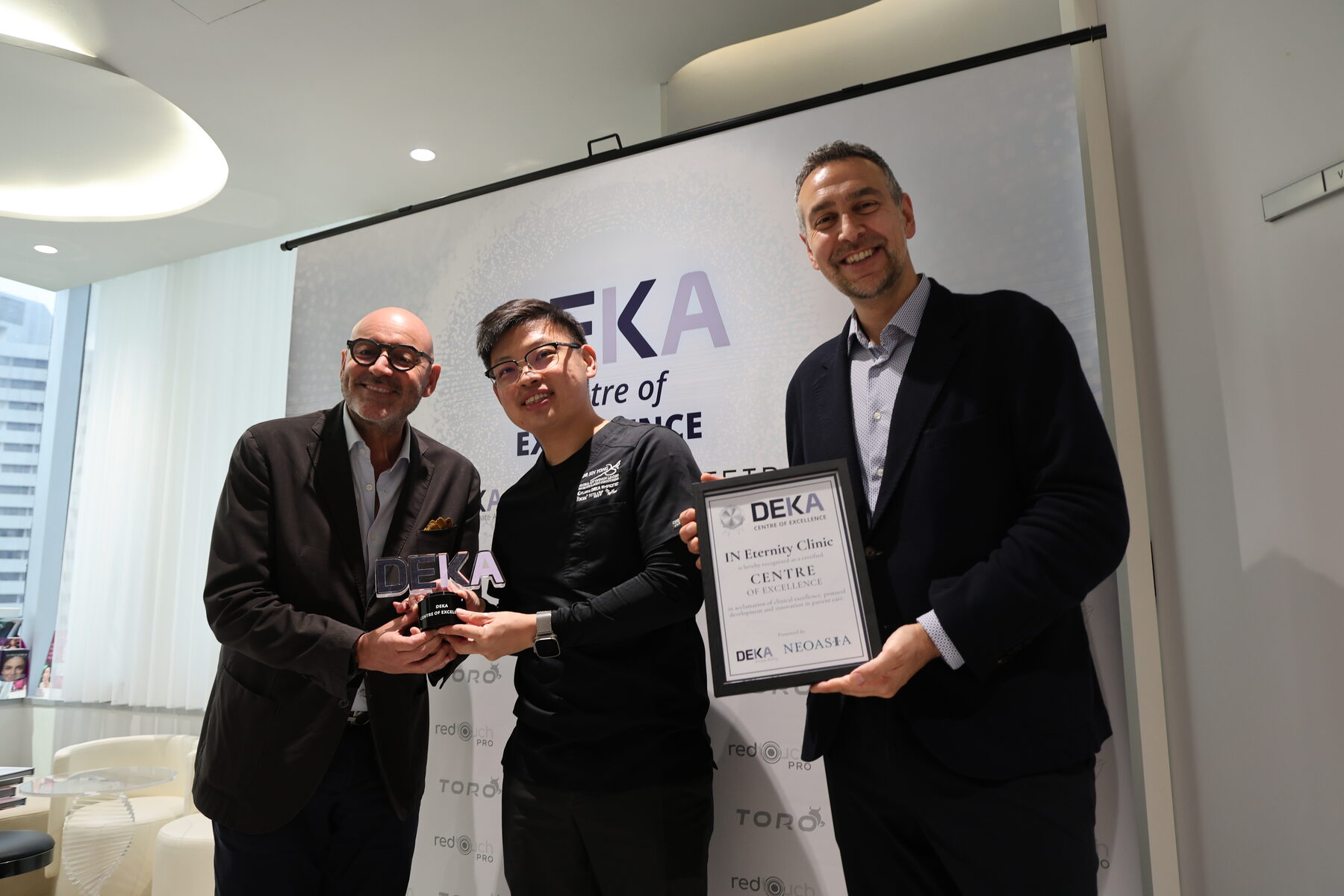
IN Eternity Clinic was designated a DEKA Centre of Excellence by DEKA and NeoAsia in July 2026.
Who treats you
Assessed and treated by Medical Director Dr Sin Yong
Dr Sin Yong assesses your skin type, hair colour and density, and the area, then chooses the wavelength and settings. He is an International Key Opinion Leader for LUTRONIC, the maker of the Clarity II, and is regularly invited to share his clinical expertise on laser treatment of Asian skin. A female doctor is available on request.
- MBBS, National University of Singapore
- MRCS, Royal College of Surgeons of Edinburgh
- MSc Aesthetic Medicine, University of London
- MSc Practical Dermatology, Cardiff University
International Key Opinion Leader · CLASSYS · HIRONIC · DEKA · ALMA · FOTONA · LUTRONIC
How it works at IN Eternity
From first message to smooth skin
WhatsApp us
Tell us which areas you would like treated. Our team arranges an assessment at Pacific Plaza.
Skin & hair assessment
Dr Sin Yong checks skin type, hair colour and coarseness, medications and any history of pigment or hormonal concerns.
Your plan
Wavelength, settings, number of sessions and cost are agreed before the first session. A test patch may be advised.
Treatment course
Sessions take minutes for small areas. Progress is reviewed and settings adjusted as hair thins.
Choosing a method
Dual-wavelength laser vs diode laser vs IPL
Patients often compare clinics by device. This is how the main technologies differ.
| Dual-wavelength (755 + 1064 nm) | Diode laser (around 810 nm) | IPL (intense pulsed light) | |
|---|---|---|---|
| Light source | Two true laser wavelengths | One laser wavelength | Broad-spectrum light, not a laser |
| Lighter skin, finer hair | 755 nm Alexandrite | Effective | Can work on dark hair |
| Darker skin types | 1064 nm Nd:YAG — safest option | Used with care | Higher risk; used cautiously |
| Key advantage | Wavelength chosen per patient and per area | Widely available, fast | Low cost per session |
| Evidence | Well established for both wavelengths | Well established | Effective, generally less durable |
General comparison based on the references below. The wavelength used at IN Eternity Clinic is chosen at assessment.
The technology
Why the Lutronic Clarity II
Clarity II dual-wavelength platform
755 nm Alexandrite and 1064 nm long-pulsed Nd:YAG in one system, with integrated cooling for comfort and skin protection. Wavelength is selected by skin type, hair and area.
IntelliTrak and large spot sizes
IntelliTrak helps track coverage and delivery across larger areas, supporting even treatment of the legs, back and arms.
What to expect
Sessions, comfort and results
| Session length | Underarms or upper lip: about 10–15 minutes. Full legs: about 45–60 minutes |
| Comfort | A quick snap like a rubber band with a cooling sensation; numbing cream can be used for sensitive areas |
| Downtime | Mild redness and bumps around follicles for a few hours to a day |
| Number of sessions | Typically 6–8 for most areas; facial and hormonal hair may need more and occasional maintenance |
| Interval | About 4–6 weeks for the face; 6–8 weeks for the body |
| Before sessions | Shave the area the day before; avoid waxing, plucking and tanning for 4 weeks |
| Aftercare | Sunscreen on exposed areas, avoid hot baths, saunas and intense exercise for 24 hours |
Typical ranges only. Your own plan, number of sessions and cost are set at consultation after assessment.
Suitability & safety
Who laser hair removal suits — and when we wait
Usually a good fit
- Dark or coarse hair on the face or body
- All Fitzpatrick skin types, with the wavelength chosen accordingly
- Recurrent ingrown hairs or shaving irritation
- People who can avoid sun tanning during the course
Treated with caution or deferred
- Pregnancy (treatment deferred)
- White, grey, very fair or red hair — laser has little effect
- Recent tan or active sunburn
- Active infection, cold sores or broken skin in the area
- Excess hair from an untreated hormonal cause — medical review suggested alongside
Possible effects include temporary redness, swelling, and less commonly blistering, temporary darkening or lightening of the skin, and paradoxical hair growth. These are discussed at your assessment.
Questions patients ask
Laser hair removal FAQ
Is laser hair removal permanent?
It produces permanent hair reduction rather than guaranteed removal of every hair. Most people see a large, long-lasting reduction after a course, with occasional maintenance sessions.
How many laser hair removal sessions do I need?
Most areas need about six to eight sessions spaced four to eight weeks apart, because only hairs in the growth phase respond at each session. Facial and hormonally driven hair may need more.
Does laser hair removal hurt?
It feels like a quick rubber-band snap with cooling. Most people tolerate it well, and numbing cream can be used for sensitive areas.
Is laser hair removal safe for dark or tanned skin?
Yes, with the right wavelength. The 1064 nm Nd:YAG laser is absorbed less by skin pigment and is the safer choice for darker skin. Recent tans are allowed to fade first.
What is the difference between Alexandrite and Nd:YAG?
The 755 nm Alexandrite laser is absorbed strongly by melanin and suits finer hair and lighter skin. The 1064 nm Nd:YAG reaches deeper with less absorption by the skin, suiting darker skin types.
Is a female doctor available for Brazilian laser hair removal?
Yes. A female doctor is available on request for intimate-area treatment at IN Eternity Clinic.
Should I shave before laser hair removal?
Yes. Shave the area the day before. Avoid waxing, plucking or threading for about four weeks beforehand, because the laser needs the hair root in place.
How much does laser hair removal cost in Singapore?
Cost depends on the area, the number of sessions and whether several areas are combined. IN Eternity Clinic confirms your plan and cost at consultation.
Who performs the treatment?
Every patient is assessed by Medical Director Dr Sin Yong, who chooses the wavelength and settings. A female doctor is available on request.
Book your assessment
Start your laser hair removal course
A short assessment with Dr Sin Yong confirms the right wavelength for your skin and hair, and how many sessions to expect. WhatsApp us to arrange a time.
WhatsApp +65 8815 3008IN Eternity Clinic · 9 Scotts Road, #12-01 Pacific Plaza, Singapore 228210 · Mon–Sat 11am–8pm · [email protected]
Related at IN Eternity
References
- Gan SD, Graber EM. Laser hair removal: a review. Dermatol Surg. 2013. PubMed 23332016
- Davoudi SM, et al. Comparison of long-pulsed alexandrite and Nd:YAG lasers, individually and in combination, for leg hair reduction: an assessor-blinded, randomized trial. Arch Dermatol. 2008. PubMed 18936396
- Rao K, Sankar TK. Long-pulsed Nd:YAG laser-assisted hair removal in Fitzpatrick skin types IV–VI. Lasers Med Sci. 2011. PubMed 21519944
- Hussain M, et al. Laser-assisted hair removal in Asian skin: efficacy, complications, and the effect of single versus multiple treatments. Dermatol Surg. 2003. PubMed 12614418
- Snast I, et al. Paradoxical hypertrichosis associated with laser and light therapy for hair removal: a systematic review and meta-analysis. Am J Clin Dermatol. 2021. PubMed 34057666
Medically reviewed by Dr Sin Yong, MBBS (NUS), MRCS (Edinburgh), MSc Aesthetic Medicine (London), MSc Practical Dermatology (Cardiff) · Last reviewed 27 September 2026. This page is general information and not a substitute for an individual medical assessment. Results vary between individuals.