Why Post-Laser Skin Is Vulnerable
Laser treatment — whether ablative resurfacing, picosecond pigmentation treatment, or non-ablative rejuvenation — induces a controlled injury response in the skin. Collagen is remodelled, the barrier function is temporarily disrupted, and new skin cells are generated as part of the healing process.
During this period, the skin is significantly more sensitive to ultraviolet radiation. UV exposure in the weeks following laser treatment can trigger post-inflammatory hyperpigmentation (PIH) — darkening of treated areas that can be more pronounced and longer-lasting than the original pigmentation concern.
For Asian skin types (Fitzpatrick III–V), this risk is particularly significant. The higher baseline melanin content means any inflammatory trigger — including sun exposure — is more likely to result in hyperpigmentation. Post-laser sun protection is not optional; it is a clinical necessity.
The Limitation of Topical Sunscreen Alone
Topical SPF is the cornerstone of post-laser sun protection — but it has real-world limitations. Most people apply significantly less than the amount required to achieve the stated SPF. Reapplication every two hours is rarely done consistently, particularly in a working day. Physical activity and perspiration further reduce coverage.
More fundamentally, topical sunscreen protects only the skin surface it directly contacts. It does not address the oxidative stress and DNA damage induced by UV radiation at the cellular level — the mechanism by which cumulative UV exposure leads to pigmentation, impaired healing, and accelerated ageing.
How Heliocare Works
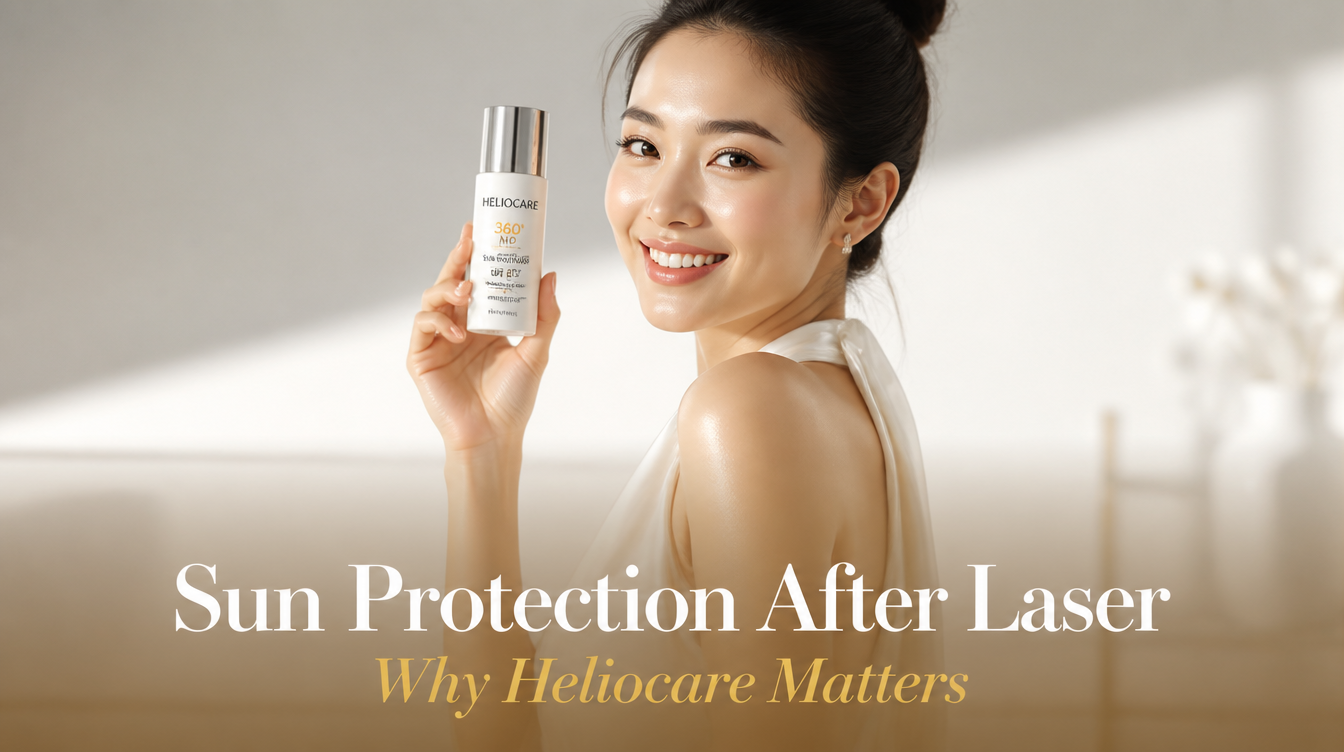
Heliocare oral photoprotection supplements contain Fernblock® — a standardised extract of Polypodium leucotomos fern with a robust clinical evidence base supporting its photoprotective properties.
Fernblock® works at the cellular level — reducing UV-induced oxidative stress, supporting DNA repair mechanisms, and modulating the inflammatory response triggered by sun exposure. It does not replace topical sunscreen; it works synergistically with it, providing a layer of protection that topical products cannot deliver.
For patients undergoing laser treatment at IN Eternity Clinic, Dr. Sin Yong recommends Heliocare as part of the post-treatment protocol — particularly for pigmentation treatments, scar resurfacing, and any ablative procedure where the skin barrier has been disrupted.
Heliocare is available from IN Eternity Clinic at S$150 per course.
The Complete Post-Laser Protocol
Optimal post-laser skin recovery requires a multi-component approach. Heliocare addresses internal photoprotection. The RAI Post Laser Intensive Recovery Serum supports barrier repair and accelerates healing. Topical mineral sunscreen (SPF 50+) provides surface UV protection.
Avoiding direct sun exposure for the first 2–4 weeks following laser treatment remains important — particularly in Singapore's equatorial UV environment. Hats, UV-protective clothing, and minimising time outdoors between 10am and 3pm significantly reduce cumulative UV load during the critical healing period.
For advice on the most appropriate post-treatment protocol for your specific procedure, speak to Dr. Sin Yong at your consultation or follow-up appointment.
Singapore's UV Environment: Why the Risk Is Higher Here
Singapore sits at 1.3 degrees north of the equator. The annual average UV Index in Singapore ranges between 10 and 13 — categorised as 'Very High' to 'Extreme' on the WHO UV Index scale. By comparison, London averages a UV Index of 3–5 in summer. This means that a patient in Singapore stepping outdoors for 15 minutes at midday is receiving a UV dose that would take hours to accumulate in a temperate climate.
For post-laser skin — already in an inflammatory and remodelling state — this level of UV exposure creates a meaningful risk of post-inflammatory hyperpigmentation with any unprotected sun exposure. Patients often underestimate this risk because the response is not immediate: PIH typically manifests 2–6 weeks after the triggering UV exposure, long after the patient has forgotten the specific outing they had without adequate protection.
Building a Sustainable Post-Treatment Routine
The post-laser skincare protocol does not need to be complex. The fundamentals are: Heliocare taken daily as internal photoprotection; the RAI Post Laser Intensive Recovery Serum applied morning and evening; and a mineral SPF 50+ sunscreen applied each morning and reapplied every two hours when outdoors.
The reapplication of sunscreen is the step most patients skip. A morning application provides meaningful protection until approximately 10am; after that, UV exposure accumulates without additional application. In Singapore's UV environment, this is not a minor omission — it is the difference between protecting and not protecting the healing skin.
Dr. Sin Yong provides specific post-treatment guidance at each session, including the precise timing for reintroducing active skincare ingredients and what to watch for in terms of healing progress.
In Singapore's equatorial UV environment, photoprotection after laser is not optional skincare advice — it is a clinical requirement for the treatment to work as intended.
- Singapore's UV Index of 10–13 is classified as 'Very High' to 'Extreme' — among the highest in the world
- Post-laser skin is significantly more vulnerable to UV-triggered post-inflammatory hyperpigmentation, particularly in Asian skin types
- Topical sunscreen alone does not address cellular UV damage — internal photoprotection works at a different level of protection
- Heliocare's Fernblock extract reduces oxidative stress and supports DNA repair at the cellular level, complementing topical SPF
- Sunscreen must be reapplied every two hours when outdoors — morning application alone is insufficient in Singapore's UV environment
- The RAI Post Laser Serum supports barrier repair and reduces the inflammatory response during the critical healing window